Money-Back Guarantee · 100 days Free Worldwide Delivery
449,564artworks 30,613artists 4,660museums 32languages
Catalogue entry

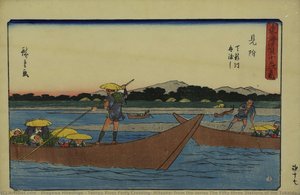
Hakone

1834. Woodblock Print. Indianapolis Museum of Art.

Fig. 1. Utagawa Hiroshige, Hakone, 1834. Shown as the reproduction you are specifying: , .

§ 1Catalogue data

§ 2Abstract

Collectible Description

Hiroshige's "Hakone" captures the serene beauty of Japan's landscape with snow-capped mountains, tranquil waters, and a solitary figure admiring the view – a timeless woodblock print.

Artist Biography

Discover Utagawa Hiroshige (1797-1858), Japan's last great ukiyo-e master. Explore iconic landscapes like 'Fifty-three Stations of the Tōkaidō,' his poetic style, and profound influence on Impressionism & Van Gogh.

§ 3Commentary

A Glimpse of Tranquility: Utagawa Hiroshige's "Hakone"

Utagawa Hiroshige’s “Hakone,” created in 1834, is more than just a landscape; it's a poetic meditation on the beauty and transience of nature within Edo-period Japan. This woodblock print, part of his renowned series "The Fifty-three Stations of the Tōkaidō," captures a specific moment along the vital trade route connecting Tokyo (then Edo) with Kyoto. However, Hiroshige elevates this seemingly simple depiction of a mountain pass into something profoundly evocative, inviting viewers to share in the quiet contemplation of a traveler pausing amidst breathtaking scenery.

The Artist and His Vision

Hiroshige (1797-1858), considered the last great master of *ukiyo-e*, possessed an unparalleled ability to translate the essence of a place onto paper. Born in Tokyo, his early life was steeped in samurai tradition before he embraced art under Utagawa Toyohiro. Hiroshige’s genius lay not merely in replicating what he saw but in imbuing it with emotion and atmosphere. He moved beyond the typical *ukiyo-e* focus on portraits of actors or courtesans, choosing instead to celebrate the natural world—the mountains, rivers, and roads that shaped Japanese life. His travels along the Tōkaidō provided him with a wealth of inspiration, allowing him to meticulously document the changing landscapes and capture the spirit of each station.

A Composition of Harmony: Technique and Symbolism

“Hakone” exemplifies Hiroshige’s masterful technique in woodblock printing. The print showcases a layered approach, using multiple blocks for different colors and tones to create depth and nuance. Notice how the snow-capped peaks recede into the distance, rendered with subtle gradations of blue and grey that convey atmospheric perspective. The trees, scattered across the hillside, are not merely decorative elements but contribute to the overall sense of scale and tranquility. The body of water reflects the sky, creating a mirror image that doubles the beauty of the scene. A lone figure stands near the center, seemingly absorbed in the grandeur before them—a silent participant in this serene vista. This inclusion is significant; it humanizes the landscape, reminding us of our place within nature's vastness and inviting viewers to imagine themselves experiencing this moment firsthand.

Historical Context and Enduring Legacy

The Tōkaidō was a vital artery for commerce and communication in Edo-period Japan. Hiroshige’s series documenting its stations served not only as visual guides for travelers but also as celebrations of the nation's geography and culture. “Hakone,” with its challenging terrain and stunning views, represents a moment of respite along this arduous journey. The print reflects a broader cultural appreciation for nature in Edo Japan, where landscapes were increasingly valued for their aesthetic qualities. Hiroshige’s work had a profound impact on Western art, particularly influencing the Impressionist movement. Artists like Monet and Van Gogh drew inspiration from his compositions and color palettes, recognizing the power of capturing fleeting moments of beauty.

An Invitation to Contemplation

“Hakone” is more than just a beautiful image; it’s an invitation to pause, reflect, and appreciate the simple wonders of the natural world. The print's quiet elegance and subtle details create a sense of peace and tranquility that transcends time and culture. Whether you are an art enthusiast, a collector seeking a piece of Japanese heritage, or simply someone looking for a calming presence in your home, Hiroshige’s “Hakone” offers a timeless glimpse into the beauty of Edo-period Japan.

Questions & Answers

What color harmony does "Hakone" by Utagawa Hiroshige display?

"Hakone" by Utagawa Hiroshige displays a discordant palette color harmony.

How do I download the image of "Hakone" by Utagawa Hiroshige?

A download is available for "Hakone": the artwork's Download page offers a high-resolution digital image download.

Is "Hakone" by Utagawa Hiroshige a painting, a drawing or a print?

"Hakone" is a wall art piece.

§ 4The artist

Utagawa Hiroshige

Utagawa Hiroshige

1797 - 1858, Japan

Quick facts about Utagawa Hiroshige

  • Artistic Movement Or Style: Ukiyo-e
  • Artists Or Movements Influenced By This Artist:
    • Manet
    • Monet
    • Van Gogh
    • Impressionism
  • Artists Who Influenced This Artist: ['Hokusai']
  • Date Of Birth: 1797
  • Date Of Death: 1858
  • Full Name: Utagawa Hiroshige
  • Nationality: Japanese
  • Notable Artworks:
    • Fifty-three Stations of the Tōkaidō
    • One Hundred Famous Views of Edo
  • Place Of Birth: Tokyo, Japan

Artist Biography

A Poetic Vision of Edo Japan: The Life and Art of Utagawa Hiroshige

Utagawa Hiroshige, born Andō Tokutarō in 1797 in the bustling city of Edo (modern Tokyo), stands as a pivotal figure in the world of *ukiyo-e*, or “pictures of the floating world.” Though deeply rooted in the traditions of Japanese woodblock printing, Hiroshige transcended mere replication, imbuing his landscapes with a poetic sensibility that resonated profoundly both within Japan and, later, across the Western art world. His life unfolded during a period of relative peace and prosperity under the Tokugawa shogunate, yet also one marked by increasing social change and eventual westernization – forces that would ultimately contribute to the decline of *ukiyo-e* even as they amplified Hiroshige’s enduring legacy. Initially destined for a more conventional path within a samurai family—his father served as a fire warden—Hiroshige's artistic inclinations led him to apprenticeship under Utagawa Toyohiro, a master of the Utagawa school. This proved a crucial turning point, steering him away from the popular depictions of courtesans and actors favored by many *ukiyo-e* artists toward a focus on landscape, a genre he would ultimately redefine.

From Genre Scenes to Evocative Landscapes

Hiroshige’s early work adhered to the conventions of his school, featuring portraits and scenes from daily life. However, it was his embrace of landscape that truly distinguished him. Influenced by earlier masters like Hokusai—whose *Thirty-six Views of Mount Fuji* had already captivated audiences—Hiroshige developed a unique style characterized by atmospheric perspective, subtle color palettes, and a profound sensitivity to the changing seasons. He didn’t merely depict places; he evoked their mood, capturing the essence of a particular moment in time. The series *The Fifty-three Stations of the Tōkaidō* (1833–1834), perhaps his most celebrated achievement, exemplifies this approach. This monumental work documented the journey along the Tōkaidō road, the main route connecting Edo to Kyoto, not as a straightforward travelogue but as a series of evocative vignettes—a sudden rain shower at Shono, a distant view of Mount Fuji from Kanaya, the bustling activity at Odawara. Each print is imbued with a sense of transience and quiet beauty, inviting viewers to experience the journey alongside the travelers. He masterfully employed *bokashi*, a technique involving multiple impressions to create subtle gradations of color, adding depth and atmosphere to his compositions.

A Master of Atmosphere and Technique

Hiroshige’s technical skill was as remarkable as his artistic vision. He wasn't simply interested in accurate representation; he sought to capture the *feeling* of a place. His use of color, though often restrained compared to some of his contemporaries, was crucial in achieving this effect. He frequently employed multiple blocks for a single color, allowing him to create nuanced shades and atmospheric effects that were incredibly difficult to replicate. The delicate washes of blue in his depictions of rain or mist, the warm hues of autumn foliage—these weren’t accidental; they were carefully considered elements designed to evoke specific emotions and sensations. Beyond *bokashi*, Hiroshige was adept at utilizing blank space – *ma* – a concept central to Japanese aesthetics, allowing areas of the print to “breathe” and enhancing the overall sense of tranquility. His series *One Hundred Famous Views of Edo* (1856–1858) further showcased his mastery, offering intimate glimpses into the life and landscapes of his beloved city.

The Enduring Legacy: Japonisme and Beyond

Though the *ukiyo-e* tradition began to wane after Hiroshige’s death in 1858—a decline accelerated by the Meiji Restoration and the subsequent influx of Western culture—his influence on the art world proved remarkably enduring. In the late 19th century, Japanese prints flooded Europe, sparking a phenomenon known as *Japonisme*. Artists like Édouard Manet, Claude Monet, and Edgar Degas were captivated by the bold compositions, flattened perspectives, and unconventional color schemes of *ukiyo-e*, incorporating these elements into their own work. Vincent van Gogh was particularly enthralled with Hiroshige’s prints, creating copies of several, including “Plum Park in Kameido,” demonstrating his deep admiration for the Japanese master's use of color and composition. Hiroshige’s influence extended beyond painting; it can be seen in architecture, design, and even literature. Today, Utagawa Hiroshige is remembered not only as a brilliant artist but also as a cultural ambassador who helped bridge the gap between East and West, leaving an indelible mark on the history of art. His serene landscapes continue to inspire awe and contemplation, reminding us of the beauty and transience of the natural world.

Notable Works

  • The Fifty-three Stations of the Tōkaidō: Hiroshige’s most famous series, depicting the journey along the main road between Edo and Kyoto.
  • One Hundred Famous Views of Edo: A captivating portrayal of life and landscapes in his beloved city.
  • Influence on Vincent van Gogh's Japonaiserie Series: Including “Flowering Plum Tree after Hiroshige,” demonstrating Van Gogh’s deep admiration for the Japanese master.

§ 5Comparanda

§ 6Questions

Quick Facts

  • Title: Hakone
  • Year: 1834
  • Influences: Hokusai
  • Artistic style: Poetic landscape
  • Artist: Utagawa Hiroshige

Art Quiz

There is only one correct answer for each question.

Question 1:
What is the title of the artwork?
Question 2:
Who is the artist of 'Hakone'?
Question 3:
In what year was 'Hakone' created?
Question 4:
What is a prominent feature in the background of the artwork?
Question 5:
What artistic tradition does 'Hakone' belong to?

§ 7Cite this entry

AllPaintingsStore.com, “Utagawa Hiroshige, Hakone (1834)”, https://allpaintingsstore.com/en/art/utagawa-hiroshige-hakone-D43D6D-en/ArtistReproduction/ (accessed 11 October 2026).

§ 8The reproduction

Hand Made Oil Reproduction

Hand-painted oil on canvas in your size and frame, made to order by our artists. ( Switch to Print Switch to Digital Image)

It is specified on the order sheet in the margin; the present state of that sheet reads as follows.

Hakone

Reproduction Medium

Reproduction Size

-

Elite Senior Artist

More detail, finesse, and extra production time

-

Reproduction Frame

-

-

For artworks or reproductions larger than 105 cm (approximately 41 inches) on any side, the frame will be shipped as a kit, disassembled. This method ensures safe delivery and prevents damage during transport.

Professional assembly required - this is not a DIY product.
The kit must be assembled and the canvas stretched by an experienced professional framer, using wood glue (not supplied), a canvas stretching plier and clamps to hold the bars square while the glue dries. Incorrect assembly or uneven canvas tension can permanently damage the artwork and is not covered by our warranty.

  • All solid wood bars are included, precisely cut to size.

  • Assembled with the screws provided, plus wood glue for the corner joints, which is not supplied and must be sourced by your framer.

  • Professional tools are required and not included: a canvas stretching plier (tensioner) and clamps to hold the bars square while the glue dries.

Important:
The corner joints require wood glue, the bars must be held with clamps until the glue is fully dry, and tightening the canvas on the assembled frame requires a canvas stretching plier. None of these are included in the kit. Please arrange an experienced professional framer before ordering this size.

Nameplate

-

-

Protective Varnish

Glossy Varnish (enhances colors, protects against light/moisture)

-

Customize My Artwork

Examples of what can be changed: Replace face with customer photo; Add pet (e.g., replace cat with dog); Include hidden message in background; Change background landscape or elements.

-

Urgent

Worldwide Delivery () in 3/4 weeks instead of standard 5 weeks. (8 November). No compromise on quality.

-

Express Shipping

Worldwide Delivery () in 5 weeks. (15 November).

Included

Total Price

$ 258

Included with every order

  • Free Worldwide Express Shipping
  • High-Quality Linen Canvas
  • Full Shipping Insurance
  • Customs Tax Refund Guarantee
  • True Color Matching Guarantee
  • 100-Day Return Policy (Defects Only)
  • 100% Money-Back Guarantee
  • Bulk Discount Offer
Order sheet