Money-Back Guarantee · 100 days Free Worldwide Delivery
449,587artworks 30,613artists 4,660museums 32languages
Currency
    Language
      Atelier · Est. 2015 · Paris, France
      AllPaintingsStore
      allpaintingsstore.com
      Catalogue entry

      Self portrait

      1745. Acrylic On Canvas, 90.0 x 70.0 cm.

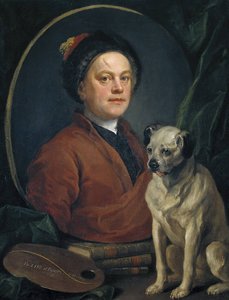
      Fig. 1. William Hogarth, Self portrait, 1745. Shown as the reproduction you are specifying: , .

      § 1Catalogue data

      § 2Abstract

      Collectible Description

      William Hogarth's 'Self-Portrait' (1745) captures the artist amidst books and his dog, reflecting his life as an observer of London society & a pioneering satirical painter. A unique glimpse into his world.

      Artist Biography

      Explore the satirical world of William Hogarth (1697-1764), pioneering English painter & engraver. Discover *A Harlot's Progress* & insightful social commentary.

      § 3Commentary

      A Glimpse Behind the Brush: William Hogarth's Introspective Masterpiece

      William Hogarth’s 1745 self-portrait isn’t merely a likeness; it’s a meticulously crafted window into the mind of one of England’s most astute and satirical observers. Painted during a period of profound social and artistic transformation, this work transcends the conventional portraiture of its time, offering a rare and intimate glimpse into the life and sensibility of the artist himself. The painting immediately draws the eye with Hogarth's direct gaze – a shrewd, almost challenging look that speaks volumes about his intellectual curiosity and unwavering commitment to documenting the realities of London society.

      William Hogarth Self-Portrait

      The scene is deceptively simple, yet brimming with carefully orchestrated details. Hogarth, clad in a vibrant red coat – a bold choice that immediately commands attention – sits amidst a clutter of books and artistic paraphernalia: a palette smeared with paint, scattered sketches, and open volumes hinting at his scholarly pursuits. Beside him rests a loyal pug dog, Trump, a constant companion depicted with an air of quiet contemplation, mirroring perhaps the artist’s own thoughtful disposition. This inclusion isn't arbitrary; it speaks to Hogarth’s deep affection for animals and subtly reinforces the theme of domesticity within his broader social commentary.

      The Satirical Eye: Hogarth’s Social Commentary

      Hogarth was far more than a painter; he was a visual chronicler of 18th-century London. His earlier works, such as *Marriage A-la-Mode* and *Gin Lane*, exposed the hypocrisy and moral decay lurking beneath the veneer of polite society. This self-portrait, however, offers a different perspective – one of introspection and artistic engagement. It’s a moment captured before the storm of his satirical campaigns, suggesting a quiet contemplation on his role as an artist and observer. The books surrounding him are not simply props; they represent Hogarth's deep engagement with classical literature and philosophy, informing his approach to art and his critical analysis of human behavior.

      The inclusion of the palette is particularly significant. It’s a visual declaration of Hogarth’s profession, but also a subtle reminder of the labor involved in creating art – a labor that demanded both skill and relentless observation. The arrangement of objects around him isn't random; it’s carefully constructed to create a sense of domestic comfort and intellectual stimulation, reflecting Hogarth’s own values and priorities.

      Neoclassical Roots & Artistic Legacy

      Painted in the wake of the Neoclassical movement, this self-portrait reflects the influence of classical ideals – particularly in its emphasis on order, clarity, and rational composition. Hogarth's meticulous attention to detail, his use of realistic rendering, and his carefully balanced arrangement of elements are all hallmarks of the Neoclassical style. However, unlike many of his contemporaries who slavishly imitated ancient models, Hogarth infused his work with a distinctly English sensibility, using satire and social commentary to critique contemporary society.

      Furthermore, this painting anticipates Hogarth’s later works, particularly *The Rake's Progress* and *The Harlot’s Progress*, which continued his exploration of moral decay and social injustice. It serves as a crucial bridge between his early, more observational work and his later, more overtly satirical output. The self-portrait offers a rare insight into the evolution of Hogarth’s artistic vision – from a keen observer of human nature to a powerful voice of social critique.

      A Reproduction for Your Space

      AllPaintingsStore is proud to offer high-quality, hand-painted reproductions of William Hogarth's Self-Portrait. Each reproduction captures the painting’s rich detail, vibrant colors, and evocative atmosphere with exceptional accuracy. Whether you are a seasoned art collector or simply seeking to add a touch of historical elegance to your home, this reproduction is a stunning addition to any collection. It’s more than just an image; it's a tangible connection to one of England’s most influential artists and a captivating window into the world of 18th-century London.

      Questions & Answers

      Is there a guide for "Self portrait" by William Hogarth?

      The guide to "Self portrait" is the artwork's Guide page - a printable factsheet showing the artwork with its caption, credit line and identity table (artist, dates, medium, original size, collection).

      What is "Self portrait" made with?

      The medium of "Self portrait" by William Hogarth is acrylic on canvas. Reproductions aim to render the appearance of this technique.

      Which room is "Self portrait" by William Hogarth recommended for, given its colors?

      With its earthy palette, "Self portrait" by William Hogarth is recommended for a living room. The colors are part of the reason for this suggestion.
      § 4The artist

      William Hogarth

      William Hogarth

      1697 - 1764, United Kingdom

      Quick facts about William Hogarth

      • Artistic Movement Or Style: Modern moral subjects
      • Artists Or Movements Influenced By This Artist:
        • James Gillray
        • George Cruikshank
      • Artists Who Influenced This Artist: ['Pieter de Hooch']
      • Full Name: William Hogarth
      • Nationality: British
      • Notable Artworks:
        • A Harlot's Progress
        • A Rake's Progress
        • Marriage A-la-Mode
      • Place Of Birth: London, United Kingdom
      • Date Of Birth: 1697
      • Date Of Death: 1764

      Artist Biography

      A London Life in Ink and Paint: The World of William Hogarth

      William Hogarth, born into the bustling heart of 18th-century London in 1697, was more than just an artist; he was a visual historian, a keen observer of human nature, and a satirical commentator on the societal currents of his age. His life story is inextricably linked to the very fabric of England during a period of significant transformation – its burgeoning ambitions, underlying anxieties, and pervasive hypocrisies all finding potent expression in his remarkably detailed and often biting works. The son of a struggling Latin schoolmaster, Hogarth’s early experiences instilled within him both a love for learning and a sharp awareness of social inequalities, a foundation that would prove crucial to shaping his artistic vision. Initially apprenticed to an engraver, he quickly demonstrated a talent extending beyond mere technical skill; he possessed an innate ability to observe the nuances of human behavior and translate them into compelling visual narratives. However, he chafed against the constraints of traditional engraving, seeking a more expressive outlet for his burgeoning creativity. This led him to studies at both St Martin’s Lane Academy and under Sir James Thornhill, where he honed his skills in painting and composition, absorbing influences that would later inform his unique style.

      The Birth of Modern Moral Subjects

      Hogarth's true innovation lay not simply *what* he painted, but *how*. He pioneered what he termed “modern moral subjects” – series of pictures designed to tell a story, often imbued with a strong satirical edge. These weren’t isolated portraits or landscapes; they were visual novels unfolding before the viewer’s eyes, offering pointed commentary on contemporary society. A Harlot's Progress, created in 1742, stands as perhaps his most famous example. This series of six paintings meticulously follows the tragic downfall of Mary, a young woman arriving in London full of hope but quickly succumbing to the temptations and dangers of city life. Each scene is rendered with painstaking detail, filled with symbolic elements that reveal the moral decay surrounding her. Similarly, A Rake's Progress, begun in 1733, charts the reckless decline of Tom Rakewell, a man who squanders his inheritance on gambling, debauchery, and ultimately, madness. These weren’t merely cautionary tales; they were unflinching portraits of a society grappling with issues of class, morality, and social mobility. Hogarth's genius resided in his ability to elevate everyday scenes – the bustling streets of London, the opulent interiors of the wealthy, the squalid lives of the poor – into works of art that resonated deeply with his audience. He didn’t shy away from depicting the harsh realities of life, presenting them with a blend of humor and pathos that forced viewers to confront uncomfortable truths about themselves and their society.

      Technique and Influences: A Synthesis of Styles

      Hogarth's artistic style was a unique amalgamation of diverse influences. He greatly admired the realism and narrative detail found in the works of Dutch genre painters like Pieter de Hooch, evident in his meticulous depictions of interiors and everyday life. The satirical prints produced in France also played a role in shaping his approach to social commentary. However, Hogarth wasn’t simply imitating these sources; he was synthesizing them into something entirely new and distinctly his own. His technique was characterized by a masterful use of line and shading, particularly evident in his engravings. He employed a distinctive cross-hatching technique that created depth and texture, bringing his scenes to life with remarkable clarity. He also possessed an exceptional eye for composition, arranging figures and objects within the frame to create dynamic and engaging narratives. Beyond visual art, Hogarth was influenced by literary works, particularly those of Jonathan Swift and Henry Fielding, whose satirical wit informed his own social observations. He believed that art should not merely be beautiful but should also serve a moral purpose, challenging viewers to confront uncomfortable truths about themselves and their society. He sought to hold a mirror up to nature, reflecting both its beauty and its ugliness with unflinching honesty.

      Legacy and Lasting Impact

      The impact of William Hogarth extends far beyond the realm of 18th-century art. His work gained immense popularity thanks to the mass production of prints based on his paintings, making his satirical commentary accessible to a wider audience than ever before. He is widely considered a precursor to political cartooning and comic strips, laying the groundwork for visual storytelling in popular culture. Artists like James Gillray and George Cruikshank were directly influenced by his style, carrying forward his tradition of social satire. Even Charles Lamb, the celebrated essayist, recognized the narrative power of Hogarth’s images, famously remarking that they were “like books to be read rather than merely looked at.”
      • Hogarth established a distinctly British artistic identity.
      • His work provides invaluable insights into 18th-century English society.
      • He influenced generations of artists and satirists.
      William Hogarth died in 1764, leaving behind a legacy that continues to resonate today. He remains a pivotal figure in the history of British art, celebrated for his innovative approach to storytelling, his unflinching social commentary, and his enduring ability to capture the complexities of human life. His paintings and engravings are not merely historical artifacts; they are vibrant windows into a bygone era, offering timeless insights into the follies and foibles of humanity. He demonstrated that art could be both entertaining and enlightening, challenging viewers to think critically about the world around them and their place within it.

      § 5Comparanda

      § 6Questions

      Quick Facts

      • Influences: Hogarth’s work
      • Medium: Oil on canvas
      • Location: Private Collection
      • Notable elements or techniques: Satirical, detailed
      • Artistic style: Rococo, Neoclassical

      Art Quiz

      There is only one correct answer for each question.

      Question 1:
      What is the primary subject of William Hogarth’s ‘Self-Portrait’?
      Question 2:
      In the ‘Self-Portrait’, what object is prominently displayed in the foreground, suggesting Hogarth’s profession?
      Question 3:
      The ‘Self-Portrait’ was painted in which year?
      Question 4:
      What artistic movement is most closely associated with William Hogarth’s style, as evidenced in this work?
      Question 5:
      The inclusion of a dog in the ‘Self-Portrait’ likely symbolizes which aspect of Hogarth's life?

      § 7Cite this entry

      AllPaintingsStore.com, “William Hogarth, Self portrait (1745)”, https://allpaintingsstore.com/en/art/william-hogarth-self-portrait-8XZ73E-en/ArtistReproduction/ (accessed 2 October 2026).

      § 8The reproduction

      Hand Made Oil Reproduction

      Hand-painted oil on canvas in your size and frame, made to order by our artists. ( Switch to Print Switch to Digital Image)

      It is specified on the order sheet in the margin; the present state of that sheet reads as follows.

      Self portrait

      Reproduction Medium

      Reproduction Size

      -

      Elite Senior Artist

      More detail, finesse, and extra production time

      -

      Reproduction Frame

      -

      -

      For artworks or reproductions larger than 105 cm (approximately 41 inches) on any side, the frame will be shipped as a kit, disassembled. This method ensures safe delivery and prevents damage during transport.

      Professional assembly required - this is not a DIY product.
      The kit must be assembled and the canvas stretched by an experienced professional framer, using wood glue (not supplied), a canvas stretching plier and clamps to hold the bars square while the glue dries. Incorrect assembly or uneven canvas tension can permanently damage the artwork and is not covered by our warranty.

      • All solid wood bars are included, precisely cut to size.

      • Assembled with the screws provided, plus wood glue for the corner joints, which is not supplied and must be sourced by your framer.

      • Professional tools are required and not included: a canvas stretching plier (tensioner) and clamps to hold the bars square while the glue dries.

      Important:
      The corner joints require wood glue, the bars must be held with clamps until the glue is fully dry, and tightening the canvas on the assembled frame requires a canvas stretching plier. None of these are included in the kit. Please arrange an experienced professional framer before ordering this size.

      Nameplate

      -

      -

      Protective Varnish

      Glossy Varnish (enhances colors, protects against light/moisture)

      -

      Customize My Artwork

      Examples of what can be changed: Replace face with customer photo; Add pet (e.g., replace cat with dog); Include hidden message in background; Change background landscape or elements.

      -

      Urgent

      Worldwide Delivery () in 3/4 weeks instead of standard 5 weeks. (31 October). No compromise on quality.

      -

      Express Shipping

      Worldwide Delivery () in 5 weeks. (7 November).

      Included

      Total Price

      $ 258

      Included with every order

      • Free Worldwide Express Shipping
      • High-Quality Linen Canvas
      • Full Shipping Insurance
      • Customs Tax Refund Guarantee
      • True Color Matching Guarantee
      • 100-Day Return Policy (Defects Only)
      • 100% Money-Back Guarantee
      • Bulk Discount Offer
      Order sheet