


 Preview
 Send
Send Share
Share
 Details
 Guide
Guide

 Download
 Similars
 X-Ray
X-Ray Diaporama
 Stats
StatsWindswept lakeshore
 Acrylic On Canvas
- WallArt
- Contemporary Realism
 1201
1201 26.0 x 27.0 cm
 Metropolitan Museum of Art
 Read More
The artwork displayed on this page is protected by copyright law, which means we cannot legally create or sell an identical reproduction. This protection is enforced under international agreements such as the Berne Convention and by national laws, including those outlined by the U.S. Copyright Law - Title 17.
As a respectful and legal alternative, we offer custom, hand-painted artworks inspired by the original. Our skilled and professional artists carefully study the original's style, mood, and artistic essence to create a new, unique piece that evokes the same feeling - while remaining an original creation in its own right.
This method fully complies with copyright regulations because it does not involve copying or duplicating the protected artwork. Instead, it is a creative reinterpretation - a new painting that is influenced by the original but not identical to it.
Hand Made Oil Reproduction
Hand-painted oil on canvas in your size and frame, made to order by our artists. ( Switch to Print Switch to Digital Image)




P118B $10

P118H $10

P118W $10

P438Z $10

P508JH $12

P508YH $12

P805H $10

P805Z $10

P919BZ $10

P919G $10

P919XJ $10

P959ZH $10

P968JZ $12

W106C $8

W218G $10

W218JH $8

W218Y $10

W307PJ $10

W316G $10

W316PJ $8

W316Y $10

W398PJ $8

W4111J $10

W500HY $15

W500JH $15

W692G $12

W849H $8

W940BG $15

W953PJ $8




Pick from our preset sizes that match the artwork's original proportions.

Type the width and the height you need, to fit your frame or your wall. This is hand-painted, so for a size with a different shape the artist can paint a bit more around the picture, or cut a bit — you choose. We send you a digital mockup to approve before the painting starts. The picture shown on this page does not show the real result — only the mockup does.
After order, AllPaintingsStore.com team will email client for instructions and provide a mockup preview
Worldwide Delivery () in 3/4 weeks instead of standard 5 weeks. (23 October). No compromise on quality.

Free Worldwide Express Shipping

High-Quality Linen Canvas

Full Shipping Insurance

Customs Tax Refund Guarantee

True Color Matching Guarantee

100-Day Return Policy (Defects Only)

100% Money-Back Guarantee

Bulk Discount Offer
 Glass option is only available in size under 110 CM

Windswept lakeshore
Reproduction Medium
Reproduction Size
-


Total Price
$ 258
A Breathless Vista: Xia Gui’s Windswept Lakeshore
Xia Gui, a figure as enigmatic as the landscapes he immortalized, remains one of China's most revered landscape painters from the Southern Song dynasty. Despite the paucity of biographical details—his birth year and personal life largely unknown—the profound impact of his artistic vision persists in the surviving canvases that exemplify an unparalleled sensitivity to natural beauty and a masterful command of technique. Unlike many artists whose lives unfold across documented pages, Xia Gui’s story is primarily conveyed through his art itself, offering tantalizing glimpses into a creative spirit nurtured within the Imperial Painting Academy of Hangzhou. He wasn't merely depicting mountains; he was distilling them down to their core essence—a breathtaking simplification that speaks volumes about his artistic philosophy.The Essence of Minimalist Landscape
Xia Gui’s approach distinguishes him from earlier Song painters who embraced monumental compositions, prioritizing grandeur and scale. Instead, he adopted a radically different strategy, mirroring the aesthetic sensibilities of Li Tang—a deliberate reduction to its most fundamental elements. This stylistic choice resulted in paintings that eschewed elaborate ornamentation and instead focused on conveying immediacy and emotional resonance. The resulting images are strikingly powerful, capturing not just what is seen but how it *feels*. He achieved this remarkable feat by employing a technique characterized by sparse brushstrokes and tonal variations—a masterful distillation of the Song landscape tradition.Technique: Wet Ink Wash – A Dialogue with Silence
Xia Gui’s signature method was wet ink wash, a technique that involved applying diluted ink to paper using delicate brushstrokes and subtle tonal gradations. This approach prioritized capturing atmospheric conditions—misty mornings, hazy sunsets—rather than meticulously rendering every detail. The artist skillfully utilized dots and dashes of ink alongside broad washes of color, creating textures that evoked the rugged grandeur of mountainous terrain. These seemingly simple marks possessed immense expressive potential, conveying a sense of vastness and solitude – mirroring the profound contemplation inherent in observing nature undisturbed.Historical Context: Tranquility Amidst Turbulent Times
Created during the Southern Song dynasty (1195–1224), Xia Gui’s “Windswept Lakeshore” reflects both the serenity and underlying melancholy of a period marked by political instability. The court had retreated southwards to escape Mongol invasions, fostering an atmosphere of quiet resilience amidst external pressures. Yet, within this context of uncertainty, Xia Gui's art embodies a steadfast devotion to capturing the sublime beauty of the natural world—a testament to the enduring human desire for solace and contemplation.Symbolism: Echoes of Daoist Philosophy
The composition itself speaks volumes about Daoist principles – the belief in harmony with nature and acceptance of impermanence. The solitary trees, positioned against an infinite expanse of sky and water, symbolize resilience and adaptability—a quiet defiance of chaos. They invite viewers to consider the insignificance of human concerns within the grand scheme of existence, prompting a meditative response akin to witnessing the timeless beauty of the landscape itself.Emotional Impact: A Moment Frozen in Time
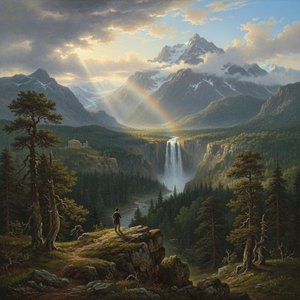
“Windswept Lakeshore” transcends mere visual representation; it evokes a palpable sense of tranquility and awe. The artist’s masterful use of wet ink wash captures not just the physical appearance of the mountains but also their intangible spirit—a feeling of profound stillness and connection to something larger than oneself. It's an artwork designed to inspire contemplation, reminding us that true beauty resides in simplicity and that nature possesses a power to heal and rejuvenate the soul.Questions & Answers
Is "Windswept lakeshore" available as a fine art print?
To get a print of "Windswept lakeshore" by Xia Gui, simply order it on its Fine Art Print page: a fine art print on cotton canvas or archival canvas paper.
What emotion does "Windswept lakeshore" by Xia Gui convey?
"Windswept lakeshore" is associated with a tranquil feeling. The emotional tone describes the impression the work gives.
Which artistic current is "Windswept lakeshore" by Xia Gui part of?
"Windswept lakeshore" is a work of Contemporary Realism. The movement indicates the artistic tradition the work is part of.
Related Artworks


Artist Biography
A Master of Subtle Landscapes: The Life and Art of Xia Gui
Xia Gui, a name resonating through the annals of Chinese art history, stands as one of the most significant landscape painters of the Southern Song dynasty (1195–1224). Though shrouded in mystery – details surrounding his birth and personal life remain elusive – his artistic legacy is powerfully present in the surviving works that exemplify a refined aesthetic and profound understanding of nature. Unlike many artists whose lives are well-documented, Xia Gui’s story is primarily told through his paintings, offering glimpses into a masterful technique honed within the Imperial Painting Academy in Hangzhou. He wasn't merely replicating scenery; he was capturing its essence, distilling it down to its most poetic form. His work emerged during a period of cultural flourishing despite political turmoil—the Southern Song court having retreated south from invading forces—and reflects both the serenity and underlying melancholy of that era.The Ma-Xia School and Artistic Development
Xia Gui is inextricably linked to the formation of the influential Ma-Xia school, a pivotal movement in Southern Song landscape painting. Alongside his contemporary, Ma Yuan, he redefined the conventions established by earlier masters like Li Tang. While building upon Li Tang’s foundations, Xia Gui diverged towards a more minimalist and evocative style. Where Li Tang's work often featured grand compositions, Xia Gui favored sparse arrangements, focusing on capturing atmosphere and suggestion rather than meticulous detail. This wasn’t about abandoning skill; it was about elevating the power of implication. He employed subtle ink washes and delicate brushwork to create scenes that felt both intimate and expansive, inviting viewers into a contemplative space. The hallmark of his technique lies in the use of short, angular strokes—often described as “axe-cut” strokes—to depict rocks and foliage with remarkable texture and vitality. This approach wasn’t simply about rendering form; it was about conveying the energy and resilience of nature itself.Technique and Notable Works
Xia Gui primarily worked in two formats: album leaves and hand scrolls. The album leaf, a small-scale painting intended for private contemplation, allowed him to showcase his mastery of detail and atmospheric perspective within an intimate frame. His hand scrolls, however, represent the pinnacle of his achievement. “Pure and Remote View of Streams and Mountains,” a monumental work exceeding nine meters in length, is perhaps his most celebrated masterpiece. This scroll exemplifies his ability to create a sense of vastness and depth using subtle tonal variations and carefully placed compositional elements. The viewer’s eye is led through winding paths, past towering peaks shrouded in mist, and along tranquil streams—a journey that evokes both awe and serenity. Other notable works include “Rapids in a Mountain Valley” and “Autumn Moonlight on Dongting Lake,” each demonstrating his unique ability to capture the mood and character of specific landscapes. He often employed a technique involving a "split brush," allowing for multiple strokes with a single application, adding complexity and dynamism to his depictions of foliage.Legacy and Enduring Influence
Despite initial acclaim during his lifetime, Xia Gui’s reputation waned in the centuries following his death, as academic painting fell out of favor. However, his genius was eventually rediscovered, and his influence began to reassert itself. Notably, Japanese master Sesshū Tōyō, who traveled to China in the 15th century, was profoundly impacted by Xia Gui’s art, incorporating elements of his style into his own work and transmitting them throughout Japan. This cross-cultural exchange ensured that Xia Gui's artistic principles continued to inspire generations of artists. Today, he is recognized as a pivotal figure in Chinese landscape painting—a master who redefined the boundaries of subtlety and suggestion. His emphasis on capturing atmosphere, his minimalist compositions, and his masterful use of ink continue to resonate with artists and art lovers alike, solidifying his place as one of the great visionaries of the Southern Song dynasty. He didn’t just paint landscapes; he painted emotions, memories, and a profound connection to the natural world—a legacy that endures through time.
Xia Gui
1940 - 1973 , United States of America
Quick Facts
- Full Name: Xia Gui
- Nationality: American
- Date Of Birth: 1940
- Date Of Death: 1973
- Place Of Birth: Chinatown, United States of America
- Notable Artworks:
- Pure and Remote View...
- Twelve Views of Landscape
- Rapids in a Mountain Valley
- Artistic Movement Or Style: Southern Song Landscape
- Artists Who Influenced This Artist: ['Li Tang']
- Artists Or Movements Influenced By This Artist:
- Sesshū Tōyō
- Ma Yuan
Related Articles
Evoking Nature's Sublime: A Comprehensive Exploration of 19th-Century Landscape Painting
Explore the captivating world of 19th-century landscape painting! Discover renowned artists like Friedrich & Monet, key movements, and find the perfect artwork to bring nature's serenity into your home. Expert insights at AllPaintingsStore.

Evocations of Place: A Historical Journey Through Landscape Art
Explore the rich history of landscape art with AllPaintingsStore. Discover renowned artists, movements like Impressionism & tonalism, and expert guidance for collecting timeless pieces. Find your perfect serene escape today!

Romantic Landscapes: 10 Masterpieces for Your Home | AllPaintingsStore
Journey through 10 Romantic landscape masterpieces by Friedrich, Turner & Cole. Explore emotional art, sublime nature scenes & iconic 19th-century paintings. Find museum-quality reproductions for your home at AllPaintingsStore.com – discover the full collection online!

Evocations of Place: A Historical Journey Through Landscape Art
Explore the rich history of landscape art with AllPaintingsStore. Discover renowned artists, movements like Impressionism & Romanticism, and expert guidance for collecting timeless pieces. Find your perfect serene escape today!

John Constable's Masterpieces: Explore 25 Iconic Landscapes for Your Home
Journey through John Constable's 25 most celebrated landscapes. Explore Romanticism, Dedham Vale & his masterful use of light in iconic paintings like 'Hay Wain'. Find museum-quality art reproductions and elevate your home decor on AllPaintingsStore.com.


