- Home

- Oil Painting Reproduction
- yi eungro
- The travels of Marco Polo Series

 Buy print
 Send
Send Share
Share
 Details

 Download
 Similars
 X-Ray
X-Ray Diaporama
The travels of Marco Polo Series
 Acrylic On Canvas
- WallArt
- East Asian Landscape
 1980
1980 17.0 x 17.0 cm
 Lee Ungno Museum
 Read More
Hand Made Oil Reproduction
Hand-painted oil on canvas in your size and frame, made to order by our artists.




P118B $10

P118H $10

P118W $10

P438Z $10

P508JH $12

P508YH $12

P805H $10

P805Z $10

P919BZ $10

P919G $10

P919XJ $10

P959ZH $10

P968JZ $12

W106C $8

W218G $10

W218JH $8

W218Y $10

W307PJ $10

W316G $10

W316PJ $8

W316Y $10

W398PJ $8

W4111J $10

W500HY $15

W500JH $15

W692G $12

W849H $8

W940BG $15

W953PJ $8




Pick from our preset sizes that match the artwork's original proportions.

You may enter your own dimensions to fit a specific frame or space. If your selected size does not match the original image's proportions, we will either crop the artwork or extend the painting with additional hand-painted elements. A digital mockup will be sent for your approval before production begins.
Please note that the on-screen preview does not reflect the actual cropping or extension. Only the mockup will accurately show the final composition.
While custom sizes are available, we recommend selecting a dimension from the predefined list to preserve the original proportions.
After order, AllPaintingsStore.com team will email client for instructions and provide a mockup preview
Worldwide Delivery () in 3/4 weeks instead of standard 5 weeks. (16 July). No compromise on quality.

Free Worldwide Express Shipping

High-Quality Linen Canvas

Full Shipping Insurance

Customs Tax Refund Guarantee

True Color Matching Guarantee

60-Day Return Policy (Defects Only)

100% Money-Back Guarantee

Bulk Discount Offer
 Glass option is only available in size under 110 CM

The travels of Marco Polo Series
Reproduction Medium
Reproduction Size
-


Total Price
-
Artwork Description
A Journey Across Horizons: Exploring Lee Ungno’s “The Travels of Marco Polo Series”
Lee Ungno (Yi Eungro), born in Seoul in 1904, was a Korean-born French painter and printmaker whose artistic journey spanned decades of exploration between East and West. His formative years were spent at Hongseong Botong Hakyo before he embarked on intensive training under Yeomjae Song Tae-hoe from 1920, establishing himself firmly within the influential ‘haegang style,’ a movement that sought to modernize Korean painting traditions while retaining their core aesthetic values. This dedication to mastering brushwork and composition would prove invaluable as Ungno pursued his artistic ambitions across continents.- Early Influences & Artistic Training: Ungno’s initial exposure to art came through Hongseong Botong Hakyo, where he honed foundational skills in drawing and color theory. However, it was Song Tae-hoe's tutelage that truly shaped his artistic vision, immersing him in the techniques of traditional Korean ink wash painting – specifically the haegang style—characterized by its meticulous attention to detail and harmonious blending of colors.
- The Bamboo Motif: Ungno’s celebrated mukjuk (묵죽), or bamboo painting, exemplifies this stylistic approach. Winning a prize at the 3rd Joseon Art Exhibition solidified his reputation as a gifted artist and demonstrated his ability to capture subtle nuances of light and shadow within a deceptively simple composition. The bamboo itself holds profound symbolic significance in Korean culture – representing resilience, humility, and longevity—mirroring Ungno’s own unwavering commitment to artistic excellence.
A Series Dedicated to Exploration & Perspective
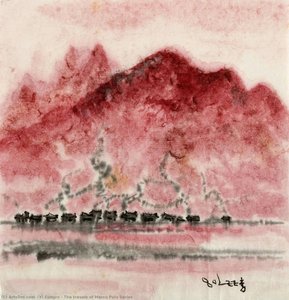
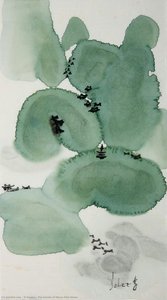
“The Travels of Marco Polo Series,” conceived during the colonial era, represents a pivotal moment in Korean art history. Recognizing the limitations faced by Eastern ink painters attempting to engage with Western influences, Ungno deliberately adopted a bird’s-eye view—a technique borrowed from East Asian painting—to convey a sense of expansive distance and panoramic grandeur. This stylistic choice reflects Ungno's desire to transcend conventional artistic boundaries and capture the essence of intercultural dialogue. The triangular forms dominating the landscape subtly evoke mountainous terrains, mirroring the geographical realities encountered by Marco Polo during his expeditions.Architectural Echoes & Symbolic Representation
The inclusion of miniature architectural figures amongst the triangular landscapes is particularly noteworthy. These stylized representations hark back to East Asian architectural traditions—specifically those observed by European travelers—adding another layer of complexity and visual interest to the artwork. Ungno’s masterful use of color – predominantly red and white – contributes to a striking aesthetic impact, symbolizing vitality and purity respectively. The overall composition invites contemplation on themes of exploration, discovery, and the merging of cultures.Legacy & Rediscovery
Despite Ungno's ambition to publish his series, it remained largely unknown until its donation to the Lee Ungno Museum in Daejeon, where it now resides as a testament to Korean artistic heritage. “The Travels of Marco Polo Series” stands as an enduring symbol of Ungno’s pioneering spirit and his unwavering belief in the transformative power of art—a captivating piece that continues to inspire admiration for its innovative technique and evocative imagery.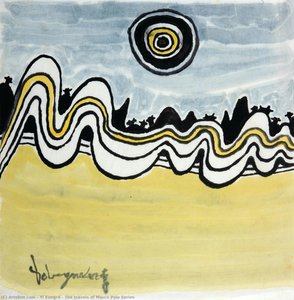



Artist Biography
**early life and training**
lee ungno, also known as yi eungro, was a korean-born french painter and printmaker born in séoul, south korea in 1904. his early life was marked by a brief stint at the hongseong botong hakyo (홍성보통학교, 홍城초등학교, 洪城普通學校), after which he dedicated himself to studying painting under yeomjae song tae-hoe from 1920.**artistic career in korea and japan**
lee ungno's artistic career began in earnest when he moved to seoul in 1922, becoming an apprentice to celebrated calligrapher-painter-photographer haegang kim gyu-jin. he primarily learned to paint the four gentlemen in the 'haegang style.' notably, his inkwash painting of a bamboo, mukjuk (묵죽, 墨竹, ink bamboo), won a prize in the 3rd annual joseon art exhibition. lee ungno consecutively won prizes in the joseon art exhibition throughout the colonial period. however, he believed that eastern ink painters should modernize their style. in the early 1930s, lee began producing inkwash landscapes influenced by new, modern eastern ink painting styles and naturalistic renditions found in western-style paintings.**international recognition and later life**
after training in traditional inkwash painting in korea from the 1920s to the 1930s, lee gradually experimented with western-style painting techniques in japan. his works from the 1950s showcase creative attempts at merging eastern medium and brushstrokes with western perspective and forms. lee ungno relocated to france in 1958, where he fully established his standing as an abstract artist. he is most known for his series of ink and paper collage, abstract letters, and crowd paintings that developed during his stay in france.- view yi eungro's artworks on AllPaintingsStore: [https://AllPaintingsStore.com/@/yi-eungro](https://AllPaintingsStore.com/@/yi-eungro)
- explore the musée national jean-jacques henner, a museum featuring a vast collection of art pieces, including those inspired by eastern styles: [https://AllPaintingsStore.com/@@/a@d3cew9-il-museo-musee-national-jean-jacques-henner-di-parigi-francia](https://AllPaintingsStore.com/@@/a@d3cew9-il-museo-musee-national-jean-jacques-henner-di-parigi-francia)
- discover more about the ilkhanid art movement, which also blends eastern and western influences: [https://AllPaintingsStore.com/art.nsf/o/a@d3cq2m](https://AllPaintingsStore.com/art.nsf/o/a@d3cq2m)
yi eungro
1904 - 1989 , South Korea
Quick Facts
- Artistic Movement Or Style: Eastern & Western Expressionism
- Artists Or Movements Influenced By This Artist: ['Haegang Style']
- Artists Who Influenced This Artist: ['Yeomjae Song Tae-hoe']
- Date Of Birth: January 12, 1904
- Date Of Death: January 10, 1989
- Full Name: Yi Eungro (Lee Ungno)
- Nationality: Korean-French
- Notable Artworks: ['Composition']
- Place Of Birth: Seoul, South Korea
Related Articles

Winston Churchill: Beyond Statesman – The Unexpected Life of a Passionate Painter
Discover the surprising artistic life of Winston Churchill! Explore his captivating paintings, influences, and unique style. Learn about collecting Churchill's art & its historical significance.

Evoking Tranquility: A Comprehensive Exploration of Serene Landscapes in Art History
Explore the history of serene landscapes in art! Discover renowned artists like Monet & Munch, movements from Impressionism to Tonalism, and find the perfect piece to bring tranquility to your home. Expert insights at AllPaintingsStore.

Alfred East: Pioneering Plein Air & Evoking Atmospheric Landscapes
Explore the life & work of Alfred East, a pioneer of British plein air painting. Discover his techniques for capturing atmospheric landscapes, Barbizon influences, and lasting legacy. Learn more at AllPaintingsStore.

Adolph von Menzel: Realism, Prussian Society & the Painterly Chronicle of a Changing Era
Explore the life & work of Adolph von Menzel, a leading German Realist painter. Discover his detailed depictions of Prussian society, innovative techniques, and lasting influence on art history. Hand-painted reproductions available at AllPaintingsStore.

Evocations of Place: A Historical Journey Through Landscape Art
Explore the rich history of landscape art with AllPaintingsStore. Discover renowned artists, movements like Impressionism & tonalism, and expert guidance for collecting timeless pieces. Find your perfect serene escape today!