


The Reaction to Rococo: Seeking Clarity Amidst Ornamentation
In the mid-18th century, the European aesthetic landscape was dominated by the Rococo style, a movement defined by its sensuousness, asymmetry, and decorative excess. This period favored the playful and the ornate, often prioritizing grace and lightheartedness over structural substance. However, as the Enlightenment began to reshape intellectual life, a growing segment of artists and thinkers felt a profound dissatisfaction with this perceived frivolity. They sought a return to the principles of simplicity and harmony, looking toward the perceived stability of the ancient world to counter the unrestrained dynamism of the Baroque and the decorative whimsy of the Rococo.
This shift mirrors the historical transition from the complex, often chaotic textures of the late Baroque to the disciplined clarity of the Classical period. Just as the Rococo sought to delight the senses through intricate curves, Neoclassicism sought to satisfy the mind through geometric precision. This was not merely a change in fashion, but a fundamental realignment of artistic purpose, moving away from the purely decorative and toward the pursuit of universal truths through order and restraint.
By rejecting the asymmetrical flourishes of the previous era, Neoclassicism established a new visual language rooted in balance. This movement provided a necessary corrective for a generation looking for permanence in an era of rapid social change.
Archaeological Discovery: The Impact of Pompeii on the Visual Mind
The mid-1700s brought a series of transformative archaeological discoveries that fundamentally altered the trajectory of Western art. The excavations of Pompeii and Herculaneum provided the first direct, tangible encounters with the domestic and public life of ancient Rome. For the first time, artists were not merely reading about antiquity in texts; they were observing the actual colors, forms, and spatial arrangements of a lost civilization. These sites offered a wealth of material that fueled a renewed interest in Greco-Roman ideals, providing a concrete foundation for the burgeoning Neoclassical movement.
This archaeological fervor finds a historical echo in the Grand Tour, where generations of European art students traveled to Italy to study these ruins firsthand. The physical presence of these artifacts acted as a catalyst, transforming theoretical admiration into a practical, stylistic revolution. The discovery of these ancient cities provided the visual evidence required to move beyond the stylized interpretations of the Renaissance and toward a more rigorous, observational approach to classical antiquity.
The tangible reality of Pompeii ensured that Neoclassicism was grounded in observation rather than mere imagination. It turned the study of the past into a precise science of form and function.
The Winckelmann Ideal: Noble Simplicity and the Pursuit of Perfection
 Johann Joachim Winckelmann (1717–1768)
Johann Joachim Winckelmann (1717–1768), Anton Raphael Mengs
Central to the intellectual framework of Neoclassicism was the work of Johann Joachim Winckelmann, whose writings helped define the movement's aesthetic goals. Winckelmann championed the imitation of Greek art, famously extolling its "noble simplicity and quiet grandeur." He argued that true beauty was found in the serene composure of the human figure, even when depicting intense emotion. To Winckelmann, the ideal was not found in the exaggerated movement of the Baroque, but in the ability of a work to convey profound meaning through restrained, perfected forms.
This pursuit of an ideal form is a recurring theme in the history of art, seen in the way Renaissance masters like Raphael sought to harmonize the human figure through mathematical proportion. Winckelmann’s theories provided a modern framework for this ancient pursuit, suggesting that by adhering to the strictures of Greek and Roman models, artists could achieve a level of universality that transcended their own era. He sought to strip away the accidental and the superfluous to reach the essential.
Winckelmann’s influence ensured that Neoclassicism was as much a philosophical movement as it was a stylistic one. It was an attempt to capture the eternal through the disciplined application of classical principles.
Line Over Color: The Precision of Neoclassical Composition
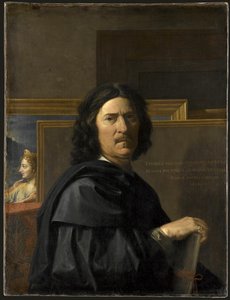 Nicolas Poussin
Nicolas Poussin. A master of French Classicism, he is famed for Et in Arcadia Ego. Discover his serene and intellectual masterpieces at AllPaintingsStore.
In the execution of Neoclassical painting, a clear hierarchy was established: line was paramount, and color was secondary. This emphasis on linear design was a deliberate departure from the painterly, color-driven approach of the Rococo. Artists focused on clear, austere outlines and precise definitions of form to create a sense of structural integrity. This technique ensured that the subject matter remained the primary focus, preventing the emotional or sensory distractions that often accompanied heavy, expressive brushwork or a saturated color palette.
This focus on line can be seen in the works of Nicolas Poussin, whose compositions prioritized clarity and idealized beauty, setting a precedent for the structured compositions of the 18th century. By prioritizing the contour and the edge, Neoclassical artists achieved a sense of permanence and stability. The result was a visual clarity that mirrored the rationalism of the Age of Enlightenment, where every element of a composition had a specific, logical place within the whole.
The mastery of line allowed for a sense of sculptural depth on a two-dimensional surface. It provided the clarity necessary to communicate complex narratives without the interference of atmospheric or chromatic ambiguity.
Moral Grandeur: Heroism and Civic Virtue in History Painting
 Patroclus
Patroclus, Jacques-Louis David
Neoclassical art was frequently used to communicate themes of heroism, self-sacrifice, and civic responsibility. This was particularly evident in history painting, which became the most prestigious genre of the era. Artists like Jacques-Louis David utilized scenes from classical mythology and Roman history to celebrate virtues such as austerity and duty. In works like Patroclus (1780), the emphasis is placed on the idealized, stoic figure, embodying a strength that is as much moral as it is physical. These paintings were intended to serve as moral exemplars for the viewer, reinforcing the social and political values of the time.
The use of art as a vehicle for moral instruction is a tradition that stretches back to the didactic functions of religious art in the Middle Ages. However, Neoclassicism shifted this focus from the divine to the civic. The hero was no longer a saint, but a citizen—a person whose greatness was defined by their devotion to the state or to a higher ethical principle. This transition reflected a world moving toward modern concepts of nationalism and secular ethics.
By depicting the struggles and triumphs of the past, Neoclassical artists provided a visual framework for the virtues required by the present. The art was designed to inspire action through the contemplation of ideal character.
Symmetry and Structure: The Architectural Language of Order
 Andrea Palladio
Explore the world of Andrea Palladio (1508-1580), the influential Italian Renaissance architect behind iconic villas & 'The Four Books of Architecture'. Discover his classical designs!
The principles of Neoclassicism extended far beyond the canvas, profoundly shaping the architecture of the 18th and 19th centuries. Neoclassical architecture is characterized by a strict adherence to symmetry, the use of classical orders—such as the Doric, Ionic, and Corinthian—and a preference for geometric clarity. Elements like pediments, porticos, and pilasters were employed to create a sense of monumental stability and grandeur. This was a direct response to the perceived lack of structure in the preceding Rococo architecture, which often favored organic, flowing lines and asymmetrical ornamentation.
This architectural language draws heavily from the Renaissance works of Andrea Palladio, who had previously looked to Roman antiquity to establish a sense of proportion and harmony. Neoclassical architects refined these ideas, applying them to a wide range of structures, from grand public buildings to private residences. The result was a built environment that felt permanent, rational, and deeply connected to the classical tradition.
The enduring legacy of this style is evident in the civic architecture of many modern cities, where the language of columns and symmetry continues to convey authority and order. Neoclassicism provided a visual standard for stability that remains recognizable even centuries later.
For those seeking to bring this sense of historical order and disciplined elegance into a contemporary space, AllPaintingsStore.com offers a comprehensive selection of high-quality options. We specialize in 100% hand-painted oil reproductions of the masters, ensuring that the tactile depth and visible brushstrokes of the original works are preserved. Whether you require a large-format mural for a commercial project or a bespoke custom commission, our professional Project Coordinators and expert artists ensure a seamless process from digital mockup to final delivery. From museum-quality Giclée prints to bespoke "remixed" portraits, we provide the tools to integrate classical grandeur into any environment. Visit AllPaintingsStore.com to explore our catalog or consult with our experts on your next acquisition.


