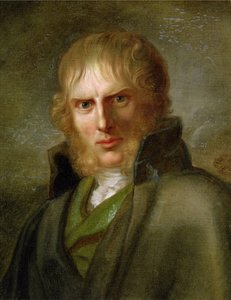
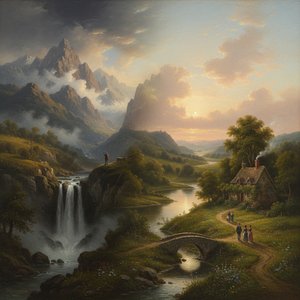
The Emotional Revolution: Rejecting Reason for Passion and Intuition
 Romanticism
Romanticism (also known as the Romantic movement or Romantic era) was an artistic and intellectual movement that originated in Europe towards the end of the 18th century. The purpose of the movement was to advocate for the importance of subjectivity,...
To understand the seismic shift brought about by Romanticism, one must first look back at the rigid structures of the Age of Enlightenment. For decades, the intellectual landscape of Europe was dominated by a devotion to logic, scientific order, and the measurable. Art, in its Neoclassical form, sought to uphold these values through clarity, symmetry, and didactic purpose. However, as the 18th century drew to a close, a profound rebellion began to stir within the human psyche. This movement, known as Romanticism, emerged not merely as a change in aesthetic preference, but as a fundamental reclamation of the individual soul. It was a deliberate rejection of social conventions and the cold, mechanical certainty of the Industrial Revolution in favor of subjectivity, imagination, and the raw power of intuition.
The Romantics argued that the world could not be fully understood through a microscope or a mathematical formula alone; rather, true comprehension required an engagement with the irrational, the mysterious, and the deeply personal. This era championed the importance of individualism, suggesting that beauty is far more than an affair of form or proportion—it is something that evokes a visceral, emotional resonance within the viewer. By prioritizing passion over reason, artists began to explore the depths of human experience, from the heights of heroic idealism to the darkest recesses of psychological turmoil. This shift transformed the canvas from a window of objective reality into a mirror reflecting the turbulent, uncontainable essence of the human spirit.
Defining the Sublime: Where Beauty Meets the Terror of Nature
 Victorian Romanticism: Exploring the Sublime Emotion and Untamed Majesty of 19th-Century Landscape Art
The Soul of the Sublime: Defining Romanticism's Emotional Revolution Sublime (philosophy) In aesthetics, the sublime (from Latin sublīmis 'uplifted, lofty, exalted, etc.; elevated, raised') is the quality of greatness, whether physical, moral, intell...
At the very heart of the Romantic movement lies one of its most captivating and complex aesthetic concepts: the sublime. Derived from the Latin sublīmis, meaning uplifted or lofty, the sublime refers to a quality of greatness that transcends mere beauty. While beauty often provides comfort through harmony and grace, the sublime seeks to overwhelm. It is found in that breathtaking, often terrifying intersection where the human spirit encounters something far greater than itself. In the context of 19th-century art, the sublime is the sensation experienced when standing before a vast, churning ocean or a mountain peak shrouded in impenetrable mist—a moment where awe is inextricably linked with a sense of mortal insignificance.
This aesthetic experience serves as an invitation to move beyond simple observation and instead surrender to the soul of the natural world. The sublime captures the untamed majesty of existence, presenting landscapes that are both magnificent and menacing. It is a state of being where the boundaries between the observer and the infinite begin to dissolve. For the Romantic artist, capturing the sublime was not about documenting a scene with topographical accuracy, but about translating the feeling of being humbled by the monumental. Through dramatic lighting, scale, and atmospheric tension, these works allow us to experience the sublime emotion—a profound, often overwhelming power that leaves the viewer both exalted and deeply moved.
Masters of Atmosphere: From Paul Huet’s Landscapes to Goya’s Shadows
 CHEVAL NORMAND
Paul Huet: A Pioneer of Romantic Landscape Paul Huet (1803-1869) stands as a pivotal, yet often understated, figure in 19th-century French art – a landscape painter who profoundly influenced both the Barbizon School and the nascent Impressionists. Bo...
The execution of such intense emotional themes required a new vocabulary of technique, one that favored atmosphere over meticulous detail. This is perhaps most evident in the work of Paul Huet, a pivotal figure in French landscape painting. A pioneer who bridged the gap between the traditional academy and the nascent Impressionists, Huet rejected the rigid formalism of his predecessors. His journey was defined by a relentless observation of light and the fleeting beauty of the natural world. Influenced by the groundbreaking approach of Richard Parkes Bonington, Huet utilized plein air techniques to capture the very essence of atmosphere, prioritizing tonal harmony and the way light transforms surfaces. His work does not merely depict scenery; it breathes with the movement of wind and the shifting weight of clouds.
While Huet explored the luminous possibilities of the landscape, other masters utilized shadow and psychological depth to explore the darker side of the Romantic spirit. The legendary Francisco de Goya stands as a titan of this era, using chiaroscuro mastery to delve into the depths of human tragedy and social critique. In his hands, light does not just illuminate; it haunts. Similarly, artists like Oswald Achenbach, part of the renowned Düsseldorf School, acted as interpreters of color and emotion, bringing a realistic yet deeply atmospheric approach to European landscapes. Whether through the vibrant, detailed precision of Swiss artist Hans Conrad Schulthess or the monumental depictions of historic structures by David Cox, these masters shared a singular goal: to use the medium of oil on canvas to evoke a profound, lasting emotional impact.
The Landscape as a Spiritual Vessel: Capturing Light, Mist, and Majesty
 Sammlung Schack
A Hidden Sanctuary of Romantic Dreams: Exploring the Sammlung Schack Nestled within the elegant confines of Munich’s Prinzregentenstraße lies a treasure trove for those captivated by the evocative power of 19th-century German art – the Sammlung Schac...
In the Romantic era, the landscape was elevated from a mere backdrop to a spiritual vessel. No longer was nature just a setting for human drama; it became the primary protagonist. This period saw the rise of the landscape as a medium for exploring the divine and the supernatural. Artists sought to capture the untamed majesty of the earth, often imbuing their works with a sense of mythic importance. The use of mist, fog, and dramatic weather patterns served to obscure the tangible world, allowing the imagination to wander into the unknown. This technique created a sense of mystery, suggesting that beneath the visible surface of nature lies a deeper, more spiritual reality.
This reverence for nature is beautifully illustrated in the works of artists like Alexander Joseph Daiwaille, who bridged Dutch tradition with Romantic vision, and Alexei Bogolyubov, who brought a unique Russian sensibility to the landscape tradition. Even in the more structured environments of museum collections, such as the Sammlung Schack in Munich or the Museo Nacional del Romanticismo in Madrid, one can feel this spiritual connection. These institutions preserve works that treat the natural world as a sanctuary for emotion and individualism. By focusing on the interplay of light, shadow, and atmospheric perspective, these artists transformed the landscape into a profound meditation on existence, where every mountain peak and every forest glade serves as a testament to the infinite.
Romanticism's Legacy: Influencing Impressionism and Modern Subjectivity
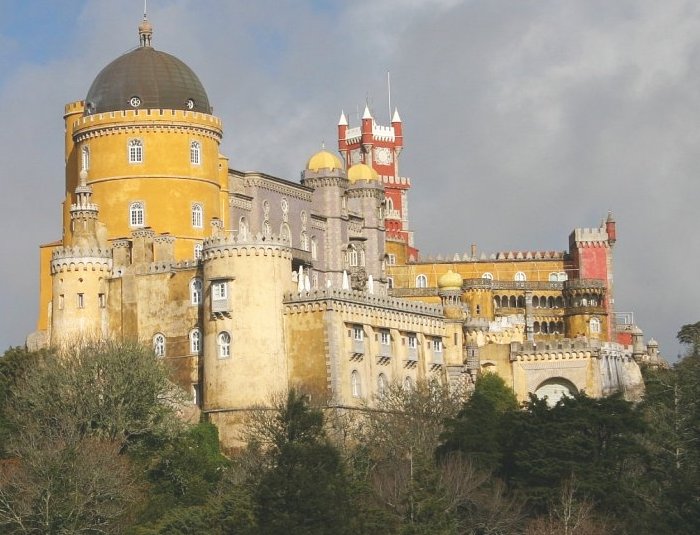 Neo-romanticism
The term neo-romanticism is used to cover a variety of movements in philosophy, literature, music, painting, and architecture, as well as social movements, that exist after and incorporate elements from the era of Romanticism. It has been used with r...
Though the height of the Romantic movement is generally considered to be between 1800 and 1850, its influence did not vanish with the arrival of more modern styles; rather, it laid the essential groundwork for the revolutions that followed. The Romantic emphasis on subjectivity and the importance of the artist's personal perception provided the philosophical foundation for Impressionism. The Impressionists’ obsession with capturing the fleeting effects of light and atmosphere is a direct descendant of the Romantic pursuit of the ephemeral. When we look at the way Paul Huet or the Barbizon School painters prioritized tonal harmony over rigid detail, we see the seeds of Monet and Renoir already beginning to bloom.
<Furthermore, the movement's celebration of the individual and the rejection of standardized social conventions paved the way for the modern era's focus on self-expression. The "Late Romantic" and even "Neo-romantic" revivals continued to resist the encroaching materialism of a positivist age, maintaining a belief in the power of myth, legend, and deep emotion. Today, when we encounter art that moves us through its raw intensity or its ability to transport us to another realm, we are experiencing the enduring legacy of Romanticism. It taught us that art is not merely a record of what we see, but a profound expression of how we feel—a timeless truth that continues to resonate in every brushstroke and every masterpiece.
At AllPaintingsStore.com, we celebrate this enduring legacy by offering high-quality, hand-painted reproductions of these historical masterpieces. Whether you are looking for a large-scale landscape to anchor a corporate space or a custom portrait that captures a personal moment in the style of the Old Masters, our professional artists use traditional techniques on 100% cotton canvas to ensure every piece retains the texture and soul of the original era. From museum-grade Giclée prints to bespoke oil commissions, we provide reliable, high-volume solutions for collectors and decorators worldwide.