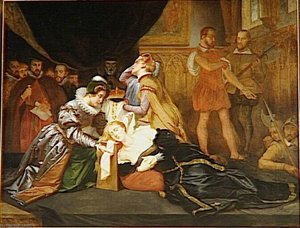
The Dawn of a Neoclassical Visionary
Emerging from the refined traditions of a noble family with deep connections to the Bourbon monarchy, Alexandre Denis Abel de Pujol was destined for a life steeped in the grandeur of classical antiquity. His journey began in Valenciennes, where an aristocratic education fostered a profound reverence for humanist values and the timeless beauty of historical tradition. This early immersion prepared him for his pivotal apprenticeship under the legendary Jacques-Louis David at the École Royale Supérieure des Beaux-Arts in Paris. From David, Pujol inherited far more than mere technical prowess; he absorbed a commitment to the dramatic power of historical narrative and a meticulous attention to detail. His stylistic language became one of clarity, balance, and idealized figures, all imbued with a deep sense of moral significance that would define his approach to the monumental canvases of his era.
Monumental Narratives and the Glory of France
Pujol’s true mastery was revealed through his ambitious decorative commissions, works that transformed the very architecture of French institutions into stages for epic storytelling. He possessed a rare ability to command vast, soaring spaces, utilizing color and perspective to breathe life into mythological legends and historical triumphs. In the hallowed halls of the Louvre, his depiction of Virgil's Aeneas upon the ceiling of the Grand Staircase serves as a powerful allegory of Roman virtue and destiny, captivating viewers with its dramatic scale. This talent for monumental fresco was further realized at Fontainebleau, where the Galerie de Diane showcases a breathtaking moment of triumph: Julius Caesar’s return to Rome after defeating Pompey. Through his brush, the struggle and glory of antiquity felt immediate and palpable.
His most symbolically profound achievement can be found in the ceiling of the Bourse de Paris, where he portrayed the Herculean struggle of Hercules against the Hydra—a timeless emblem of courage and the relentless human spirit in the face of overwhelming adversity. To understand the breadth of his impact, one might look to these defining works:
- The Grand Staircase at the Louvre: An exploration of Roman destiny through the lens of the Aeneid.
- The Galerie de Diane at Fontainebleau: A cinematic portrayal of Julius Caesar's triumphant return.
- The Bourse de Paris Ceiling: A symbolic representation of perseverance via the myth of Hercules.
A Legacy of Honor and Artistic Lineage
Beyond his individual triumphs, Pujol’s significance is etched into the fabric of the nineteenth-century art world through his role as a mentor and a distinguished figure of the French state. As a member of the prestigious Institut de France and an officer of the Légion d'honneur, he stood at the pinnacle of his profession, recognized for his contributions to the national identity of France. His influence extended far beyond his own canvas, as he nurtured a new generation of talent, passing down the disciplined techniques of the Neoclassical tradition to notable students such as Alexandre-Gabriel Decamps and Émile Lévy. While history sometimes places him in the shadow of more turbulent Romanticists, the enduring strength of his compositions remains a testament to a man who sought to capture the eternal through the lens of classical perfection. His life, spanning from the twilight of the Bourbon era to the mid-nineteenth century, remains a vital and luminous chapter in the history of French art.
Questions & Answers
Where can I see Alexandre Denis Abel de Pujol's artworks in a 3D gallery?
The 3D Museum of Alexandre Denis Abel de Pujol is a page that displays the artist's artworks in a virtual three-dimensional gallery.
Can I browse Alexandre Denis Abel de Pujol's works by mood?
The artist's Mood Room page shows Alexandre Denis Abel de Pujol's artworks arranged by their atmosphere.
Can I browse Alexandre Denis Abel de Pujol's works by movement?
The All Movements page groups Alexandre Denis Abel de Pujol's artworks by art movement.