Early Life, Family and Training
Giovanni Antonio Canal, known to many as Canaletto, was born in Venice, Italy, on October 18, 1697. He grew up in a house where the lines of perspective and the illusion of space were part of daily life. His father, Bernardo Canal, was a painter who specialized in theatrical scene settings, and his mother was Artemisia Barbieri. From a young age, Canaletto watched how his father constructed the backdrops for the stage, learning how to make a flat surface appear as a deep, receding street or a grand hall.
His formal training began under his father's watchful eye. He did not work alone; he served an apprenticeship alongside his brother, both of them learning the craft of theatrical scene painting. This early work required a precise understanding of how light hits a surface and how architecture can be manipulated to trick the eye. These years spent working on stage sets provided the technical foundation for his later interest in the actual buildings and waterways of Venice.
The influence of his family's trade stayed with him as he moved toward more permanent subjects. His early years were defined by this apprenticeship, where the focus was on the mechanics of sight and the construction of space. He learned to handle the brush not just to depict a subject, but to build a world that felt physically present.
The Formative Years in Rome
In 1718, Canaletto left Venice for Rome. He spent much of this time working within the theatrical world, applying the skills he had learned from his father to the stage. During the carnival season of 1720, he helped produce the scenery for two operas at the Teatro Catranica. These productions were composed by Alessandro Scarlatti, Tito Sempronio Greco, and Turno Aricino. Working on these sets required a steady hand and a careful understanding of how light and shadow fall across a designed space.
While in Rome, he encountered the work of the vedutista Giovanni Paolo Pannini. This exposure to Pannini's approach to architectural views began to shift his focus. He moved away from the purely theatrical and toward a way of seeing the city itself. He started to look at the tangible, physical reality of buildings and streets, a habit that would define his later work. The transition from designing imaginary backdrops to documenting actual urban spaces was a quiet but significant change in his practice.
The Venetian Vedute and Topographical Style
After returning to Venice, Canaletto began to settle into a signature topographical style. He turned his attention to the city's canals, the facades of palaces, the activity of markets, and the quiet details of everyday life. His first known signed and dated work, an Architectural Capriccio from 1723, appeared in a private collection in Milan. This early work shows a growing interest in the way buildings occupy space.
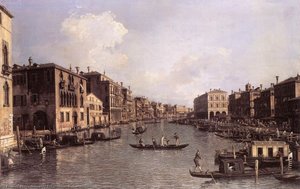
He spent much of his time documenting the specific textures of the Venetian landscape. In 1725, he painted The Stonemason's Yard, a work that shows his early skill in capturing architectural detail. He also recorded the movement of the water and the crowds during public events, such as the Regatta on the Grand Canal. His paintings were not merely records; they were careful observations of how light and shadow fall upon stone and water.
- Architectural Capriccio (1723)
- The Stonemason's Yard (1725)
- Regatta on the Grand Canal
The English Period and London Life
Between 1746 and 1756, Canaletto made several trips to England. During this time, he found a steady place among British collectors, aided significantly by the merchant and connoisseur Joseph "Consul" Smith. Smith’s influence helped secure a foothold for the artist within the circles of those who collected his views. While his eyes were often turned toward the architecture of Venice, his presence in England allowed him to document new landscapes and settings for a different kind of audience.
From 1749 to 1752, he lived in London, staying at 41 Beak Street in the Soho district. This period saw him moving through the city and its surroundings, capturing the specific light and structure of the English landscape. His work from these years reflects a shift in subject matter, moving away from the canals of his home toward the stone and greenery of the British countryside.
- Eton College (1746-1756)
Technique and Artistic Style
Canaletto’s approach moved away from the religious and mythological subjects favored by earlier Venetian painters. Instead, he turned his attention to the tangible reality of the streets, the water, and the stone of the cities he documented. His work often relied on a precise sense of perspective. The meticulous nature of his preparatory drawings has led some to suggest he used a camera obscura to achieve such topographical accuracy. He did not simply record a scene as a camera might; he manipulated his images to ensure they felt harmonious to the human eye, balancing the actual view with a sense of compositional order.
Beyond his oil paintings, he was an important printmaker who utilized the etching technique to spread his visual records. His ability to capture light and shadow was not merely about imitation, but about how light actually hits a surface. He observed how sunlight glints off the water and how it casts long shadows across a piazza, recreating these effects in his studio to build depth and dimension. This careful observation allowed him to construct a vision of Venice that felt both real and carefully arranged.
- The Stonemason's Yard
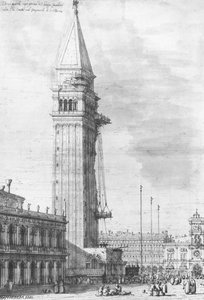
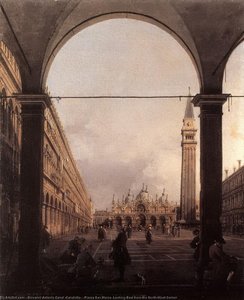
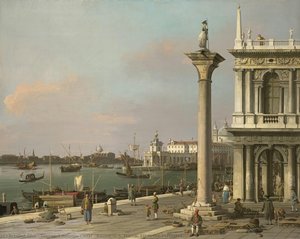
- Piazza San Marco: the Clocktower
- Eton College
Legacy and Where to See His Works
His presence remains felt in the collections of major institutions across Europe and beyond. In London, his hand is visible in the National Gallery and within the Royal Collection. These works offer a way to see the precise lines and light he captured during his time in Venice and his years in England. Many of his paintings have found permanent homes in the Gemäldegalerie in Dresden, adding to the weight of his influence on the way cities are documented.
Across the Atlantic, the National Gallery of Art in Washington holds his 1742 work, View of the Church and the Doge's Palace from the Procuratie Vecchie. This piece shows the way he handled the architecture and the atmosphere of the Venetian streets. His influence also extended to his family, as his nephew Bellotto followed his path, becoming an accomplished artist in his own right.
- The Stonemason's Yard
- Eton College
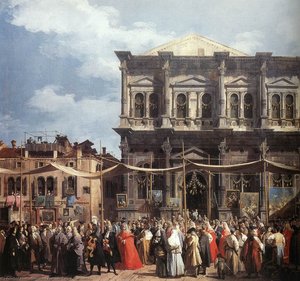
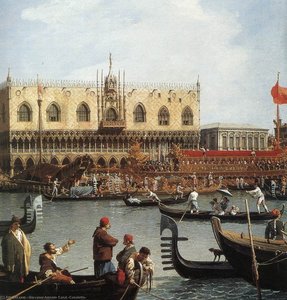
- Arrival of the French Ambassador in Venice (detail)
Questions & Answers
Where can I find statistics about Canaletto's works?
A Stats page exists for Canaletto, presenting statistics about the artist's artworks on this website.
How many artworks by Canaletto are available to browse?
You can browse 537 artworks by Canaletto on the All Artworks page.
Is there a 3D virtual tour of Canaletto's works?
The 3D Museum of Canaletto is a page that displays the artist's artworks in a virtual three-dimensional gallery.