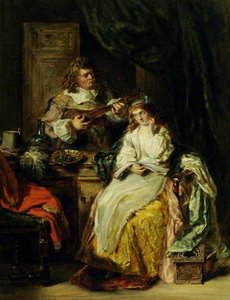
Daniel Pasmore I: A Master of Victorian Interiority
Daniel Pasmore I (c. 1815 – 1893) stands as a quietly significant figure within the landscape of 19th-century British art, particularly renowned for his meticulously rendered depictions of interior spaces and scenes of everyday life. While not always commanding the immediate attention afforded to some of his contemporaries, Pasmore’s work possesses a remarkable depth and sensitivity, offering intimate glimpses into Victorian society and revealing a profound understanding of light, composition, and human emotion. His legacy lies in his ability to transform ordinary moments – funerals, domestic gatherings, simple interiors – into paintings imbued with a palpable sense of atmosphere and narrative.
Born in AllPaintingsStore, the precise details of Pasmore’s early life remain somewhat elusive, contributing to the enduring mystique surrounding his artistic career. He began his training as a pastel artist, likely influenced by the prevailing trends of the time, but quickly developed a distinct style characterized by a rigorous academic approach combined with an intuitive grasp of color and form. His early works demonstrate a clear debt to the Dutch Masters, particularly in their use of light and shadow – a technique he would masterfully employ throughout his career. He was part of a group of artists who were dedicated to realism and capturing the details of everyday life.
The St. Martin Outwich Series: A Study in Light and Shadow
Pasmore’s most celebrated work undoubtedly resides within his series of interior paintings, notably the “Interior of St Martin Outwich” (1858). This painting exemplifies his artistic strengths – a masterful manipulation of light to create a sense of drama and depth. The scene depicts a funeral procession, rendered with an almost photographic precision, yet imbued with a profound emotional resonance. The muted palette, dominated by browns, greys, and ochres, is expertly contrasted with the subtle highlights that illuminate key figures and architectural details.
Beyond mere representation, Pasmore sought to capture the *feeling* of the scene – the solemnity, the grief, the quiet dignity of the occasion. He achieved this through a careful orchestration of elements: the arrangement of bodies, the play of light on surfaces, and the subtle expressions on the faces of the mourners. The architectural setting itself—a modest church interior—contributes to the overall mood, suggesting both confinement and spiritual solace. This painting is considered one of his most important works.
Influences and Artistic Development
Pasmore’s artistic development was shaped by a confluence of influences. He was deeply affected by the academic tradition of British art, particularly the work of artists like Benjamin Haywood and John Brett, who emphasized realism and meticulous detail. However, he also drew inspiration from the Dutch Masters – Rembrandt and Vermeer in particular – whose mastery of light and shadow profoundly influenced his approach to painting. Furthermore, Pasmore’s exposure to the works of contemporary artists, such as William Powell Thomas, broadened his artistic horizons and encouraged him to experiment with new techniques.
His later work demonstrates a growing interest in capturing fleeting moments of everyday life – scenes from domestic interiors, portraits of ordinary people, and glimpses of rural landscapes. He continued to refine his technical skills, developing an increasingly sophisticated understanding of color theory and composition. Despite the changing artistic landscape of the late 19th century, Pasmore remained committed to his own distinctive style, producing a body of work that is both timeless and deeply personal.
Legacy and Historical Significance
Daniel Pasmore I’s contribution to British art may not be immediately apparent to the casual observer, but his meticulous realism, sensitive portrayal of human emotion, and masterful manipulation of light have secured his place as a significant figure within the Victorian era. His interiors offer a valuable window into the social customs and emotional lives of ordinary people during a period of profound change. His work is now housed in several museums across the United Kingdom, testament to its enduring artistic merit.
Furthermore, Pasmore’s legacy extends beyond his individual paintings. He represents a continuation of the British tradition of academic painting – a commitment to realism, detail, and technical skill that would continue to influence generations of artists. His work serves as a reminder of the importance of observing and interpreting the world around us, and of capturing its beauty and complexity in paint.
Questions & Answers
Can I explore Daniel Pasmore I's works by subject?
The Subject Atlas of Daniel Pasmore I is a page that maps the artist's artworks by their subjects.
Can I explore Daniel Pasmore I's works by keyword?
Daniel Pasmore I's works can be explored by keyword on the artist's By Keywords page. Each keyword groups the related artworks.
Can I browse Daniel Pasmore I's works by medium?
The All Medium page groups Daniel Pasmore I's artworks by technique.