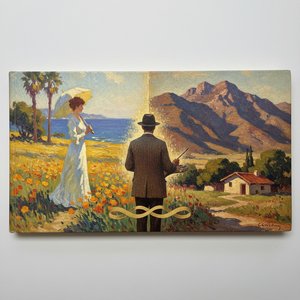
Elmer Wachtel: A California Impressionist
Early Life and Education
- Born: January 21, 1864, in Baltimore, Maryland.
- In 1882, Wachtel moved to California with his brother, settling in San Gabriel.
- He initially worked as a ranch hand and furniture store clerk while saving funds for art education.
- Self-taught beginnings: While largely self-taught, he briefly studied at the Art Students' League in New York and later at the Lambeth School of Art in London.
- Wachtel also pursued a musical career, playing violin for the Philharmonic Orchestra of Los Angeles.
Artistic Development and Style
- California Landscapes: Wachtel dedicated his artistic focus to capturing the beauty of California’s landscapes, diverging from the European scenes favored by many contemporaries.
- Impressionist Influences: His style is characterized by Impressionistic techniques – vibrant colors, textured brushstrokes, and a focus on light and atmosphere.
- He frequently worked en plein air, painting outdoors directly from nature to capture the immediacy of his surroundings.
- Common subjects included missions, valleys, coastal scenes, and depictions of rural life in Southern California.
Marriage and Life in Arroyo Seco
- In 1904, Wachtel married sculptor Marion Kavanagh.
- The couple resided in the Arroyo Seco region of Los Angeles, a thriving artistic community at the time.
- Their home became a gathering place for artists and intellectuals.
Major Works and Achievements
- Notable Paintings: Some of his most recognized works include “Convict Lake,” “Capistrano Mission,” “Valley Afternoon,” and numerous depictions of the San Juan Capistrano mission.
- His paintings are celebrated for their ability to evoke a sense of place and capture the unique character of California’s natural beauty.
- Wachtel's work contributed significantly to establishing a distinct California Impressionist style.
Historical Significance and Controversies
- World War I Informant: During World War I, Wachtel served as an informant for the U.S. Department of Justice.
- He reported alleged pro-German sentiments and antiwar statements made by fellow artists and militant socialists – a controversial role that reveals a complex aspect of his life.
- Legacy: Elmer Wachtel’s paintings provide valuable insights into the early 20th-century California landscape and artistic community.
- He died suddenly on August 31, 1929, while on a painting trip in Guadalajara, Mexico.
Questions & Answers
Where is Elmer Wachtel from?
Elmer Wachtel was born in United States of America.
How can I see every artwork made by Elmer Wachtel?
Every work by Elmer Wachtel on this website can be browsed from the artist's All Artworks page.
Where can I see Elmer Wachtel's artworks arranged by atmosphere?
Elmer Wachtel's works can be browsed by mood on the artist's Mood Room page, which arranges the artworks by their recorded moods.