Early Life, Family and Training
Frederick Arthur Bridgman enters the world on November 10, 1847, in Tuskegee, Alabama. He is born into the household of a physician, a background that places an early emphasis on formal education. The trajectory of his life shifts when his father dies in 1850, prompting his mother to move the family north to New York City.
The young Frederick Arthur Bridgman begins his professional life not in a studio, but at a drafting table. Between 1864 and 1865, he works as a draughtsman for the American Bank Note Company. This period of technical labor provides a foundation in precision. While managing these duties, he pursues formal instruction at the Brooklyn Art Association and the National Academy of Design. These institutions provide the academic framework that will eventually lead him toward Europe.
The Parisian Period and Academic Training
Paris beckons in 1866. Moving from the American Bank Note Company to the heart of the French art world, Bridgman enters the studio of Jean-Léon Gérôme. This encounter shifts his trajectory. Under Gérôme, the influence of precise draftsmanship and smooth finishes begins to take hold. The academic rigor of the studio provides the technical foundation for his emerging interest in Middle Eastern themes. From 1867 to 1870, he formalizes this training at the École des Beaux-Arts, Paris.
The training is intense. He absorbs the methods of the academic tradition, focusing on the meticulous rendering of form and light. This period in France establishes Paris as his permanent headquarters. While his technical skills sharpen in the atelier, his professional standing grows back in the United States. By 1874, he is recognized as an Associate member of the National Academy of Design.
Travels and North African Inspiration
The quietude of the Parisian studio gives way to the heat of North Africa. Between 1872 and 1874, Bridgman moves through Morocco, Tunisia, Algeria, and Egypt. He does not merely observe; he documents. He travels along the Nile, pushing south toward Abu Simbel. The landscape dictates a new visual language. During these excursions, he executes approximately 300 sketches, capturing the immediate reality of the region to serve as the foundation for his future oils.
The sketches provide the raw material for his fascination with the Maghreb and the Nile. He focuses on the street life of Cairo and the architectural details of Islamic monuments. This period of intense observation shifts his focus toward the specificities of Middle Eastern and North African settings. The light and the social structures he encounters in these territories become the primary subjects of his career.
- A Street in Algeria
- Horse Market at Cairo
- In a Village, El Biar, Algeria
Technique and Artistic Style
The influence of Jean-Léon Gérôme remains visible in the foundation of Bridgman's method. From his time in the Parisian atelier, he carries a commitment to precise draftsmanship and smooth finishes. These academic rigors provided the structural discipline required to render the complex architecture and social rituals of the Near East. His early training focused on this level of technical accuracy, ensuring that every line and contour held weight.
However, a shift occurs as his brushwork evolves. Bridgman moves toward a more naturalistic aesthetic that breaks from the rigid stillness of pure academicism. He begins to favor bright colors and a more painterly brushwork, allowing light to interact with surfaces in a less controlled, more atmospheric way. This transition allows him to capture the heat and texture of North African and Near Eastern settings with a sense of immediacy. The precision of his draftsmanship meets a more fluid application of paint, creating a tension between formal structure and the organic movement of light and shadow.
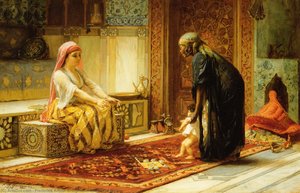
His compositions often center on Orientalist genre scenes, where the focus lies on the intersection of human activity and specific regional environments. In works such as The Siesta (1878), the interplay of textures—from soft fabrics to verdant foliage—demonstrates this balance of academic detail and painterly expression. He uses color not merely to define form, but to establish the specific atmosphere of the Maghreb or the Nile.
Major Successes and Key Works
The year 1877 marks a definitive peak in Bridgman's career. His large-scale composition, The Funeral of a Mummy on the Nile, enters the Paris Salon and immediately commands attention. The work secures him the Cross of the Legion of Honor in 1878. This recognition signals his arrival as a major force in academic painting. By 1881, his professional standing in the United States is solidified when he is elected a full member of the National Academy of Design.
His influence extends across the Atlantic. In 1890, he brings a massive collection of over 400 pictures to New York's 5th Avenue galleries. This exhibition underscores his commercial and critical dominance. The French state continues to honor his contributions, eventually naming him an Officer of the Légion d'Honneur in 1907. His ability to translate North African and Near Eastern subjects into highly detailed, academically precise canvases maintains his prominence for decades.
- The Funeral of a Mummy on the Nile (1877)
- An Interesting Game (1881)
- The Siesta (1878)
- In a Village, El Biar, Algeria (1889)
Later Years and Death
The personal landscape of Bridgman's life shifts in 1904 when he remarries. This period follows the loss of his first wife to neurological illness. As the decades progress, the focus of his life moves away from the bustling art centers of Paris and New York. Following the conclusion of World War I, he seeks a quieter existence, retiring to the region of Normandy.
The end comes in Rouen, France. He dies there on January 13, 1928. Because his auction supply remains thin, his works are primarily handled on the secondary market. This scarcity maintains a specific rhythm for his presence in the art market, as his pieces do not appear for sale with the frequency of his contemporaries.
Where to See the Works Today
His canvases reside in several major institutions across the United States. The Smithsonian American Art Museum maintains a presence in his legacy, holding works that reflect his academic training. In the Midwest, the Art Institute of Chicago preserves his output, where his detailed compositions remain accessible to the public. These collections provide a physical connection to the scenes he observed during his travels through North Africa and the Near East.
The geographic reach of his work extends to the South and the East Coast. The Speed Art Museum in Louisville, Kentucky, holds pieces that demonstrate his ability to render light and texture. Meanwhile, the Corcoran Gallery maintains works that highlight his technical precision. Visitors seeking to encounter his specific depictions of social and domestic life can find them within these varied museum settings.
- An Interesting Game (1881)
- The Siesta (1878)
- In a Village, El Biar, Algeria (1889)
Questions & Answers
How popular are Frederick Arthur Bridgman's artworks?
The Stats page of Frederick Arthur Bridgman presents statistics computed from the artist's artworks listed on this website.
Is there a 3D virtual tour of Frederick Arthur Bridgman's works?
Frederick Arthur Bridgman's artworks can be seen in a 3D gallery on the artist's 3D Museum page.
Where are Frederick Arthur Bridgman's artworks grouped by art movement?
The movements Frederick Arthur Bridgman worked in can be seen on the artist's All Movements page, which groups the artworks by movement.