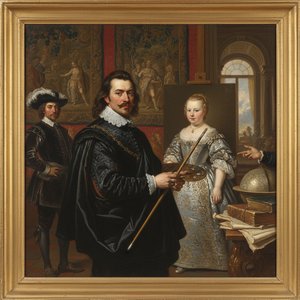
Gilbert Stuart: A Life in Portraiture
- Born: December 3, 1755, Saunderstown, Rhode Island
- Died: July 9, 1828, Boston, Massachusetts
- Nationality: American
- Movement: Neoclassicism
- Known for: Portraiture, particularly portraits of prominent figures in early American history.
Early Life and Training
- Gilbert Stuart was born into a family with Scottish roots; his father, also named Gilbert, was an inventor who established the first snuff mill in Rhode Island.
- His artistic talent emerged at a young age, demonstrating skill even as a child.
- At 14, he painted "Dr. Hunter's Spaniels," showcasing early promise.
- He traveled to Scotland around 1771 to study under Cosmo Alexander, but returned after Alexander’s death in 1775.
- Further training occurred in London with Benjamin West, a prominent American painter residing in England, from 1775 to 1780. This period was crucial for developing his artistic style and gaining recognition within the Royal Academy.
Artistic Career and Major Works
- Stuart's career faced challenges during the American Revolution, prompting him to relocate to England in 1775.
- He achieved early success with "The Skater" (1782), a portrait that established his reputation.
- His most famous work is the unfinished portrait of George Washington, known as the Athenaeum Portrait (begun in 1796). This image has become iconic, appearing on U.S. currency and postage stamps. Stuart produced numerous copies of this portrait for patrons across America and Europe.
- He painted portraits of several other prominent figures including John Adams, Thomas Jefferson, James Madison, and many members of the Federalist elite.
- Stuart’s style was characterized by a Neoclassical approach, emphasizing realism and capturing the likeness and character of his subjects. He often employed a dramatic use of light and shadow to enhance the portraits' impact.
Influences and Development
- Cosmo Alexander provided early training in technique and composition.
- Benjamin West’s influence was significant, shaping Stuart’s understanding of portraiture and artistic principles.
- The Neoclassical movement, with its emphasis on classical forms and ideals, heavily influenced his style.
- Stuart's own observations and interactions with his subjects contributed to the psychological depth and realism in his portraits. He aimed to capture not just a likeness but also the character and personality of those he painted.
Historical Significance and Legacy
- Gilbert Stuart is considered one of America’s foremost portraitists, playing a vital role in documenting the early years of the United States.
- The Athenaeum Portrait of George Washington has become an enduring symbol of American identity and leadership.
- His portraits provide valuable historical insights into the lives and appearances of prominent figures from the late 18th and early 19th centuries.
- Stuart’s work is represented in major museums across the United States and Europe, ensuring his legacy continues to be appreciated by generations.
- He established a distinct American style of portraiture that blended European techniques with uniquely American sensibilities.
Questions & Answers
Is there an overview of all the subjects Gilbert Stuart painted?
The Subject Atlas page maps Gilbert Stuart's artworks by subject.
What are the birth city and country of Gilbert Stuart?
Gilbert Stuart was born in North Kingstown, in United States.
Where is Gilbert Stuart from?
Gilbert Stuart was born in United States.