Early Life, Family and Training
Born on 2 May 1811 in Rennes, Ille-et-Vilaine, France, Henri Delaborde entered a world shaped by the distinctions of his lineage. He was the son of Count Henri-François Delaborde and Julie, née Guillaume, and grew up as the third of four children in their household. While his family roots were firmly planted in the nobility, his own path was not initially destined for the courtroom or the halls of governance. He began his education with the intention of studying law, spending time at the Bourbon and Charlemagne lycées in Paris to prepare for a legal career.
However, a different calling soon took hold of his spirit. The precocious talent he possessed for the visual arts proved too strong to ignore, leading him to abandon his legal studies in favor of the brush and the palette. This decision redirected his life toward the studios of Paris, where he sought to master the disciplined techniques of the age. Between 1829 and 1834, he entered the studio of the painter Paul Delaroche, a period of intense training that would define his technical foundation. Under this guidance, Henri Delaborde learned to navigate the complexities of composition and form, preparing himself for the rigorous demands of the academic tradition.
Artistic Career and Commissions
The artist first stepped into the public eye at the Paris Salon in 1836, presenting works that focused on the weight of history and the solemnity of religious life. His early years were marked by a steady pursuit of these grand themes, seeking to capture the gravity of sacred narratives through a disciplined, classical lens. This dedication to the traditional modes of painting eventually caught the attention of the state, which saw in his hand a capacity for large-scale storytelling. He was subsequently commissioned to create several history paintings intended for the Musée d’Impérial de Versailles, tasks that required both technical precision and a deep understanding of historical composition.
His ambitions extended beyond the confines of canvas and into the very architecture of the faith. He was entrusted with the creation of frescoes for the Saint Clotilde Basilica in Paris, a project that demanded a mastery of the difficult fresco technique to decorate such a significant sacred space. These works allowed him to translate his academic training into a permanent, monumental form. While his brush moved across walls and canvases, his professional life also became deeply entwined with the preservation of the arts. From 1855 until 1885, he held the position of Conservator of the department of prints at the National Library in Paris, a role that placed him at the heart of the city's artistic administration.
Key Works and Notable Paintings
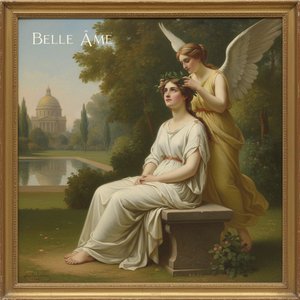
In the early years of his career, Delaborde sought to establish his presence within the competitive halls of the Paris Salon. He turned his brush toward the heavy weight of history and the solemnity of faith, producing works that sought to capture the gravity of the human condition. His 1836 painting, Hagar in the Desert, now held in the Musée des Beaux-Arts de Dijon, signaled his ability to handle profound biblical narratives. This was followed by St. Augustine in 1837, a work that demonstrated his command over religious subject matter. That same year, he produced L’Arrestation du Comte Ugolin, a piece that drew favorable attention from his peers during its exhibition.
As his reputation grew, he moved toward more expansive and complex historical compositions. He was commissioned by the state to create significant works for the Musée d’Impérial de Versailles, including a large-scale depiction of the crusaders, Les Croisés, commandés par Jean de Brienne, allèrent mettre le siége devant Damiette, painted in 1839. His ambition for grand narrative was further realized in 1844 with Knights of the Order of St. John of Jerusalem Restoring Religion in Armenia in 1347, a work that required a meticulous eye for detail to reconstruct the atmosphere of a bygone era. Even in his more intimate or devotional studies, such as Le Christ acceptant son supplice, his commitment to the classical tradition remained evident.
Literary and Scholarly Contributions
Beyond the canvas, his mind turned toward the preservation of the academic classical tradition, acting as a guardian for the principles he had practiced. He spent many decades serving as the Perpetual Secretary of the Académie des Beaux-Arts, a position that allowed him to influence the very discourse of French art. His presence in the halls of the Academy was marked by a deep commitment to the standards of his training, ensuring that the discipline of the past remained a guiding light for the artists of his era.
His pen was as active as his brush, and he sought to codify the truths of beauty through extensive writing. In 1864, he published Études sur les beaux-arts en France et en Italie, a work that reflected his deep interest in the artistic currents of both his homeland and the Italian masters. He continued this scholarly pursuit in 1870 with Ingres: sa vie, ses travaux, sa doctrine, a text that examined the life and methods of a significant figure in the tradition he so dearly defended. Through these volumes, he sought to explain the logic of form and the importance of historical continuity.
Later in his life, his curiosity led him to the intricate world of printmaking. He turned his attention to the technical and historical aspects of the medium, producing La gravure in 1882. This interest was not merely a passing fancy, as he followed this with La gravure en Italie in 1883. As a curator and critic, he moved through the libraries and galleries with a scholar's precision, leaving behind a body of writing that sought to protect the integrity of classical aesthetics against the shifting tides of modern experimentation.
Questions & Answers
What aliases or alternate names does Henri Delaborde have?
Henri Delaborde appears under the alternate names Henri Borde, Henri Delaborde (vicomte), Henri de la Borde, Henri de Laborde, Count Henri Delaborde, Paris.
How did Henri Delaborde's art evolve over time?
A chronological account of Henri Delaborde's work is available on the artist's Chronicle page, where the artworks pass in order of creation, chapter by chapter.
Where can I see Henri Delaborde's artworks arranged by atmosphere?
Henri Delaborde's works can be browsed by mood on the artist's Mood Room page, which arranges the artworks by their recorded moods.