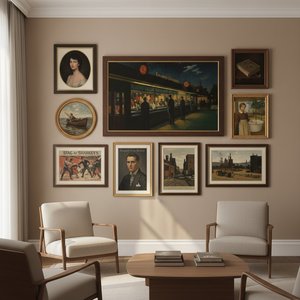
The Soul of the Scottish Scene: The Life and Art of Henry Wright Kerr
Born in the historic heart of Edinburgh in 1857, Henry Wright Kerr emerged as a painter whose brush possessed a rare ability to capture both the physical likeness and the inner spirit of his subjects. The son of John Kerr, a respected solicitor, and Elizabeth Thomson, Kerr’s early years were steeped in an environment that valued both intellect and the arts. His formative education at Banff Academy provided the foundational discipline required for a lifetime of mastery, where he studied alongside contemporaries such as James Matthews Duncan. Before fully committing to the easel, Kerr experienced the rigors of military service in the Royal Artillery between 1879 and 1883, an interval that perhaps contributed to the disciplined precision later seen in his anatomical accuracy and compositional strength.
Upon returning to Edinburgh, Kerr’s professional journey took a pragmatic turn through his work as a commercial artist for the Leith Shipping Company. This period of maritime-related employment was far from a distraction; rather, it served to broaden his visual vocabulary, exposing him to diverse landscapes and the shifting qualities of light over water. It was during this era that he began to transition from the charming, character-driven genre scenes—reminiscent of Wilkie Collins—toward the profound depth of portraiture. His artistic evolution was deeply shaped by his time in Holland, where the luminous, tonalist approach of the Hague School left an indelible mark on his technique. He learned to eschew flamboyant color in favor of subtle gradations, allowing light to emerge from shadows with a quiet, breathing intensity.
A Master of Character and Light
Kerr’s oeuvre is a testament to his versatility, spanning the delicate transparency of watercolor to the rich, textured weight of oil on canvas. He became particularly renowned for his ability to render "characterful" subjects, most notably elderly gentlemen whose faces served as maps of lived experience. His portraits were never merely superficial likenesses; they were psychological studies. Whether depicting the scholarly Joseph Anderson or the dignified Archibald Kennedy, Kerr utilized a sophisticated tonal palette to evoke authority, wisdom, and even a sense of melancholy. This skill extended to his landscapes, where the Scottish scenery was treated with a sympathetic eye, capturing the atmospheric moods of his homeland with an almost tactile realism.
Beyond the canvas, Kerr’s influence permeated the literary and academic circles of his time. He was a successful book illustrator, lending his visual storytelling to works such as:
- Dean Ramsay’s "Scottish Life and Character"
- Mitford’s "Annals of the Parish"
- G.A. Birmingham’s "The Lighter Side of Irish Life"
- Galt’s "The Last of the Lairds"
His dedication to his craft earned him significant institutional recognition, including election as a member of the Royal Scottish Society of Painters in Watercolour (RSW) and prestigious roles within the Royal Scottish Academy (RSA), where he served as Deputy President during the 1923-24 period. His work remains a vital part of the Scottish artistic canon, preserved in esteemed collections such as the National Galleries of Scotland and the City of Edinburgh Collection.
Legacy and Historical Significance
As the twentieth century progressed, Kerr’s style remained a steadfast bridge between the classical traditions of his mentors and the emerging sensibilities of a modernizing world. While he embraced the subtle impressionistic touches that characterized late 19th-century art, he never abandoned the fundamental principles of composition and anatomical truth instilled in him by John Holloway. His ability to act as a "sympathetic recorder" of Scottish life ensured that his paintings serve not only as art but as historical documents of a vanishing era of social character.
When Henry Wright Kerr passed away in Edinburgh in 1936, he left behind a legacy defined by light, dignity, and an unwavering devotion to the truth of the human countenance. His life’s work continues to resonate with those who seek the quiet beauty found in the nuances of shadow and the enduring strength of a well-told visual story.
Questions & Answers
Is there a 3D virtual tour of Henry Wright Kerr's works?
A virtual visit is possible: the 3D Museum page of Henry Wright Kerr presents the artist's works in a three-dimensional gallery.
What other names is Henry Wright Kerr known by?
Henry Wright Kerr is also known as Fergus Gordon Thomson Kerr.
Where can I see the color profile of Henry Wright Kerr's work?
The color profile of Henry Wright Kerr's work is shown on the artist's Palette Genome page.