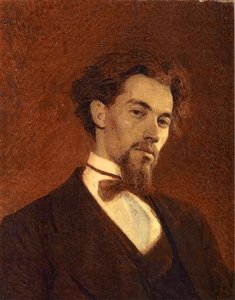
The Soul of Russian Realism: The Life and Legacy of Ivan Kramskoy
Ivan Nikolaevich Kramskoy, born on May 27, 1837, in the quiet town of Ostrogozhsk, stands as a monumental figure within the landscape of Russian art history. His life was defined by an intellectual fervor and an unwavering dedication to artistic principles rooted in social realism, leaving an indelible imprint on both his contemporaries and subsequent generations. Growing up in Voronezh Province, Kramskoy’s early years were shaped by an upbringing steeped in intellectual curiosity and a profound engagement with the burgeoning ideas of Russian revolutionary democracy. Influenced by the radical thinkers of his era, such as Chernyshevsky and Herzen, he embraced the conviction that art possessed a moral obligation—a duty to reflect truthfully upon society and champion its betterment.
This deep-seated belief in the transformative power of art propelled him toward the St. Petersburg Academy of Arts, yet it was there that his rebellious spirit truly ignited. Kramskoy famously spearheaded the “Revolt of Fourteen,” a historic student uprising against the academy’s restrictive and outdated artistic standards. This act of defiance led to his expulsion, but rather than stifling his talent, it solidified his commitment to independent expression. Under the guidance of mentors like Mikhail Borisovich Tulinov, who recognized his burgeoning genius, Kramskoy began to forge a path that would eventually lead him to become a cornerstone of the Peredvizhniki, or the Wanderers movement.
A Visionary of the Peredvizhniki Movement
The formation of the Peredvizhniki movement marked a decisive intersection in Kramskoy’s artistic trajectory. Alongside luminaries like Ilya Repin, he sought to reject official patronage and the didacticism of the Imperial Academy in favor of a more democratic and socially conscious approach to painting. His work became a vessel for social commentary, capturing the psychological depth of the Russian people and the stark realities of their existence. Kramsk_oy was not merely a painter but a profound art critic and leader, shaping the aesthetic discourse of his time through his ability to blend technical mastery with intense emotional resonance.
His repertoire is characterized by a remarkable versatility that ranges from the deeply introspective to the symbolically grand:
- Self-Portraiture: In works such as Self-Portrait 1, Kramskoy utilizes a somber and introspective Realist style. The profound depth of his gaze invites viewers into a soulful encounter with the artist's own psyche, capturing the weight of his intellectual burdens.
- Religious and Symbolic Mastery: His masterpiece, Christ in the Desert (1872), serves as a poignant exploration of solitude and faith. Through dramatic lighting and profound symbolism, he depicts the spiritual struggle of Jesus, creating a work that remains a cornerstone of Russian art.
- Romantic Realism: In Water Nymphs (1871), Kramskoy demonstrates his ability to capture serene figures and nature through rich colors and a softer, more romanticized lens of realism, proving that his social consciousness could coexist with aesthetic beauty.
Historical Significance and Enduring Impact
Kramskoy’s contribution to art extends far beyond the canvas. As an organizer and critic, he provided the intellectual scaffolding upon which Russian Realism was built. He believed that the artist must be a witness to their time, a role he fulfilled with unparalleled integrity. His ability to navigate the complexities of political upheaval while maintaining a focus on the human condition allowed his work to transcend the immediate politics of the 19th century.
The legacy of Ivan Nikolaevich Kramskoy is found in the very fabric of Russian identity. By championing the truth of the common experience and challenging the elitism of academic institutions, he helped democratize art, making it a tool for national reflection. Today, his works continue to captivate audiences worldwide, offering a window into a period of intense spiritual and social transformation. His life remains a testament to the idea that art, when wielded with courage and truth, can serve as a powerful catalyst for change.