The Genesis of a Visionary
In the heart of Baghdad’s Fadhl neighborhood, a profound artistic consciousness began to stir within the young Khadim Hayder. His journey was not merely one of technical acquisition but of a deep-seated, intuitive rebellion against the mundane. This spirit was famously ignited during a childhood encounter with the artist Mohammad Saleh Zaki; when tasked with painting a fish, Hayder refused the conventional, choosing instead to depict it at a diagonal—a defiant assertion that the subject was not dead yet. This early spark of symbolic defiance would become the heartbeat of his entire oeuvre. Educated in both Arabic Literature and Fine Arts, Hayder possessed a rare duality, allowing him to weave the rhythmic complexities of poetry into the visual language of painting, creating a bridge between the written word and the painted image.
A Tapestry of Myth and Modernity
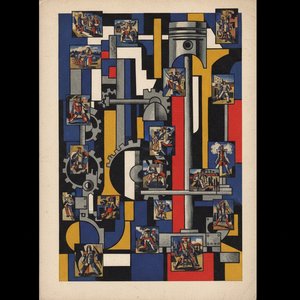
Hayder’s mature work represents a masterful synthesis of Iraq's ancient soul and the avant-garde movements of the twentieth century. He did not merely paint; he excavated history, drawing heavily from the Epic of Gilgamesh and the poignant, transformative narratives of the Battle of Karbala. By integrating these primordial motifs with the stylistic textures of Surrealism and Expressionism, he transformed the canvas into a site of ritual and social commentary. His paintings, such as the evocative The Tigris River, serve as more than mere landscapes; they are poetic allegories exploring themes of national identity, social justice, and the enduring struggle for human dignity. Through his use of abstract symbolism, Hayder captured the spiritual weight of religious rites and the historical echoes of Mesopotamia, making the ancient feel urgently contemporary.
The Architect of Iraqi Modernism
Beyond the canvas, Hayder was a foundational pillar of the Iraqi art community, a multifaceted creator whose influence extended into theatre design, printmaking, and pedagogy. As a member of the influential Baghdad Modern Art Group and the Pioneers, he helped shape the very trajectory of modern Iraqi aesthetics. His commitment to nurturing future generations was evident in his leadership roles at the Academy of Fine Arts, where he founded the Design Department and served as Head of the Plastic Arts Department. His legacy is defined by this incredible breadth:
- The Educator: A dedicated teacher who shaped the curriculum of Iraqi fine arts.
- The Designer: An innovator in theatre set design, bringing visual drama to the stage.
- The Poet: A literary voice that provided the conceptual depth for his visual explorations.
Questions & Answers
Can I explore Khadim Hayder's works by color spectrum?
The Spectral Index page organizes Khadim Hayder's artworks by color.
What moods do Khadim Hayder's artworks express?
The Mood Room of Khadim Hayder is a page that arranges the artist's artworks by mood.
In which historical period did Khadim Hayder work?
Khadim Hayder worked in the Modern period. The period situates the artist's activity in history.