Martino Altomonte: A Life in Baroque Art
- Born: Naples, Italy (1657)
- Died: 1745
- Other Names: Johann Martin Hohenberg
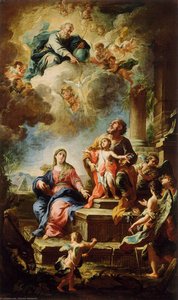
Martino Altomonte, born Johann Martin Hohenberg, was a significant Italian Baroque painter of Austrian descent. His career spanned Poland and Austria, leaving behind a legacy of vibrant battle scenes, royal portraits, and impressive altarpieces that reflect the artistic currents of his time.
Early Life and Training
- Family Background: Altomonte’s father, Michael Hohenberg, emigrated from Tyrol to Naples.
- Apprenticeship in Rome: At the age of 15, he was apprenticed to Giovanni Battista Gaulli (Baciccio) in Rome, a leading figure in monumental Baroque painting.
- Further Studies: He later trained under Carlo Maratti, another prominent Roman painter known for his classical influences.
- Name Change: In 1684, upon becoming the court painter of John III Sobieski, King of Poland, he adopted the name Altomonte.
Career in Poland and Artistic Development
- Royal Court Painter: As the court painter to King John III Sobieski, Altomonte primarily focused on battle pieces (notably depicting the Siege of Vienna) and royal portraits.
- Religious Works: He also produced numerous altarpieces, though many have not survived.
- Early Style: The surviving "Sacrifice of Abraham" (Tarnów Diocese Museum) demonstrates Altomonte’s early style as a “follower of Neapolitan chiaroscuro painting.”
- Son's Career: His son, Bartolomeo Altomonte, also became a painter, born in 1694.
Vienna and the Development of Viennese Baroque
- Move to Vienna: Around 1699-1702, Altomonte relocated to Vienna, where he spent the remainder of his career.
- Academic Recognition: In 1707, he was appointed a teaching member of the Akademie der bildenden Künste (Academy of Fine Arts).
- Neue Favorita Commission: This likely led to a commission to decorate the Neue Favorita, an annex of Schloss Augarten.
- Synthesis of Styles: Altomonte’s oil paintings during this period reveal a unique style blending Neapolitan chiaroscuro with Venetian pastel tones, contributing significantly to the development of Viennese Baroque painting.
- Notable Works in Vienna: He created ceiling paintings for the Archbishop's Residenz at Salzburg (1709-10), altar paintings for the Dorotheerkirche (1713), the Peterskirche and Stephansdom (both 1714), the parish church in Krems, and the Deutschordenskirche in Ljubljana (both 1715).
- Further Commissions: He painted ceiling frescoes in the Lower Belvedere in Vienna (1716).
Major Works and Legacy
- Alexander Cutting the Gordian Knot (1708) – Demonstrates his skill in depicting dramatic historical scenes.
- The Ascension of Mary (1737) – A significant high altarpiece at the Stiftskirche Wilhering, showcasing his religious artistry.
- High Altarpiece (1738–40) of the Ursuline Church dedicated to St. Michael in Linz - Another example of his impressive altar work.
- The Apotheosis of St. Leopold (ca. 1750) – A later work reflecting his continued artistic evolution.
- Influence: Altomonte is recognized as a pioneer of Viennese Baroque painting, bridging the gap between Italian and Austrian artistic traditions. His ability to combine Neapolitan drama with Venetian color created a distinctive style that influenced subsequent generations of artists.
Questions & Answers
Is there a complete list of Martino Altomonte's artworks?
Every work by Martino Altomonte on this website can be browsed from the artist's All Artworks page.
Is there a chronological account of Martino Altomonte?
A chronological account of Martino Altomonte's work is available on the artist's Chronicle page, where the artworks pass in order of creation, chapter by chapter.
Can I browse Martino Altomonte's works by movement?
The All Movements page groups Martino Altomonte's artworks by art movement.