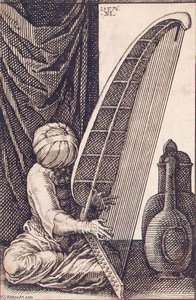
Melchior Lorck: A Life Bridging Renaissance Art and Ottoman Encounters
- Born: Flensburg, Germany (1526/27)
- Died: Copenhagen, Denmark (1583)
- Nationality: Danish-German
- Known For: Renaissance painter, draughtsman, and printmaker; detailed visual record of 16th-century Turkey.
Early Life and Training
- Born in Flensburg, Schleswig (present-day Germany), Lorck came from a family with ties to the Reformation movement.
- Around 1549, he received a four-year travel stipend from King Christian III of Denmark, enabling him to study art across Europe.
- Early training likely involved apprenticeship with a goldsmith in Lübeck.
- During his travels, Lorck demonstrated early artistic skill, producing engravings influenced by artists like Heinrich Aldegrever and paying homage to Albrecht Dürer.
The Ottoman Experience: A Unique Visual Record
- In 1555, Lorck joined the Imperial embassy led by Ogier Gheselin Busbecq to the court of Sultan Suleiman the Magnificent in Constantinople (Istanbul).
- This pivotal experience shaped his career and legacy. He spent approximately one and a half years within the Ottoman capital.
- Lorck meticulously documented Turkish life, customs, architecture, military practices, and portraits of key figures like Sultan Suleiman and Isma'il, the Persian envoy.
- His drawings and engravings provide an unparalleled visual record of 16th-century Ottoman society, a unique source for historians and art scholars.
- Notable works from this period include the monumental "Prospect of Constantinople," a detailed panoramic view of the city, and the series of prints known as “The Turkish Publication.”
Artistic Style and Influences
- Lorck's style reflects the influence of the Northern Renaissance, particularly German masters like Dürer.
- His work demonstrates a keen observational skill and attention to detail, evident in his precise renderings of architecture, costumes, and portraits.
- He skillfully employed engraving techniques, creating intricate and expressive prints.
- Lorck's topographic drawings, such as the "Prospect of Constantinople," foreshadowed later developments in landscape art and cartography.
Later Career and Legacy
- After returning to Europe in 1559, Lorck worked in Vienna, producing engravings of antique monuments and portraits.
- He served briefly as a cartographer for the Hamburg city council, creating a large-scale map of the Elbe River.
- Lorck's "Turkish Publication," though not published during his lifetime, was eventually released in 1626, showcasing his extensive documentation of Ottoman life.
- He is considered the first Danish artist with a substantial biography and body of work attributable to him.
- His detailed visual record of Turkey remains invaluable for understanding 16th-century Ottoman culture and represents a significant contribution to Renaissance art and cartography. He is recognized as a precursor to later traveling artists and visual reporters.
Questions & Answers
Is there a 3D virtual tour of Melchior Lorck's works?
Melchior Lorck's artworks can be seen in a 3D gallery on the artist's 3D Museum page.
What are the birth city and country of Melchior Lorck?
Melchior Lorck was born in Flensburg, in Germany.
In which movements did Melchior Lorck work?
Melchior Lorck's works can be browsed by movement on the artist's All Movements page.