The Dawn of Netherlandish Realism: The Legacy of Robert Campin
In the misty, burgeoning landscape of the fifteenth-century Low Countries, a transformative vision began to take shape, forever altering the trajectory of Western art. At the heart of this revolution stood Robert Campin, an artist whose name is now inextricably linked with the Master of Flémalle. Born around 1375 in Valenciennes, France, Campin emerged from a period of transition, bridging the gap between the stylized elegance of the International Gothic and the profound, tactile realism that would define the Northern Renaissance. While much of his early life remains veiled by the shadows of history, his presence in Tournai for over three decades established him as a titan of the Flemish tradition, a master whose brushwork breathed life into the divine through the lens of the everyday.
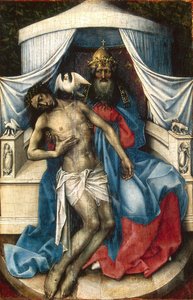
The evolution of Campin’s artistry was not merely a personal journey but a technical conquest. He was among the earliest and most daring pioneers to embrace the medium of oil painting, moving away from the flatter, more opaque qualities of tempera. This mastery of oil allowed him to achieve an unprecedented luminosity, capturing the way light dances across polished brass, settles into the heavy folds of velvet, or glimmers upon a single drop of water. Through this innovation, Campin did not just paint subjects; he sculpted them with light and shadow, creating a sense of weight and presence that felt startlingly immediate to his contemporary viewers.
Symbolism Within the Domestic Sphere
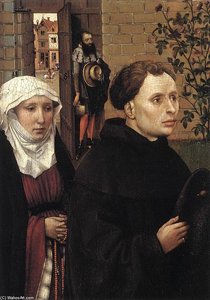
What truly distinguishes the work of Robert Campin is his ability to weave the sacred into the seemingly mundane. To look upon a masterpiece like the Mérode Altarpiece is to enter a world where every object carries a whispered prayer. In his hands, a domestic interior—a quiet room filled with the familiar clutter of middle-class life—becomes a stage for profound theological truths. This technique, often referred to as disguised symbolism, invites the viewer to look closer, finding the miraculous hidden within the ordinary.
In these sacred narratives, nothing is accidental:
- The Annunciation: Within a contemporary Flemish parlor, the arrival of the Angel Gabriel is marked by subtle cues, where light streaming through a window serves as a metaphor for divine grace.
- Everyday Objects: A simple basin of water or a clean towel represents purity, while the flickering candle or the humble flora in a vase speaks to the omnipresence of the Holy Spirit.
- Texture and Detail: The meticulous rendering of wooden furniture, heavy drapery, and ceramic vessels grounds the spiritual event in a tangible, human reality that resonates with emotional depth.
A Lasting Influence on the Northern Renaissance
The historical significance of Robert Campin cannot be overstated. Alongside contemporaries like Jan van Eyck, he laid the foundational stones for the development of Early Netherlandish painting. While Van Eyck is often celebrated for his ethereal perfection, Campin provided a more robust, grounded realism—a style that emphasized the physical presence and psychological weight of his figures. His influence rippled through the workshops of Tournai and beyond, shaping the next generation of painters, including Jacques Daret, who carried forward the traditions of Flemish precision.
Though some of his works were once attributed to the anonymous "Master of Flémalle," modern scholarship has largely unified these identities, recognizing the singular, powerful voice behind the panels. His ability to marry the spiritual with the material created a visual language that would dominate Northern Europe for decades. Today, when we gaze upon his surviving altarpieces and devotional panels, we are not merely looking at relics of the past; we are witnessing the very moment when art learned to see the world with new, unblinking eyes, finding the eternal within the ephemeral beauty of human existence.