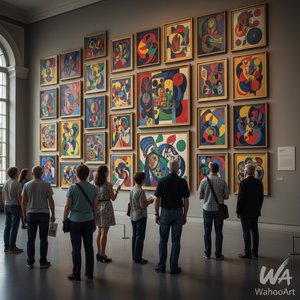
The Architecture of Abstraction: The Life and Vision of Tomma Abts
In the quiet, deliberate world of contemporary abstraction, few voices resonate with as much structural clarity and intellectual depth as Tomma Abts. Born in Kiel, Germany, in 1967, Abts emerged from a background steeped in academic rigor—the daughter of a primary school teacher and a physician—a lineage that perhaps preordained her fascination with the underlying structures of language and form. Her journey into the heart of minimalism began in earnest during her studies at the Hochschule der Künste Berlin between 1989 and 1995, where she cultivated a practice that would eventually defy the loud, emotive impulses of the neo-expressionist movement dominating the era. Moving to London in 1995, she established herself within the vibrant creative pulse of Clerkenwell, carving out a space where the canvas serves not as a window to a landscape, but as a site for pure, geometric discovery.
The magic of Abts’ work lies in its profound rejection of premeditation. Unlike many of her contemporaries who approach the canvas with a fixed destination in mind, Abts begins each piece with nothing more than the physical dimensions of the support and the tactile potential of her materials. This method allows for an organic, almost evolutionary development of form, where shapes emerge through a process of trial, error, and intuitive layering. Her technique is a meticulous dance of acrylic and oil paints, building up complex, interlocking geometries that seem to vibrate with a quiet, internal logic. There is no representational anchor here; no landscape to ground the eye or portrait to evoke empathy. Instead, the viewer is invited into a purely cerebral experience, navigating a labyrinth of lines and planes that exist solely for their own sake.
A Language of Names and Numbers
One of the most enchanting idiosyncrasies of Abts’ practice is her unique approach to nomenclature. In a departure from the traditional descriptive titles of abstract art, she frequently names her works using German first names. This choice creates a whimsical, almost humanizing connection to otherwise austere geometric compositions, imbuing the mathematical precision of the paint with a sense of character and identity. It suggests that each painting is not merely an arrangement of shapes, but a distinct entity with its own "personality" and history. This interplay between the rigid logic of geometry and the soft familiarity of human names creates a tension that is central to her aesthetic achievement.
The significance of her contribution to the art world was formally recognized in 2006 when she was awarded the prestigious Turner Prize. This accolade served as a powerful validation of her minimalist approach, proving that abstraction, when executed with such profound structural integrity, could command the highest levels of international attention. Her work stands as a testament to the power of restraint, demonstrating how the removal of subject matter can actually intensify the viewer's engagement with the fundamental elements of art: color, line, and space.
To understand the depth of her impact, one must consider the following pillars of her artistic legacy:
- The Rejection of Narrative: By eschewing representational imagery, she forces a direct confrontation with the medium itself.
- Process-Driven Creation: Her refusal to work from preconceived notions allows for a sense of discovery that is palpable in every layer of paint.
- Linguistic Connection: The use of German names bridges the gap between the abstract and the human, creating a unique semiotic layer within her work.
- Geometric Precision: Her ability to build complex, multi-dimensional structures through repetitive, disciplined application of color.
Today, Tomma Abts remains a vital figure in contemporary art, continuing to push the boundaries of what geometric abstraction can communicate. Her canvases remain silent of stories, yet they speak volumes about the beauty of order, the elegance of mathematics, and the infinite possibilities found within the limits of a frame.
Questions & Answers
Where can I see Tomma Abts's artworks in a 3D gallery?
The 3D Museum of Tomma Abts is a page that displays the artist's artworks in a virtual three-dimensional gallery.
How do I find all works by Tomma Abts in a given medium?
Tomma Abts's works can be browsed by medium on the artist's All Medium page.
Can I browse Tomma Abts's works by color palette?
To find works by Tomma Abts in a specific palette, use the artist's By Palettes page.