Money-Back Guarantee · 100 days Free Worldwide Delivery
646,446artworks 53,409artists 5,406museums 32languages
Portrait of Nicolas Poussin

The 100 Most Famous Nicolas Poussin Paintings to Choose From

Updated October 2026 · ranked by our popularity score (searches, visits and orders for each work) · 412 works by Nicolas Poussin in our catalogue

Quick answer

Number one among Nicolas Poussin's paintings is Et in Arcadia Ego (1637), whose original is at the The Louvre, Paris. In second and third place: The Slaughter of the Innocents and Dance to the Music of Time (1638). Our catalogue holds 412 works by Nicolas Poussin. The 100 listed here are the most famous, in rank order, with the year and museum of each original.

1594 – 1665, Le Havre Baroque Most works: The Louvre

The top 10: Nicolas Poussin's most famous paintings

1
Et in Arcadia Ego (1637) by Nicolas Poussin

Et in Arcadia Ego

1637 · Oil On Canvas · The Louvre, Paris

Et in Arcadia Ego: A Baroque Meditation on Mortality and Beauty Nicolas Poussin’s “Et in Arcadia Ego” – Latin for “Even in Arcadia, there am I” – is not merely a painting; it's an invitation to contemplate the profound intersection of beauty, mortality, and the enduring human spirit. Completed in 1637 during his intensely personal late period, this masterpiece housed within the hallowed halls of the Musée du Louvre in…

2
The Slaughter of the Innocents by Nicolas Poussin

The Slaughter of the Innocents

Acrylic On Canvas · Grand Palais, Paris

Nicolas Poussin’s *The Slaughter of the Innocents*, completed around 1628–1629, stands as a cornerstone of French Baroque painting and a profound exploration of biblical narrative rendered with unparalleled clarity and intellectual rigor. Commissioned by Vincenzo Giustiniani for his opulent palazzo in Rome—a testament to the burgeoning patronage of classical ideals amidst the turbulent religious fervor of the era—the canvas transcends mere depiction; it embodies a carefully constructed visual argument rooted…

3
Dance to the Music of Time (1638) by Nicolas Poussin

Dance to the Music of Time

1638 · Oil On Canvas · Wallace Collection, London

A Dance Through Time: Poussin’s Masterpiece Unveiled Nicolas Poussin's "Dance to the Music of Time," painted in 1638, isn’t merely a depiction of a festive gathering; it’s an intricate allegory woven with threads of classical philosophy, Renaissance ideals, and a profound meditation on the human condition. Initially commissioned by Cardinal Giulio Rospigliosi – later Pope Clement IX – the painting quickly transcended its initial purpose to become one of the…

4
The Rape of the Sabine Women (1637) by Nicolas Poussin

The Rape of the Sabine Women

1637 · Oil On Canvas · The Louvre, Paris

The Rape of the Sabine Women: A Masterpiece of Baroque Drama Subject and Historical Context Nicolas Poussin's "The Rape of the Sabine Women" (1637) is a powerful depiction of one of Rome's most dramatic historical events. The artwork captures the moment when Romulus, the founder of Rome, orchestrated the abduction of Sabine women to ensure the survival and growth of his city. This event, steeped in legend and history, was…

5
A Roman Road (1648) by Nicolas Poussin

A Roman Road

1648 · Oil On Canvas · Dulwich Picture Gallery, London

A Timeless Pastoral Vision Nicolas Poussin's "A Roman Road" is a masterful landscape painting that captures the serene beauty of rural life in the 17th century. This exquisite work invites viewers into a tranquil world where nature and human activity coexist harmoniously. The winding path, trees, buildings, and figures engaged in everyday tasks create a sense of peace and timelessness, making it a captivating addition to any art collection or…

6
The Poet's Inspiration (1630) by Nicolas Poussin

The Poet's Inspiration

1630 · Oil On Canvas · The Louvre, Paris

Nicolas Poussin’s *The Poet’s Inspiration* (182 x 213 cm), painted in 1630, is a masterful embodiment of the Classical Baroque style. More than just a visually stunning work, it's a profound exploration of creativity, divine influence, and the enduring power of mythology. This painting represents Poussin at his most compelling – blending rigorous composition with emotive storytelling and technical brilliance.

7
The Adoration of the Golden Calf (1634) by Nicolas Poussin

The Adoration of the Golden Calf

1634 · Oil On Canvas · National Gallery, London

Captivating Subject and Rich Symbolism This powerful masterpiece vividly depicts the biblical scene of the worship of the Golden Calf, a moment of societal chaos and spiritual deviation from the Book of Exodus. Central to the composition is the majestic golden calf, elevated on a pedestal, surrounded by a bustling crowd engaged in fervent adoration and ritualistic dance. The scene captures a moment of collective devotion intertwined with societal distraction,…

8
Echo and Narcissus (1628) by Nicolas Poussin

Echo and Narcissus

1628 · Oil On Canvas · The Louvre, Paris

Nicolas Poussin’s *Echo and Narcissus*, completed in 1627-1628, stands as a cornerstone of Classical French Baroque painting—a testament to his unwavering devotion to idealized beauty and profound understanding of mythological narratives. More than just a depiction of a famous tale from Greek mythology, the canvas embodies a complex exploration of themes like desire, rejection, remembrance, and ultimately, sorrow.

9
Autumn (The Spies with the Grapes of the Promised Land) (1664) by Nicolas Poussin

Autumn (The Spies with the Grapes of the Promised Land)

1664 · Oil On Canvas

A Pastoral Vision of Discovery: Nicolas Poussin’s *Autumn (The Spies with the Grapes of the Promised Land)* Nicolas Poussin's *Autumn (The Spies with the Grapes of the Promised Land)*, completed in 1664, is a cornerstone of his celebrated series, The Four Seasons, commissioned by the Duc de Richelieu. This oil on canvas masterpiece (118 x 160 cm) resides within the esteemed collection of the Louvre Museum in Paris and exemplifies…

10
St Cecilia (1627) by Nicolas Poussin

St Cecilia

1627 · Acrylic On Canvas · Museo del Prado, Madrid

Nicolas Poussin’s St. Cecilia is a captivating oil on canvas painting that showcases the artist's mastery in capturing the essence of classical themes with elegance and poise. Created in 1627, this work of art resides at the prestigious Museo del Prado in Madrid, Spain.

Ranks 11 to 100: more Nicolas Poussin paintings

11Jesus Healing the Blind of Jericho by Nicolas PoussinJesus Healing the Blind of Jericho 12Autumn (1660) by Nicolas PoussinAutumn1660 · The Louvre 13The Rape of the Sabine Women (1634) by Nicolas PoussinThe Rape of the Sabine Women1634 · Metropolitan Museum of Art 14Marriage (1638) by Nicolas PoussinMarriage1638 · Scottish National Gallery 15The Triumph of Bacchus (1636) by Nicolas PoussinThe Triumph of Bacchus1636 · The Nelson-Atkins Museum of Art 16The Assumption of the Virgin (1650) by Nicolas PoussinThe Assumption of the Virgin1650 · The Louvre 17Sleeping Venus Surprised by Satyrs (1625) by Nicolas PoussinSleeping Venus Surprised by Satyrs1625 · Kunsthaus Zürich 18Venus, Mother of Aeneas, presenting him with Arms forged by Vulcan" (1637) by Nicolas PoussinVenus, Mother of Aeneas, presenting him with Arms forged by Vulcan"1637 · Art Gallery of Ontario 19Gathering of Manna (1637) by Nicolas PoussinGathering of Manna1637 · The Louvre 20The Arcadian Shepherds (Et in Arcadia Ego) - (1638) by Nicolas PoussinThe Arcadian Shepherds (Et in Arcadia Ego) -1638 21The Funeral of Phocion, National Museum of Wal (1648) by Nicolas PoussinThe Funeral of Phocion, National Museum of Wal1648 22The Noble Deed of Scipio (1640) by Nicolas PoussinThe Noble Deed of Scipio1640 · Pushkin State Museum 23Landscape with the Gathering of the Ashes of Phocion by his Widow (1648) by Nicolas PoussinLandscape with the Gathering of the Ashes of Phocion by his Widow1648 · Walker Art Gallery 24Venus Presenting Arms to Aeneas (1639) by Nicolas PoussinVenus Presenting Arms to Aeneas1639 · Musée des Beaux-Arts 25Rape of the Sabine Women (1638) by Nicolas PoussinRape of the Sabine Women1638 26The Nurture of Bacchus (1630) by Nicolas PoussinThe Nurture of Bacchus1630 · Condé Museum 27Ecstasy of Saint Paul (1643) by Nicolas PoussinEcstasy of Saint Paul1643 · John and Mable Ringling Museum of Art 28Battle of Gideon Against the Midianites (1626) by Nicolas PoussinBattle of Gideon Against the Midianites1626 29The Nurture of Bacchus (detail) (1630) by Nicolas PoussinThe Nurture of Bacchus (detail)1630 · The Louvre 30Landscape with Diogenes (1647) by Nicolas PoussinLandscape with Diogenes1647 · The Louvre 31The Inspiration of the Poet, Musée du Louvr (1638) by Nicolas PoussinThe Inspiration of the Poet, Musée du Louvr1638 32Confirmation (1645) by Nicolas PoussinConfirmation1645 33The Holy Family with St. Elizabeth and John the Baptist (1655) by Nicolas PoussinThe Holy Family with St. Elizabeth and John the Baptist1655 · Hermitage Museum 34Death of the Virgin (1623) by Nicolas PoussinDeath of the Virgin1623 35Venus and Adonis (1628) by Nicolas PoussinVenus and Adonis1628 · Rhode Island School of Design Museum of Art 36Apollo and Daphne (1625) by Nicolas PoussinApollo and Daphne1625 37Winter (The Flood) (1664) by Nicolas PoussinWinter (The Flood)1664 38The Seven Sacraments, Eucharist by Nicolas PoussinThe Seven Sacraments, EucharistScottish National Gallery 39The Ecstasy of St. Paul (1643) by Nicolas PoussinThe Ecstasy of St. Paul1643 · The Louvre 40The Agony in the Garden (1626) by Nicolas PoussinThe Agony in the Garden1626 · Metropolitan Museum of Art 41Stormy Landscape with Pyramus and Thisbe (1651) by Nicolas PoussinStormy Landscape with Pyramus and Thisbe1651 · Städelsche Kunstinstitut Und Städtische Galerie 42Choice of Hercules (1636) by Nicolas PoussinChoice of Hercules1636 43Sleeping Venus, surprised by Satyr (1626) by Nicolas PoussinSleeping Venus, surprised by Satyr1626 · Kunsthaus Zürich 44The Seven Sacraments, Marriage by Nicolas PoussinThe Seven Sacraments, Marriage 45Bacchanal before a Statue of Pan (1633) by Nicolas PoussinBacchanal before a Statue of Pan1633 46And in Arcadia I am (1640) by Nicolas PoussinAnd in Arcadia I am1640 47The Nurture of Bacchus (1626) by Nicolas PoussinThe Nurture of Bacchus1626 · National Gallery 48Landscape with a Man Frightened by a Snake (1633) by Nicolas PoussinLandscape with a Man Frightened by a Snake1633 · Montreal Museum of Fine Arts 49Apollo and Daphne (1626) by Nicolas PoussinApollo and Daphne1626 50The Triumph of Neptune (detail) (1634) by Nicolas PoussinThe Triumph of Neptune (detail)1634 · Philadelphia Museum of Art 51The Infant Jupiter Nurtured by the Goat Amalthea (1638) by Nicolas PoussinThe Infant Jupiter Nurtured by the Goat Amalthea1638 · Staatliche Museen zu Berlin 52Triumph of Neptune and Amphitrite (1634) by Nicolas PoussinTriumph of Neptune and Amphitrite1634 · Philadelphia Museum of Art 53Helios and Phaeton with Saturn and the Four Seasons (1635) by Nicolas PoussinHelios and Phaeton with Saturn and the Four Seasons1635 · Gemäldegalerie 54Landscape with a Calm (Un Tem[p]s calme et serein) (1651) by Nicolas PoussinLandscape with a Calm (Un Tem[p]s calme et serein)1651 · J. Paul Getty Museum 55The Holy Family with Saint John (1627) by Nicolas PoussinThe Holy Family with Saint John1627 · Toledo Museum of Art 56Victory of Joshua over the Amorites (1625) by Nicolas PoussinVictory of Joshua over the Amorites1625 · Pushkin State Museum 57Moses and the Burning Bush (1641) by Nicolas PoussinMoses and the Burning Bush1641 · Statens Museum For Kunst 58Shepherds of Arcadia (1627) by Nicolas PoussinShepherds of Arcadia1627 59Venus Weeping over Adonis (1625) by Nicolas PoussinVenus Weeping over Adonis1625 60Holy Family on the Steps (1648) by Nicolas PoussinHoly Family on the Steps1648 · National Gallery of Art 61Adoration of the Magi (1633) by Nicolas PoussinAdoration of the Magi1633 · Gemäldegalerie 62The Holy Family (1641) by Nicolas PoussinThe Holy Family1641 · Detroit Institute of Arts 63Strormy Landscape with Pyramus and Thisbe (1651) by Nicolas PoussinStrormy Landscape with Pyramus and Thisbe1651 · Städelsche Kunstinstitut Und Städtische Galerie 64The Empire of Flora (1631) by Nicolas PoussinThe Empire of Flora1631 · Gemäldegalerie 65Selene and Endymion (1630) by Nicolas PoussinSelene and Endymion1630 · Detroit Institute of Arts 66The Adoration of the Shepherd (1653) by Nicolas PoussinThe Adoration of the Shepherd1653 · Yale University Art Gallery 67Pharaoh's Daughter Finds Baby Moses (1638) by Nicolas PoussinPharaoh's Daughter Finds Baby Moses1638 · The Louvre 68The victorious David (1627) by Nicolas PoussinThe victorious David1627 · Dulwich Picture Gallery 69Andrians or The Great Bacchanal with Woman Playing a Lute by Nicolas PoussinAndrians or The Great Bacchanal with Woman Playing a Lute 70Hagar and the Angel (1660) by Nicolas PoussinHagar and the Angel1660 · Galleria Nazional d Art Antica 71The Triumph of Flora (1631) by Nicolas PoussinThe Triumph of Flora1631 · The Louvre 72Mars and Venus (1634) by Nicolas PoussinMars and Venus1634 · Toledo Museum of Art 73Descent from the Cross (1630) by Nicolas PoussinDescent from the Cross1630 · Hermitage Museum 74The Destruction of the Temple at Jerusalem (1637) by Nicolas PoussinThe Destruction of the Temple at Jerusalem1637 · Kunsthistorisches Museum 75The Testament of Eudamidas (1653) by Nicolas PoussinThe Testament of Eudamidas1653 · Statens Museum For Kunst 76Self-Portrait1 by Nicolas PoussinSelf-Portrait1 77The Confirmation (1649) by Nicolas PoussinThe Confirmation1649 78The Plague of Ashdod - detail by Nicolas PoussinThe Plague of Ashdod - detailThe Louvre 79Nurture of Bacchus (1635) by Nicolas PoussinNurture of Bacchus1635 · The Louvre 80Rinaldo and armida dulwich gallery london (1629) by Nicolas PoussinRinaldo and armida dulwich gallery london1629 81Assumption of the Virgin (1630) by Nicolas PoussinAssumption of the Virgin1630 · National Gallery of Art 82Hagar and the Angel (1650) by Nicolas PoussinHagar and the Angel1650 83Blind Orion Searching for the Rising Sun (1658) by Nicolas PoussinBlind Orion Searching for the Rising Sun1658 84The Flight into Egypt (1657) by Nicolas PoussinThe Flight into Egypt1657 · Museum of Fine Arts of Lyon 85Acis and Galatea (1630) by Nicolas PoussinAcis and Galatea1630 · National Gallery of Ireland 86The Baptism of Christ. (1645) by Nicolas PoussinThe Baptism of Christ.1645 87The Judgement of Solomon (1648) by Nicolas PoussinThe Judgement of Solomon1648 88Landscape with orpheus and eurydice by Nicolas PoussinLandscape with orpheus and eurydice 89The Infant Jupiter Nurtured by the Goat Amalthea (1638) by Nicolas PoussinThe Infant Jupiter Nurtured by the Goat Amalthea1638 · Dulwich Picture Gallery 90Landscape with St Matthew and the Angel (1645) by Nicolas PoussinLandscape with St Matthew and the Angel1645 · Staatliche Museen zu Berlin 91Massacre of the Innocents by Nicolas PoussinMassacre of the InnocentsPetit Palais 92The Sacrament of Ordination (Christ Presenting the Keys to Saint Peter) (1636) by Nicolas PoussinThe Sacrament of Ordination (Christ Presenting the Keys to Saint Peter)1636 · Kimbell Art Museum 93Spring (The Earthly Paradise) (1664) by Nicolas PoussinSpring (The Earthly Paradise)1664 94The Ashes of Phocion collected by his Widow (1648) by Nicolas PoussinThe Ashes of Phocion collected by his Widow1648 95The Vision of St. Paul (1650) by Nicolas PoussinThe Vision of St. Paul1650 96The Death of Saphire (1656) by Nicolas PoussinThe Death of Saphire1656 97The Virgin of the Pillar Appearing to St. James the Greater (1628) by Nicolas PoussinThe Virgin of the Pillar Appearing to St. James the Greater1628 · The Louvre 98The Holy Family with Saint John the Baptist (1627) by Nicolas PoussinThe Holy Family with Saint John the Baptist1627 · Metropolitan Museum of Art 99The Death of Germanicus, Minneapolis Institute (1627) by Nicolas PoussinThe Death of Germanicus, Minneapolis Institute1627 100Sleeping Venus and Cupid (1630) by Nicolas PoussinSleeping Venus and Cupid1630

Nicolas Poussin paintings by period

Nicolas Poussin paintings by subject

The four most frequent subjects in this ranking, with the top painting for each.

Museums holding Nicolas Poussin's originals

The 8 museums that hold the most of the paintings on this page.

Museum City Works by Nicolas Poussin Paintings from this list
The Louvre, ParisThe Louvre Paris 30 Et in Arcadia Ego, The Rape of the Sabine Women, The Poet's Inspiration
Dulwich Picture Gallery, LondonDulwich Picture Gallery London 9 A Roman Road, The victorious David, The Infant Jupiter Nurtured by the Goat Amalthea
Metropolitan Museum of Art, New YorkMetropolitan Museum of Art New York 8 The Rape of the Sabine Women, The Agony in the Garden, The Holy Family with Saint John the Baptist
National Gallery, LondonNational Gallery London 14 The Adoration of the Golden Calf, The Nurture of Bacchus
Hermitage Museum, Saint PetersburgHermitage Museum Saint Petersburg 12 The Holy Family with St. Elizabeth and John the Baptist, Descent from the Cross
Scottish National Gallery, EdinburghScottish National Gallery Edinburgh 9 Marriage, The Seven Sacraments, Eucharist
Pushkin State Museum, MoscowPushkin State Museum Moscow 6 The Noble Deed of Scipio, Victory of Joshua over the Amorites
Philadelphia Museum of Art, PhiladelphiaPhiladelphia Museum of Art Philadelphia 6 The Triumph of Neptune (detail), Triumph of Neptune and Amphitrite

Each decade's top Nicolas Poussin painting

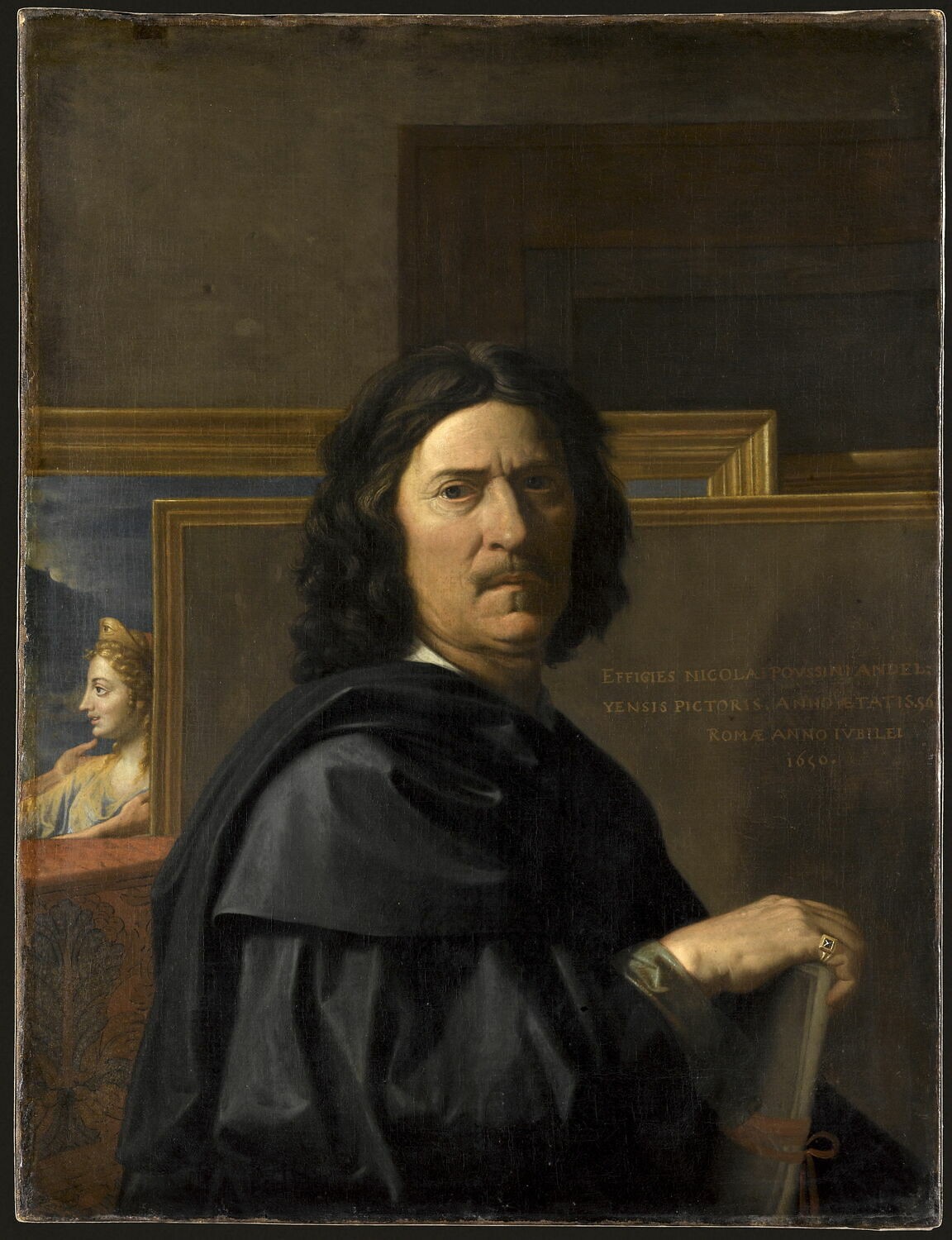
Works per decade

Select a decade to see its top painting.

Nicolas Poussin paintings: FAQ

Which is Nicolas Poussin's most famous work?Show answer

Et in Arcadia Ego (1637), The Louvre, Paris, ranks first, followed by The Slaughter of the Innocents and Dance to the Music of Time (1638).

At what age was Et in Arcadia Ego painted by Nicolas Poussin?Show answer

Nicolas Poussin was 43: Et in Arcadia Ego is dated 1637, and Nicolas Poussin was born in 1594.

What are the ten most famous Nicolas Poussin paintings?Show answer

Et in Arcadia Ego, The Slaughter of the Innocents, Dance to the Music of Time, The Rape of the Sabine Women, A Roman Road, The Poet's Inspiration, The Adoration of the Golden Calf, Echo and Narcissus, Autumn (The Spies with the Grapes of the Promised Land) and St Cecilia. Year and museum for each are in the ranking above.

How many paintings by Nicolas Poussin are listed?Show answer

412 works by Nicolas Poussin are in our catalogue, dated 1623 to 1664.

Which museums hold Nicolas Poussin's most famous originals?Show answer

Mainly in The Louvre (Paris), Dulwich Picture Gallery (London) and Metropolitan Museum of Art (New York). See the museum table above for the full list.

When were the top Nicolas Poussin paintings made?Show answer

In 1630s: 37 of the 100 paintings ranked here date from that time, including Et in Arcadia Ego.

What are the oldest and the most recent famous Nicolas Poussin paintings?Show answer

Earliest on this page: Death of the Virgin (1623). Latest: Autumn (The Spies with the Grapes of the Promised Land) (1664).

Which subjects appear most in Nicolas Poussin's paintings?Show answer

Among the 100 paintings ranked here: Mythology (34), Landscape (31) and Classical art (22).

Which medium is most common in Nicolas Poussin's paintings?Show answer

Oil On Canvas, for 78 of the 100 paintings ranked here.

What movement do Nicolas Poussin's paintings belong to?Show answer

Baroque, based on the paintings ranked on this page.

Which famous Nicolas Poussin paintings does the The Louvre have?Show answer

The The Louvre, Paris holds 15 of the paintings ranked here, including Et in Arcadia Ego, The Rape of the Sabine Women and The Poet's Inspiration.

Can I buy a Nicolas Poussin painting as a reproduction?Show answer

Yes. Every painting on this page can be ordered as a hand-painted oil reproduction or a print. Open the painting, choose the size and place your order.

Nicolas Poussin: the artist behind the paintings

Early Life, Family and Training

To understand the rigid discipline of Nicolas Poussin, one must look to his origins in Les Andelys, Normandy. Born in June 1594, his early development was not a product of sudden inspiration but of structured, methodical training. He began his technical education in Rouen, a start that provided the foundational mechanics necessary for his later, more complex compositions. This early period established a pattern of rigorous preparation that would define his entire career.

By 1612, Nicolas Poussin had moved to Paris, where he remained until 1623. This decade in the French capital was a period of significant growth, moving him beyond the initial instruction of his youth. His education was not limited to the visual; he received instruction in Latin, a fact that provided the linguistic tools required to engage directly with the classical texts he would later translate into imagery. This literacy in ancient language and structure ensured his work was built on a foundation of logic rather than mere visual sensation.

The Roman Years and Artistic Development

Poussin arrived in Rome in 1624, having traveled via Venice. At this stage, he was an unformed painter, lacking the definitive direction that would later define his career. He did not stay in France to find his voice; instead, he spent most of his working life in Rome, a city that provided the necessary intellectual and physical landscape for his evolution. This was not a period of mere residence, but a fundamental shift in his artistic trajectory. He moved away from the sensuous, Venetian-influenced style of his youth toward a more disciplined, structured approach. This transition was driven by a deep engagement with the classical ruins and the scholarly circles of the Eternal City.

His development in Rome was marked by a rejection of the flamboyant, theatrical Baroque tastes prevalent in his time. Instead of prioritizing immediate sensory impact or dramatic gesture, he sought a sense of order and logic. He studied antique remains and the works of Raphael to build a visual language rooted in clarity and balance. This period saw him move from the experimental, almost unformed works of his arrival to a highly controlled method of composition. He eventually established a style that favored line over color, focusing on the intellectual weight of his subjects rather than superficial spectacle. He remained in Rome until his death in 1665, having transformed from an unformed immigrant into a central figure of the classical tradition.

Patrons, Workshop and Commissions

Poussin’s career was defined by a selective, intellectual circle of patrons rather than the broad, theatrical demands of the Counter-Reformation. In Rome, his primary connection was Cassiano dal Pozzo, a scholar and archaeologist whose influence anchored Poussin within a specific, high-minded social stratum. This relationship secured Poussin his only papal commission in 1628. Such work required a departure from the flamboyant, emotive style popular in the city at the time, favoring instead the structured clarity that his patrons demanded. His ability to satisfy these discerning collectors established his reputation as a painter of substance.

His professional standing eventually reached the highest levels of the French state. During his brief return to Paris, he was appointed First Painter to the King under Louis XIII and Cardinal Richelieu. This position carried significant weight, yet the administrative and courtly pressures proved incompatible with his working methods. He held the title of First Painter of the King, but the demands of the court led him to abandon the position and return to Rome. His preference for the company of scholars over the intrigues of the palace highlights the disciplined, almost reclusive nature of his professional life.

  • The Martyrdom of Saint Erasmus (1628)

Technique and Style

Poussin’s approach to composition was a disciplined exercise in geometry and logic. He rejected the chaotic, emotional spontaneity of the Baroque in favor of clarity and order. To achieve this, he functioned more like an architect than a mere painter. He utilized a specialized box lit through openings in its walls to plan his canvases, allowing him to study light and shadow before a single brushstroke was applied to the final surface. This methodical preparation ensured that every figure and landscape element occupied a precise, rational space.

His process involved a physical, almost theatrical staging of his subjects. He used small stages with wax figures and arranged draperies to work out complex arrangements. This tactile method allowed him to master the interplay of light and form. He employed chiaroscuro to sculpt his figures, using light and shadow to provide depth and emotional weight without relying on the superficial drama of his contemporaries. His preference for line over color defined his aesthetic; he prioritized the structural integrity of a scene, ensuring that the underlying logic of the composition remained the primary focus for the viewer.

Key Works and Themes

Poussin’s output was defined by a rigorous commitment to structure, often using historical and mythological narratives to explore human morality. He frequently depicted scenes from ancient history, treating the canvas as a stage for stoic dignity. This intellectual approach is evident in his religious works, such as the Martyrdom of Saint Erasmus, which he painted for the Church of Saint Peter. Even in his earlier, more sensuous period, works like The Nurture of Bacchus show a transition from Venetian-inspired color toward the disciplined linearity that would define his mature style.

His thematic range extended into deep philosophical territory, most notably in Et in Arcadia Ego. This work uses a landscape setting to prompt contemplation on mortality. In the late 1630s, he turned his attention to the sacred through the Seven Sacraments series. These paintings demonstrate his ability to maintain classical restraint even when handling heavy theological subjects. He did not rely on emotional excess; instead, he used clear, logical arrangements to convey spiritual meaning.

Legacy and Influence

Poussin’s impact on French art was structural rather than merely stylistic. By establishing a standard for order and clarity, he became a cornerstone of French Classicism. His presence in the Académie Royale de Peinture et de Sculpture solidified a rigorous approach to composition that defined the era. He did not merely paint; he provided a framework for how history and myth should be organized on a canvas. This discipline ensured his influence persisted long after his death in Rome.

The reach of his method extended into the next century, shaping the direction of major movements. Artists such as Jacques-Louis David and Paul Cézanne acknowledged their debt to his intellectual depth and his preference for line over color. While David applied these principles to Neoclassicism, Cézanne found a different resonance in Poussin's structured landscapes. His ability to impose logic onto a scene remains a primary reference point for anyone studying the evolution of Western composition.

All 412 works by Nicolas Poussin →