


1


Updated October 2026 · ranked by our popularity score (searches, visits and orders for each work) · 52 works by Patrick Caulfield in our catalogue
Quick answer
Number one among Patrick Caulfield's paintings is Still life autumn fashion. In second and third place: Coloured still life and Glazed earthenware. Our catalogue holds 52 works by Patrick Caulfield. The 52 listed here are the most famous, in rank order, with the year and museum of each original.


In this captivating 1964 masterpiece, Patrick Caulfield invites the viewer into a world where reality is distilled into its most potent, graphic essence. At first glance, the composition presents a striking visual rhythm: a vibrant vase with a bold red top commands the center stage, set against a luminous yellow backdrop that radiates warmth and energy. This central focus is masterfully balanced by smaller vessels tucked toward the left, creating…

Patrick Caulfield's “Dining Recess,” completed in 1972, is more than just a depiction of a dining room; it’s a meticulously crafted meditation on loneliness, observation, and the subtle power of design. Measuring an imposing 274 x 213 cm, this large-scale work immediately commands attention with its stark simplicity – a brilliant white globe lamp dominating the center, juxtaposed against the muted grey tones of the interior space. This deliberate contrast…


 Two whiting
12
 Wall lamp
13
 Wall plate screen
14
 Second glass of whisky
15
 The letter
16
 Weekend cabin
17
 Vessel
18
 Cream glazed pot
19
 Ros bottle
20
 Three sausages
21
 Interior morning
22
 Braque curtain
23
 The blue posts
24
 Hemingway never ate here
25
 Bathroom mirror
26
 Sweet bowl
27
 Vases of flowers
28
 And i am alone in my house
29
 Small window
30
 Lampshade
31
 Interior with a picture
32
 Freud's smoke
33
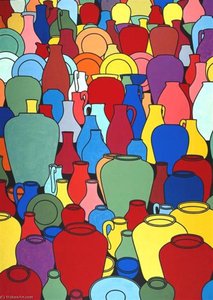 Pottery
34
 Big sausage
35
 Cigar
36
 Portrait of a frenchman
37
 Garden with pines
38
 Les demoiselles d'avignon vues de derri re
39
 Lamp and pines
40
 Sausage
41
 Terracotta vase
42
 Interior noon
43
 Bananas and leaves
44
 Still life with dagger
45
 Interior night
46
 In italy
47
 Cafe sign
48
 Found objects
49
 Still life ingredients
50
 Interior evening
51
 After lunch
52
 Cross
The four most frequent subjects in this ranking, with the top painting for each.
The museum that holds the most of the paintings on this page.
| Museum | City | Works by Patrick Caulfield | Paintings from this list |
|---|---|---|---|
 Arts Council Collection |
London | 2 | Artist, Dining Recess |
From 1964 to 1972, about ten years, Patrick Caulfield's dated paintings are listed here year by year, top works first.
Select a year to see its paintings.
In this captivating 1964 masterpiece, Patrick Caulfield invites the viewer into a world where reality is distilled into its most potent, graphic essence. At first glance, the composition presents a striking visual rhythm: a vibrant vase with a bold red top commands the center stage, set against a luminous yellow backdrop that radiates warmth and energy. This central focus is masterfully balanced by smaller vessels tucked toward the left, creating…
Patrick Caulfield's “Dining Recess,” completed in 1972, is more than just a depiction of a dining room; it’s a meticulously crafted meditation on loneliness, observation, and the subtle power of design. Measuring an imposing 274 x 213 cm, this large-scale work immediately commands attention with its stark simplicity – a brilliant white globe lamp dominating the center, juxtaposed against the muted grey tones of the interior space. This deliberate contrast…
Still life autumn fashion ranks first, followed by Coloured still life and Glazed earthenware.
Still life autumn fashion, Coloured still life, Glazed earthenware, Portrait of juan gris, Wine glasses, Greece expiring on the ruins of missolonghi after delacroix, Artist, Dining Recess, Two fish on a plate and Grey pipe. Year and museum for each are in the ranking above.
52 works by Patrick Caulfield are in our catalogue, dated 1964 to 1972.
Mainly in Arts Council Collection (London). See the museum table above for the full list.
Earliest on this page: Artist (1964). Latest: Dining Recess (1972).
Among the 52 paintings ranked here: Life (4), Interior (4) and Buildings (3).
Pop art, based on the paintings ranked on this page.
The Arts Council Collection, London holds 2 of the paintings ranked here, including Artist and Dining Recess.