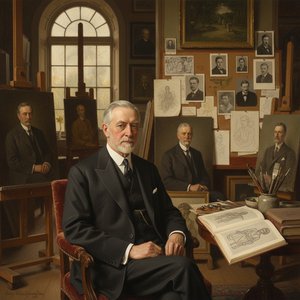
The Life and Travels of William Carpenter
Born in London, United Kingdom, in about 1818, William Carpenter was the eldest son of William Hookham Carpenter and Margaret Carpenter. After entering the Royal Academy Schools in 1835, he transitioned from working with oils to focusing on watercolour. His artistic journey took him abroad in the early 1850s, where he spent several years painting scenes of India, its people, and its life.
His travels through India included journeys to Bombay, Poona, and Salsette Island, where he painted Mount Mary's Basilica at Bandra. He also visited Kashmir in 1853, 1854, and 1855, and recorded the Golden Temple of Amritsar in 1854. His travels took him through the Punjab, Afghanistan, and Rajasthan before his return to England in 1857. In 1866, he traveled to Boston, Massachusetts.
Artistic Legacy and Collections
Carpenter's work captured significant historical figures and landscapes, such as his 1856 portrait of Prince Fakhr-ud Din Mirza, the eldest son of Bahadur Shah II. His large collection of dated watercolour paintings provides a detailed record of his travels. In 1881, he held a one-man exhibition in South Kensington Museum featuring 275 paintings, which were subsequently purchased by the Victoria and Albert Museum.
The Victoria and Albert Museum holds a significant collection of his work, including:
He died in London in 1899.
Questions & Answers
What colors did William Carpenter use most often?
The color profile of William Carpenter's work is shown on the artist's Palette Genome page.
Where are William Carpenter's artworks grouped by keywords?
The By Keywords page of William Carpenter groups the artist's artworks by their keywords.
How do I find works by William Carpenter in a specific palette?
William Carpenter's works can be browsed by color palette on the artist's By Palettes page.
Where are William Carpenter's artworks organized by color?
The Spectral Index page organizes William Carpenter's artworks by color.