

Cubism · 1912
Bottle, glass, violin (Pablo Picasso, 1912)
Bottle, glass, violin is a work of Pablo Picasso (1881–1973). It dates from 1912. It belongs to the Cubism movement. It is made in oil on canvas.
- 1912
- Oil On Canvas

 Preview

 Print
 Send
 Share
 Fact sheet


 Download
 Similars
 X-Ray
 Diaporama
 Q&A

 Stats
Bottle, glass, violin: key details
- Title
- Bottle, glass, violin
- Artist
- Pablo Picasso (1881–1973)
- Artist born in
- Málaga, Spain
- Date
- 1912
- Medium
- Oil On Canvas
- Movement
- Cubism
- Period
- Modern
- Subject
- still life, violin, bottle, glass, synthetic cubism, composition
What does Bottle, glass, violin show?
Subject and Composition of "Bottle, Glass, Violin"
"Bottle, Glass, Violin," created by Pablo Picasso in 1912, is a quintessential example of Synthetic Cubism. The artwork presents a still life arrangement featuring a bottle, a glass, and a violin placed upon what appears to be a tabletop. These objects are not depicted realistically but rather fragmented and reassembled into an abstract composition. The background remains muted, allowing the viewer's focus to remain firmly on the interplay of shapes and forms that constitute the subject matter.
Synthetic Cubism: A Revolutionary Style
Picasso’s work exemplifies Synthetic Cubism, a phase within the broader Cubist movement that emerged around 1912. Unlike earlier Analytic Cubism which focused on dissecting objects into their component parts, Synthetic Cubism introduced elements of collage and papier collé. This shift allowed artists to incorporate real-world materials directly into their artwork, blurring the lines between painting and sculpture. Picasso’s use of charcoal and what appears to be cardboard or textured paper in "Bottle, Glass, Violin" demonstrates this innovative approach. The style challenges traditional notions of representation, inviting viewers to actively engage with the artwork and reconstruct its meaning.
Historical Context and Influences
The creation of “Bottle, Glass, Violin” coincided with a period of significant artistic experimentation in Europe. Cubism itself was born from Picasso’s collaboration with Georges Braque, reacting against the conventions of Impressionism and Post-Impressionism. The early 20th century witnessed rapid technological advancements and societal shifts, which influenced artists to explore new ways of depicting reality. Synthetic Cubism reflected this spirit of innovation, embracing abstraction and challenging established artistic norms. The incorporation of everyday objects like a bottle, glass, and violin further emphasized the movement's desire to integrate art with modern life.
Symbolism and Emotional Impact
While seemingly simple in its subject matter, "Bottle, Glass, Violin" carries layers of symbolic meaning. The fragmented forms can be interpreted as representing the instability and complexity of modern existence. The violin, a symbol of music and harmony, is juxtaposed with the more utilitarian objects—the bottle and glass—creating a visual tension that reflects the contradictions inherent in contemporary society. Emotionally, the artwork evokes a sense of intellectual curiosity and invites contemplation. The muted palette and geometric forms create a calm yet stimulating atmosphere, encouraging viewers to actively participate in deciphering its meaning.
Technical Aspects and Artistic Merit
Picasso’s masterful use of charcoal is evident throughout the piece. The lines are bold and decisive, defining the fragmented shapes with precision. The incorporation of collage elements adds texture and depth, further enhancing the artwork's visual complexity. "Bottle, Glass, Violin" stands as a testament to Picasso’s genius and his pivotal role in shaping the course of 20th-century art. Its innovative approach to composition, its exploration of new materials, and its enduring emotional impact solidify its place as a landmark achievement within the Cubist movement.
Bottle, glass, violin: image files

Protected by copyright: these files are for personal reference, not a licence to republish.
Pablo Picasso, Bottle, glass, violin (1912).
Prepared from a higher-resolution image in our database, not the web image: 300 DPI minimum. Colours checked against the original, file retouched by a digital expert.
Buy the high-resolution imageQuestions about Bottle, glass, violin
What is the creation date of "Bottle, glass, violin" by Pablo Picasso?
"Bottle, glass, violin" by Pablo Picasso was created in 1912.
What medium is "Bottle, glass, violin" by Pablo Picasso executed in?
The medium of "Bottle, glass, violin" by Pablo Picasso is oil on canvas. Reproductions aim to render the appearance of this technique.
What does "Bottle, glass, violin" by Pablo Picasso depict?
The themes present in "Bottle, glass, violin" by Pablo Picasso include still life, violin, bottle, glass, synthetic cubism, composition, geometric, charcoal. Together they summarize the artwork's subject matter.
Can the image of "Bottle, glass, violin" by Pablo Picasso be freely reproduced?
Regarding copyright, "Bottle, glass, violin" is still protected by copyright.
Which artist is "Bottle, glass, violin" attributed to?
"Bottle, glass, violin" is attributed to Pablo Picasso.
Which artistic current is "Bottle, glass, violin" by Pablo Picasso part of?
The movement associated with "Bottle, glass, violin" by Pablo Picasso is Cubism. This classification situates the work among related artists and artworks.
Where does "Bottle, glass, violin" fall in Pablo Picasso's career?
Within Pablo Picasso's career, "Bottle, glass, violin" falls in the Synthetic Cubism Period. The phase helps compare it with the artist's other works.
What was Pablo Picasso's age when "Bottle, glass, violin" was created?
Pablo Picasso made "Bottle, glass, violin" at the age of 31. The artist was born in 1881 and the work is dated 1912.
What explains the copyright situation of "Bottle, glass, violin" by Pablo Picasso?
"Bottle, glass, violin" by Pablo Picasso is still protected by copyright. Copyright duration runs from the artist's death, which occurred in 1973.
About Pablo Picasso
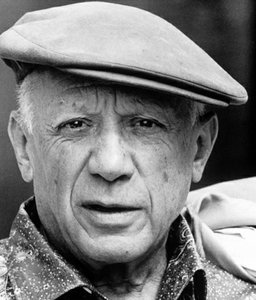
1881–1973, Spain
Pablo Picasso
Early Life, Family and Training In the city of Málaga, Spain, a boy named Pablo Picasso entered the world on October 25, 1881. He was born to María Picasso y López and José Ruiz Blasco, a man who understood the weight of a brush and the discipline of the canvas. From his earliest years, the child displayed a restless pull toward drawing, a talent that seemed to manifest in his very first attempts at speech. His father, a painter himself, recognized the spark in his son and took it upon himself to nurture that budding skill.
Other works by Pablo Picasso
 Guernica1937
 The Young Ladies of Avignon1907
 Weeping Woman1937
 The Old Guitarist
Articles on Bottle, glass, violin
 Mastering the Classics: The Top 25 Iconic Marc Duvallier ArtworksExplore 25 iconic Marc Duvallier reinterpretations of the Old Masters. Discover these timeless masterpieces on AllPaintingsStore.com.
 Understanding the Difference Between Analytical and Synthetic CubismMaster the differences between Analytical and Synthetic Cubism with our expert guide. Learn to identify these iconic art movements now.
 Deconstructing Reality: A Comprehensive Exploration of Cubist Still LifeExplore the revolutionary world of Cubist Still Life with AllPaintingsStore. Discover Picasso & Braque's groundbreaking techniques, its phi…