Preview
 Send
Send Share
Share
 Details
 Guide
Guide

 Download
 Similars
 X-Ray
X-Ray Diaporama
 Q&A
Q&A Stats
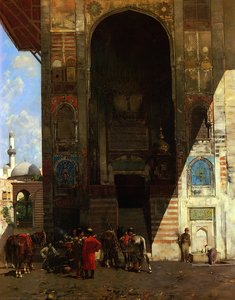
StatsHalte A La Mosquee

 Read More
Giclée / Art Print
Museum-quality giclée or canvas print with fast production and flexible finish options. ( Buy Hand Made Painting Switch to Digital Image)




































Pick from our preset sizes that match the artwork's original proportions.

Type the width and the height you need, to fit your frame or your wall. A print can only be cut, never made bigger than the picture, so a size with a different shape loses a part of the image. We send you a digital mockup to approve before we print anything. The picture shown on this page does not show the real cut — only the mockup does.
Worldwide Delivery () in 2 weeks instead of standard 4/5 weeks. (3 November)

Free Worldwide Express Shipping

High-Quality Linen Canvas

Full Shipping Insurance

Customs Tax Refund Guarantee

True Color Matching Guarantee

100-Day Return Policy (Defects Only)

100% Money-Back Guarantee

Bulk Discount Offer
 Glass option is only available in size under 110 CM

Halte A La Mosquee
Giclée / Art Print
Reproduction Size
-


Total Price
$ 65
The Painting's Composition
The scene depicted in 'Halte A La Mosquee' is set in front of an ornate mosque, where a horse stands majestically. The horse is positioned towards the left side of the canvas, surrounded by at least 12 individuals who are engaged in various activities. Some are closer to the foreground, while others blend into the background, creating a sense of depth and community. The mosque itself is a stunning example of Middle Eastern architecture, with an imposing archway that dominates the background. The intricate details on the building's facade add to its historical and cultural significance. A clock visible on one side of the structure further emphasizes the importance of time in this communal setting.Artistic Style and Influence
Alberto Pasini was renowned for his Orientalist paintings, which often featured scenes from everyday life in the Middle East. His style is characterized by a late-Romantic approach, blending vivid colors with meticulous attention to detail. This painting exemplifies his ability to capture the essence of community and shared experience. Pasini's work was influenced by his travels and studies in various parts of Europe and the Middle East. His father's position as a commissioner likely exposed him to different cultures from an early age, which later reflected in his art.Relevance and Legacy
'Halte A La Mosquee' is not only a beautiful piece of art but also a window into the cultural practices and architectural marvels of the Middle East during the 19th century. It highlights the importance of community gatherings and the role of religious structures in daily life. For those interested in exploring more of Pasini's work, Halte A La Mosquee is just one of many captivating paintings available at AllPaintingsStore. Other notable works include 'A L'entrée De La Mosquée', 'A Mosque', and 'Visiting The Mosque'. To learn more about Alberto Pasini's life and artistic journey, visit Alberto Pasini on AllPaintingsStore. In conclusion, 'Halte A La Mosquee' by Alberto Pasini is a masterpiece that combines the beauty of Middle Eastern architecture with the vibrancy of community life. It stands as a testament to Pasini's skill and his contribution to the world of Orientalist art.Questions & Answers
How does the style of "Halte A La Mosquee" relate to its creator's era?
"Halte A La Mosquee" belongs to the Orientalism movement, and its creator worked in the 19th-Century era.
Which period of Alberto Pasini's career does "Halte A La Mosquee" belong to?
"Halte A La Mosquee" belongs to the Mature Period of Alberto Pasini's career. This classification relates the work to the artist's development.
Which color stands out most in "Halte A La Mosquee"?
black (#21150c) is the leading color of "Halte A La Mosquee" by Alberto Pasini.
Related Artworks


Artist Biography
Early Life and Training (1826-1853)
- Family Background: Born in Busseto, Pasini's early life was impacted by the death of his father when he was young. He subsequently moved to Parma with his mother.
- Artistic Beginnings: At 17, he enrolled at the Academy of Fine Art in Parma, focusing on landscape painting and drawing.
- Influence of Antonio Pasini: His uncle, Antonio Pasini, a painter and manuscript illuminator working for local nobility, significantly influenced his early artistic development.
- Early Exhibitions & Lithographs: In 1852, Pasini exhibited a series of thirty designs transformed into lithographs depicting castles around Piacenza, Lunigiana, and Parma. This work garnered attention from artist Paolo Toschi.
- Parisian Studies: Encouraged by Toschi, Pasini traveled to Paris where he studied under Charles and Eugène Ciceri, associated with the Barbizon School. His lithograph "The Evening" earned him admittance to the Paris Salon in 1853 and further study with Théodore Chassériau.
Orientalist Travels and Artistic Development (1855-1870)
- Journey to Persia: The Crimean War provided an opportunity for Pasini to accompany Nicolas Prosper Bourée, the French plenipotentiary minister, to Persia in 1855. This journey proved pivotal, inspiring numerous paintings of Orientalist subjects.
- Expanding Horizons: Following his Persian expedition, Pasini continued to travel extensively throughout the Middle East, including Egypt, Arabia, Istanbul, and various regions of Persia. These travels provided a wealth of visual material for his art.
- Artistic Style: His paintings during this period showcased meticulous attention to architectural details and a vibrant use of color and light, characteristic of Orientalist painting. Notable works include "Circassian Cavalry Awaiting Their Commanding Officer at the Door of a Byzantine Monument" and "Memory of the Orient."
Later Career and Recognition (1870-1899)
- Return to Italy: After the Franco-Prussian War in 1870, Pasini returned to Italy and settled permanently in Cavoretto.
- Continued Exhibitions: He continued to exhibit his work at Salons and other exhibitions throughout Europe.
- Museum Acquisitions: His paintings were increasingly recognized for their artistic merit, leading to acquisitions by prominent museums including the Museum of Parma, the Uffizi Gallery in Florence, The Metropolitan Museum of Art, and others.
- Later Works & Piedmontese Landscapes: In his later years, Pasini also focused on painting landscapes of Piedmont, particularly scenes around Cavoretto and Issogne.
Key Characteristics & Significance
- Architectural Detail: A defining feature of Pasini’s art was his meticulous rendering of architectural details within his oriental scenes.
- Color and Light: His skillful use of color and light created a vibrant and evocative atmosphere in his paintings.
- Orientalist Movement: Pasini's work exemplifies the Orientalist movement, which depicted cultures outside of Europe with varying degrees of accuracy and romanticization.
- Influence & Connections: He was influenced by artists like Théodore Chassériau and associated with the Barbizon School, demonstrating a connection to broader artistic trends of his time.

Alberto Pasini
1826 - 1899 , Italy
Quick Facts
- Full Name: Alberto Pasini
- Nationality: Italian
- Date Of Birth: 1826
- Date Of Death: 1899
- Place Of Birth: Busseto, Italy
- Notable Artworks:
- Circassian Cavalry Awaiting
- Memory of the Orient
- Artistic Movement Or Style: Orientalist painting
- Artists Who Influenced This Artist:
- Théodore Chassériau
- Eugène Delacroix
Related Articles

Beyond Exoticism: Unveiling the Complex Legacy of Orientalist Painting
Explore the fascinating & complex world of Orientalist painting! Discover its history, key artists like Gérôme & Lewis, and Edward Said's influential critique. Uncover nuance beyond stereotypes with AllPaintingsStore.

19th Century Masterpieces: 10 Paintings That Defined an Era | AllPaintingsStore
Journey through 19th century art with AllPaintingsStore! Explore 10 iconic paintings – from Monet & Renoir to Courbet – and discover the stories behind Romanticism, Realism & Impressionism. Find museum-quality reproductions for your home decor. Explore the full collection online!

Alberto Pasini: Evoking Venetian Atmosphere & Orientalist Visions
Explore the captivating world of Alberto Pasini (1826-1899), a master of Orientalist scenes and Venetian landscapes. Discover his stunning paintings & learn about his legacy at AllPaintingsStore.

The Alluring Gaze: Orientalism in 19th-Century Art – Representation, Reception & Construction of the 'Orient'
Explore the complex history of Orientalism in 19th-century art. Discover how Western artists depicted the 'Orient,' its cultural impact, and Edward Said's critical analysis. A deep dive for art lovers & historians.

The Allure of the Exotic: Orientalism in 19th-Century Art
Explore the captivating world of 19th-century Orientalist art! Discover iconic painters like Gérôme & Benjamin-Constant, key themes, and collecting insights. Expert analysis at AllPaintingsStore.