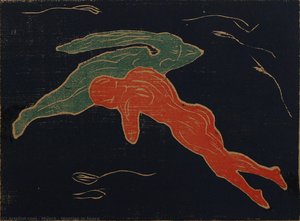
1896. Acrylic On Canvas.

§ 1Catalogue data


§ 2Abstract
Collectible Description
Experience Edvard Munch's 'Separation,' a poignant lithograph capturing emotional distance and despair. Explore the themes of loss, longing, and the complexities of human connection through Munch’s iconic Expressionist style.
 Read More
Artist Biography
Expressionist pioneer Edvard Munch created the iconic The Scream. Discover his haunting masterpieces of anxiety and emotion today.
§ 3Commentary
The Heart’s Silent Scream: Unpacking Edvard Munch's "Separation"
Edvard Munch’s “Separation,” a lithograph created in 1896, isn’t merely a depiction of two figures; it’s a raw, visceral exploration of human disconnection and the agonizing weight of unspoken sorrow. Belonging to the heart of the Expressionist movement, this work transcends simple representation, plunging the viewer directly into the emotional turmoil at its core. The painting immediately commands attention with its stark contrast – the deep blacks and somber hues of the man against the muted blues and greens of the landscape, punctuated by a jarring crimson that speaks volumes about the source of their distress. It’s a scene frozen in a moment of profound, almost unbearable, separation, a testament to Munch's ability to translate personal anguish into universally resonant imagery.
At first glance, the composition appears deceptively simple: a man, rigidly turned away, clutching his chest as if enduring an invisible wound; and a woman reaching out towards him with a desperate plea. However, beneath this surface lies a complex web of symbolism and psychological depth. The man’s posture – shoulders hunched, head bowed – speaks to a profound sense of defeat and withdrawal. His hand, gripping his heart, isn't just an expression of physical pain; it represents the crushing weight of emotional rejection. The woman, rendered in softer tones, embodies a yearning for connection, her outstretched hand a poignant symbol of lost intimacy. The flowing hair, almost like a spectral extension of herself, further emphasizes this feeling of being irrevocably distanced.
Echoes of Trauma and the Expressionist Vision
To understand “Separation,” it’s crucial to delve into the context of Edvard Munch's life and the broader movement of Expressionism. Born in 1863, Munch was profoundly shaped by a childhood marked by loss – the early deaths of his mother and sister from tuberculosis instilled within him an enduring preoccupation with mortality, illness, and psychological distress. These experiences weren’t just personal tragedies; they formed the bedrock of his artistic vision, fueling his exploration of the darker recesses of the human psyche. Expressionism, emerging in the late 19th and early 20th centuries, rejected the objective representation favored by previous art movements, instead prioritizing the subjective experience – the raw emotions, anxieties, and nightmares that haunted the artists’ inner worlds.
Munch's work is deeply intertwined with this movement. He sought to capture not just what he *saw*, but what he *felt*. “Separation” exemplifies this approach perfectly; it’s less a portrait of two individuals and more an embodiment of the feeling of profound isolation, a sensation that Munch himself experienced acutely throughout his life. The lithograph medium itself—known for its ability to capture subtle tonal variations and create a sense of immediacy—was ideally suited to conveying the intensity of Munch's emotional landscape.
Symbolism in Shadow and Light: A Deeper Look
The painting’s symbolism is layered and evocative. The dominant use of black, particularly in the man’s attire and posture, immediately establishes a mood of despair and grief. However, it's not simply darkness; there are hints of color—the woman’s pale skin, the crimson plant that blooms between them—that add complexity to the scene. This plant, often interpreted as a mandrake root (a symbol of both love and death in folklore), represents the painful blossoming of emotions within this relationship. The man's hand clutching his heart is not just a gesture of pain but also a visual metaphor for the very core of his being—his capacity for love and vulnerability.
The setting, reminiscent of Aasgaardsstrand – a coastal area near Oslo where Munch often painted – contributes to the overall atmosphere. The blurred shoreline suggests a sense of disorientation and uncertainty, mirroring the emotional state of the figures. Notably, Munch employed gold paint in the woman’s hair, an unusual choice that adds a touch of ethereal beauty amidst the prevailing gloom, perhaps representing a fleeting memory of joy or a yearning for something lost.
A Window into the Soul: Reproduction and Beyond
AllPaintingsStore offers meticulously crafted hand-painted reproductions of “Separation,” allowing you to experience Munch’s masterpiece in stunning detail. Our artists carefully replicate the painting's nuanced colors, textures, and emotional intensity, capturing the essence of this iconic work. Whether displayed in your home or office, a AllPaintingsStore reproduction will serve as a powerful reminder of the complexities of human relationships and the enduring power of art to express profound emotions. Explore our collection here to discover other exceptional reproductions by Munch and delve deeper into his extraordinary artistic legacy. For further insights, consider visiting the Bergen Kunstmuseum, where “Separation” resides, or exploring resources like Wikipedia and Google Arts & Culture for a more comprehensive understanding of this seminal work.
Questions & Answers
How does "Separation" fit into Edvard Munch's themes and style?
Within Edvard Munch's output, "Separation" sits in the Expressionism style, alongside the themes of symbolism, expressionism, fin-de-siècle, japanese prints, van gogh, gauguin, key expressionist work, exploring inner states.
What was Edvard Munch's age when "Separation" was created?
When "Separation" was created in 1896, Edvard Munch - born in 1863 - was 33 years old.
What technique was used for "Separation" by Edvard Munch?
Edvard Munch used the acrylic on canvas technique for "Separation". The technique defines the material nature of the original work.


 Switch to Print


 For artworks or reproductions larger than 105 cm (approximately 41 inches) on any side, the frame will be shipped as a kit, disassembled. This method ensures safe delivery and prevents damage during transport.