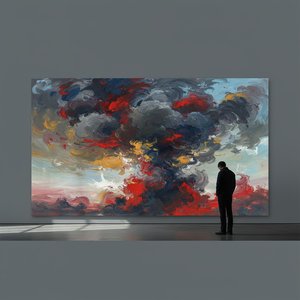
1968. Oil On Canvas, 57.0 x 76.0 cm. National Gallery of Victoria.

§ 1Catalogue data

- 57.0 x 76.0 cm


This Artwork Is Under Copyright Protection
The artwork displayed on this page is protected by copyright law, which means we cannot legally create or sell an identical reproduction. This protection is enforced under international agreements such as the Berne Convention and by national laws, including those outlined by the U.S. Copyright Law - Title 17.
As a respectful and legal alternative, we offer custom, hand-painted artworks inspired by the original. Our skilled and professional artists carefully study the original's style, mood, and artistic essence to create a new, unique piece that evokes the same feeling - while remaining an original creation in its own right.
This method fully complies with copyright regulations because it does not involve copying or duplicating the protected artwork. Instead, it is a creative reinterpretation - a new painting that is influenced by the original but not identical to it.
 Read more
§ 2Abstract
Collectible Description
Fred Williams’ "Burning Tree Stump" (1968) captures Australian bushfires in abstract expressionism. Explore layered forms, muted tones & raw emotion of this iconic landscape piece.
Artist Biography
Discover Frederick Ronald Williams (Fred Williams), a pivotal Australian artist renowned for his captivating landscape paintings & innovative etchings. Explore his journey from figurative work to becoming one of Australia’s most celebrated 20th-centu
§ 3Commentary
The Embers of Memory: Reimagining Fred Williams
In the evocative depths of "Burning Tree Stump" (1968), the viewer is not merely observing a landscape, but is instead pulled into the visceral heart of an Australian bushfire. Frederick Ronald Williams, one of Australia’s most profound twentieth-century landscapists, achieves here a masterful synthesis of abstract expressionism and raw, elemental truth. The painting does not rely on the literal depiction of flame or smoke; rather, it utilizes a sophisticated language of layered forms and muted tones to capture the very essence of destruction and rebirth. As the eye wanders across the canvas, one encounters a densely populated scene where shapes emerge from a field like ghosts of the bush, creating a sense of movement that is both chaotic and strangely rhythmic.
The technique employed by Williams is nothing short of hypnotic. Utilizing a wet-on-wet approach, he allows oil paints to bleed and merge directly upon the canvas, a method that facilitates the organic, amorphous shapes that define this piece. There is a beautiful tension between thick, tactile impasto patches and delicate, translucent washes, providing a structural depth that invites close inspection. The perspective is intentionally flattened, eschewing traditional linear depth in favor of a gestural abstraction where space is suggested through shifts in color density and the overlapping of organic forms. This creates an immersive experience, as if the viewer is standing amidst the swirling heat and settling ash of a landscape in transition.
A Palette of Somber Elegance
For the discerning collector or interior designer, the color story of "Burning Tree Stump" offers a sophisticated anchor for any high-end space. The palette is dominated by a soulful arrangement of muted browns, charcoal grays, and soft off-whites, evoking the scorched earth and heavy skies of an overcast Australian afternoon. Yet, within this somber atmosphere, Williams introduces subtle, unexpected punctuations of blue and hints of crimson. These small splashes of color act as emotional sparks, preventing the composition from becoming static and instead imbuing it with a flickering, living energy.
Beyond its aesthetic brilliance, the painting carries a profound symbolic weight. It speaks to the collective experience of a continent shaped by fire, touching upon themes of anonymity, resilience, and the disorientation of nature's most powerful forces. The way the figures—or perhaps they are merely fragments of trees and earth—cluster in the foreground creates a sense of being part of a larger, shared consciousness. To possess a reproduction of this work is to bring more than just decoration into a room; it is to invite a conversation about history, the raw power of the natural world, and the enduring beauty found within the aftermath of change.
Questions & Answers
How is "Burning tree stump" situated historically?
"Burning tree stump" by Frederick Ronald Williams belongs to the Abstract Expressionism movement, within the Modern period. Together they give the work its place in art history.
Is "Burning tree stump" by Frederick Ronald Williams a portrait, landscape or square composition?
"Burning tree stump" by Frederick Ronald Williams is a landscape composition. The proportions are worth checking before choosing a print size.
Which period of Frederick Ronald Williams's career does "Burning tree stump" belong to?
"Burning tree stump" belongs to the Mature Period of Frederick Ronald Williams's career. This classification relates the work to the artist's development.


![Untitled (rome [wall]) (1961) — Cy Twombly, Abstract Expressionism](/media/artworks/images-thumb/02/29/022976d5294bf560184bd33a69805420.jpg)

 Switch to Print


 For artworks or reproductions larger than 105 cm (approximately 41 inches) on any side, the frame will be shipped as a kit, disassembled. This method ensures safe delivery and prevents damage during transport.