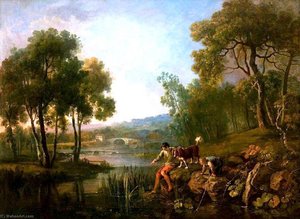
William Constable
Hand Made Oil Reproduction
Hand-painted oil on canvas in your size and frame, made to order by our artists. ( Switch to Print
Switch to Image)
Pick from our preset sizes that match the artwork's original proportions.
You may enter your own dimensions to fit a specific frame or space. If your selected size does not match the original image's proportions, we will either crop the artwork or extend the painting with additional hand-painted elements. A digital mockup will be sent for your approval before production begins.
Please note that the on-screen preview does not reflect the actual cropping or extension. Only the mockup will accurately show the final composition.
While custom sizes are available, we recommend selecting a dimension from the predefined list to preserve the original proportions.
After order, AllPaintingsStore.com team will email client for instructions and provide a mockup preview
Worldwide Delivery () in 3/4 weeks instead of standard 5 weeks. (30 July). No compromise on quality.
Free Worldwide Express Shipping
High-Quality Linen Canvas
Full Shipping Insurance
Customs Tax Refund Guarantee
True Color Matching Guarantee
60-Day Return Policy (Defects Only)
100% Money-Back Guarantee
Bulk Discount Offer
William Constable
Reproduction Medium
Reproduction Size
-
Total Price
$ 258
Related Artworks
Artist Biography
George Barret Sr.: Life & Legacy
Early Life and Training
- Born: Between 1728 and 1732 in Libertyville, Ireland, the son of a cloth merchant.
- Initially apprenticed as a staymaker before discovering his artistic talent.
- Began formal drawing training at Robert West’s Academy in Dublin around 1747, sponsored by the Royal Dublin Society.
- Subsequently taught drawing at the same academy, demonstrating early promise and skill.
- A formative friendship with Edmund Burke, formed during Burke's time at Trinity College, Dublin, would prove crucial later in life.
Early Artistic Development & Influences
- Barret’s early paintings often featured classical scenery and mythological figures.
- Influenced by: The philosophical writings of Edmund Burke, particularly *A Philosophical Enquiry into the Origin of Our Ideas of the Sublime and Beautiful*, which informed his artistic approach to landscape.
- He initially worked by reworking engravings of classical Italianate scenes by artists like Claude Lorrain, demonstrating a strong foundation in established styles.
- Despite depicting Italian landscapes, there’s no evidence he ever travelled to Italy himself.
Move to London and Rise to Prominence
- In 1762, Barret moved to London seeking greater artistic opportunities.
- Quickly gained recognition as a leading landscape artist of the period.
- Exhibited at the Society of Artists of Great Britain and attracted patronage from prominent art collectors.
- Key Achievement: In 1768, Barret was among the founding members who left the Society of Artists to establish the Royal Academy – a pivotal moment in British art history.
Artistic Style and Themes
- Barret’s style evolved from idealized Italianate landscapes to more naturalistic depictions of English and Irish scenery.
- He travelled extensively throughout England, Wales, Scotland, and Ireland, undertaking commissions and capturing the beauty of diverse landscapes.
- Common themes included idyllic views, picturesque countryside, waterfalls (like his famous *The Powerscourt Waterfall*), and topographical representations of estates and properties.
- His paintings often featured figures within the landscape, adding a sense of scale and narrative.
Later Life & Patronage
- Suffered from asthma, leading him to relocate to Westbourne Green in 1772 for health reasons.
- Despite earning substantial income, he was described as “feckless” with money and occasionally faced financial difficulties.
- Continued Support: Edmund Burke remained a loyal friend and assisted Barret financially and professionally.
- In 1782, Burke recommended Barret for the position of Master Painter of Chelsea Hospital, which he held until his death in 1784.
Legacy & Historical Significance
- Although his widow and children were left destitute upon his death, the Royal Academy provided a small pension.
- Barret’s work represents a significant transition in British landscape painting, moving from classical imitation to a more distinctly national style.
- His paintings provide valuable insights into 18th-century landscapes and aristocratic life.
- Many of his works are now held in prominent collections, including the National Gallery of Ireland and Yale Center for British Art.
George Barret the Elder
1732 - 1784 , Ireland
Quick Facts
- Birth Date: 1732
- Birth Place: Libertyville, Ireland
- Death Date: 1784
- Influenced By: Edmund Burke, Claude Lorrain
- Movement: Romanticism
- Name: George Barret Sr.
- Nationality: Irish
- Notable Works:
- The Powerscourt Waterfall
- A Prospect of Southwick Park
- Llyn Nantlle
- North Side of Danson


Glass option is only available in size under 110 CM