Money-Back Guarantee · 100 days Free Worldwide Delivery
449,564artworks 30,613artists 4,658museums 32languages
Catalogue entry

Small Triptych1

Oil.

Fig. 1. Jan van Eyck, Small Triptych1. Shown as the reproduction you are specifying: , .

§ 1Catalogue data

§ 2Abstract

Collectible Description

Discover Jan van Eyck's 'Small Triptych1,' a captivating 1437 masterpiece showcasing biblical scenes with exquisite detail and grisaille technique. Explore its significance & related works at AllPaintingsStore.

Artist Biography

A pioneer of Early Netherlandish painting and the Arnolfini Portrait. Discover his revolutionary oil techniques and masterpieces today.

§ 3Commentary

The Enigmatic Intimacy of the Small Triptych

Jan van Eyck’s Small Triptych, a masterpiece completed around 1437 and currently residing in the Gemäldegalerie Alte Meister in Dresden, isn't merely a painting; it’s an invitation. A remarkably intimate work considering its scale, this triptych offers a profound glimpse into the devotional practices of early Renaissance Europe. Measuring just under 30 centimeters tall, it immediately draws the viewer in with its meticulous detail and the quiet solemnity of its subjects. Unlike grand altarpieces designed for public display, the Small Triptych speaks to a more personal sphere – a private devotion, perhaps, or a moment of contemplative reflection. The choice of grisaille, a monochrome technique utilizing shades of grey rather than vibrant color, is particularly striking. It lends an almost sculptural quality to the figures, as if they were carved from stone, emphasizing their timelessness and spiritual weight.

Small Triptych by Jan van Eyck

A Composition of Sacred Figures

The triptych’s narrative unfolds in a carefully orchestrated sequence. The central panel presents the Virgin Mary cradling the infant Jesus within a simple, yet elegant church interior. This scene immediately establishes a sense of serenity and maternal grace – a quintessential representation of Marian devotion. To the left, St. Michael stands as a powerful protector, accompanied by a donor figure, likely representing one of the patrons who commissioned the work. His posture exudes authority and piety. On the right wing, we encounter St. Catherine, another revered saint known for her steadfast faith and unwavering virtue. The inclusion of these three figures – Mary, Michael, and Catherine – represents a harmonious balance between divine grace, earthly protection, and spiritual fortitude. Crucially, when closed, the triptych reveals an Annunciation scene on its outer wings, creating a continuous narrative thread that underscores the central theme of God’s intervention in human affairs.

The Revolutionary Technique of Oil Paint

What truly elevates the Small Triptych is Van Eyck's masterful command of oil paint. This medium, still relatively new at the time, allowed him to achieve an unprecedented level of realism and detail. The subtle gradations of light and shadow, the delicate rendering of textures – from the folds of Mary’s robes to the intricate stonework of the church – are a testament to his technical skill. Van Eyck's use of oil paint also enabled him to work with remarkable patience, layering thin glazes upon thin glazes to build up color and depth. This painstaking process is evident in every brushstroke, contributing to the painting’s luminous quality and its enduring beauty. The technique was revolutionary for its time, allowing a level of detail previously unattainable with tempera or fresco.

A Window into Early Netherlandish Devotion

The Small Triptych offers more than just aesthetic pleasure; it provides a valuable window into the religious beliefs and practices of early Renaissance Europe. Its intimate scale, combined with its meticulous detail and symbolic imagery, reflects a deeply personal form of devotion – one that sought to connect individuals directly with the divine. The work’s grisaille palette further emphasizes the spiritual nature of the scene, stripping away worldly distractions and focusing attention on the sacred figures within. Today, reproductions of this remarkable triptych allow us to appreciate Van Eyck's genius and contemplate the profound beauty of early Netherlandish art, offering a tangible connection to a bygone era of faith and artistic innovation.

Questions & Answers

In which movement and which era is "Small Triptych1" by Jan van Eyck placed?

"Small Triptych1" by Jan van Eyck is placed in the Early Netherlandish Painting movement, within the Renaissance era of its creator.

What atmosphere would a reproduction of "Small Triptych1" by Jan van Eyck bring to a room?

With its calm mood, "Small Triptych1" is suggested for a living room.

Does "Small Triptych1" show strong light-dark contrasts?

The contrast level of "Small Triptych1" by Jan van Eyck is balanced.
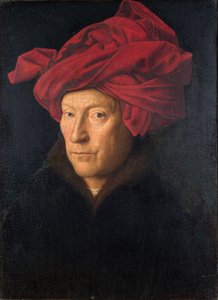
§ 4The artist

Jan van Eyck

Jan van Eyck

1390 - 1441, Netherlands

Quick facts about Jan van Eyck

  • Artistic Movement Or Style: Early Netherlandish painting
  • Artists Or Movements Influenced By This Artist:
    • Early Netherlandish painting
    • Generations of painters
  • Full Name: Jan van Eyck
  • Nationality: Flemish
  • Notable Artworks:
    • Ghent Altarpiece
    • Arnolfini Portrait
    • Dresden Triptych
    • Man in a Blue Turban
  • Place Of Birth: Maastricht, Netherlands
  • Date Of Birth: 1390
  • Date Of Death: 1441

Artist Biography

The Alchemist of Light

To look at a Jan van Eyck painting is to witness the moment Western art stopped pretending and started observing. We often hear the myth that he invented oil paint, but the truth is more grounded and far more impressive: he mastered it. By applying thin, translucent glazes of pigment over one another, he achieved a depth of color and a precision of texture that tempera simply could not sustain. He did not just paint surfaces; he captured how light interacts with them. When you see the gleam of a single candle or the heavy weight of a velvet robe in his work, you are seeing the result of a technical revolution that changed the visual language of Europe.

His career was built on more than just brushwork. Van Eyck operated within the high-stakes environment of the Burgundian court, serving Philip the Good. This position required him to be much more than a craftsman; he functioned as a diplomat, traveling to places like Portugal and Spain on official missions. This access to power provided the financial stability necessary for his technical experiments. He was a man of intellect and discretion, qualities that allowed him to move between the worlds of high politics and fine art with ease.

The Precision of the Northern Eye

The work of Van Eyck is defined by an almost obsessive attention to the minute details of the physical world. In his portraits, he does not merely record a face; he records the texture of skin, the individual strands of hair, and the specific way light hits a turban. This level of realism was driven by a shift in focus toward the individual and the tangible. His ability to render atmospheric perspective—the way distant landscapes soften into a blue haze—showed a sophisticated understanding of how the human eye perceives depth.

His most significant technical achievements can be seen in several key works:

  • The Ghent Altarpiece: A massive twelve-panel polyptych that demonstrates his ability to manage complex religious symbolism alongside realistic figures.
  • The Arnolfini Portrait: A 1434 work where every object, from the dog representing fidelity to the discarded shoes on holy ground, carries specific weight. The mirror in the background reflects a whole other layer of reality.
  • Portrait of a Man (Self Portrait?): A 1433 oil painting that features his personal motto, "Als ich kan" (As well as I can), etched directly onto the frame.

A Lasting Technical Standard

The influence of Jan van Eyck is not found in a vague sense of inspiration, but in the concrete standards he set for the medium. He moved the needle from the matte, flat surfaces of the medieval era toward a luminous, three-dimensional reality. His signature, "JOHANNES DE EYCK," and his frequent use of his motto served as a direct challenge to his contemporaries. He was not interested in the anonymity common to many medieval painters; he wanted his technical prowess to be recognized and attributed.

Even after his death in Bruges in 1441, the methods he perfected continued to dictate how artists approached light and texture for generations. His work remains a benchmark because it represents the successful marriage of scientific observation and artistic skill. He transformed pigments into something that feels alive, leaving behind a body of work that remains as sharp and clear today as it was in the fifteenth century.

§ 5Comparanda

§ 6Questions

Quick Facts

  • Year: 1437
  • Artist: Jan van Eyck
  • Influences: International Gothic
  • Artistic style: Early Netherlandish
  • Subject or theme: Religious scenes

Art Quiz

There is only one correct answer for each question.

Question 1:
What is the primary subject depicted in Jan van Eyck’s Small Triptych?
Question 2:
Which technique is most prominently used by Jan van Eyck in this triptych, contributing to its detailed appearance?
Question 3:
The Small Triptych is housed in which museum?
Question 4:
What is the significance of the 'ALS ICH KAN' inscription found on some of Van Eyck’s paintings?
Question 5:
The image description mentions figures in various poses. What artistic style is most evident in this depiction?

§ 7Cite this entry

AllPaintingsStore.com, “Jan van Eyck, Small Triptych1”, https://allpaintingsstore.com/en/art/jan-van-eyck-small-triptych1-7YSCNY-en/ (accessed 11 October 2026).

§ 8The reproduction

Hand Made Oil Reproduction

Hand-painted oil on canvas in your size and frame, made to order by our artists. ( Switch to Print Switch to Digital Image)

It is specified on the order sheet in the margin; the present state of that sheet reads as follows.

Small Triptych1

Reproduction Medium

Reproduction Size

-

Elite Senior Artist

More detail, finesse, and extra production time

-

Reproduction Frame

-

-

For artworks or reproductions larger than 105 cm (approximately 41 inches) on any side, the frame will be shipped as a kit, disassembled. This method ensures safe delivery and prevents damage during transport.

Professional assembly required - this is not a DIY product.
The kit must be assembled and the canvas stretched by an experienced professional framer, using wood glue (not supplied), a canvas stretching plier and clamps to hold the bars square while the glue dries. Incorrect assembly or uneven canvas tension can permanently damage the artwork and is not covered by our warranty.

  • All solid wood bars are included, precisely cut to size.

  • Assembled with the screws provided, plus wood glue for the corner joints, which is not supplied and must be sourced by your framer.

  • Professional tools are required and not included: a canvas stretching plier (tensioner) and clamps to hold the bars square while the glue dries.

Important:
The corner joints require wood glue, the bars must be held with clamps until the glue is fully dry, and tightening the canvas on the assembled frame requires a canvas stretching plier. None of these are included in the kit. Please arrange an experienced professional framer before ordering this size.

Nameplate

-

-

Protective Varnish

Glossy Varnish (enhances colors, protects against light/moisture)

-

Customize My Artwork

Examples of what can be changed: Replace face with customer photo; Add pet (e.g., replace cat with dog); Include hidden message in background; Change background landscape or elements.

-

Urgent

Worldwide Delivery () in 3/4 weeks instead of standard 5 weeks. (8 November). No compromise on quality.

-

Express Shipping

Worldwide Delivery () in 5 weeks. (15 November).

Included

Total Price

$ 258

Included with every order

  • Free Worldwide Express Shipping
  • High-Quality Linen Canvas
  • Full Shipping Insurance
  • Customs Tax Refund Guarantee
  • True Color Matching Guarantee
  • 100-Day Return Policy (Defects Only)
  • 100% Money-Back Guarantee
  • Bulk Discount Offer
Order sheet