Money-Back Guarantee · 100 days Free Worldwide Delivery
449,587artworks 30,613artists 4,660museums 32languages
Currency
    Language
      Atelier · Est. 2015 · Paris, France
      AllPaintingsStore
      allpaintingsstore.com
      Catalogue entry

      Portrait (Dulcinea)

      1911. Acrylic On Canvas, 146.0 x 114.0 cm.

      Fig. 1. Marcel Duchamp, Portrait (Dulcinea), 1911. Shown as the reproduction you are specifying: , .

      § 1Catalogue data

      § 2Abstract

      Collectible Description

      Witness Marcel Duchamp's groundbreaking 'Portrait (Dulcinea)' – a proto-Cubist masterpiece capturing five women in motion through fragmented forms & shifting perspectives. Explore time, perception, and art’s revolutionary spirit.

      Artist Biography

      Marcel Duchamp: Revolutionary artist who challenged art's definition with Dadaism & readymades like 'Fountain.' Explore his iconic works & philosophical impact.

      § 3Commentary

      A Revolutionary Fragment – Marcel Duchamp’s Portrait (Dulcinea)

      Marcel Duchamp's “Portrait (Dulcinea),” completed in 1911, stands as a cornerstone of Proto-Cubism and embodies the artist’s audacious challenge to conventional artistic representation. More than just a depiction of a woman—a figure glimpsed fleetingly on Parisian streets—it’s an exploration of time, movement, and the very essence of perception itself. Duchamp's decision to elevate an ordinary porcelain urinal to the status of art cemented his legacy as one of the most influential figures in modern art.

      The Genesis of Cubism: Form and Perspective

      Born Henri Robert Marcel Duchamp in 1887, Duchamp initially pursued formal training, mastering traditional techniques before rejecting them altogether. He recognized that true innovation lay not in replicating reality but in interrogating its underlying structure. “Portrait (Dulcinea)” exemplifies this approach, drawing heavily from Étienne-Jules Marey’s and Eadweard Muybridge’s pioneering chronophotography experiments—a technique aimed at capturing movement—and translating it into a visual language. The painting abandons single viewpoint perspective, presenting five women simultaneously in successive positions, each subtly shifting attire as if stripped over time.

      Compositional Innovation: Five Figures in Flux

      Measuring 146 x 114 cm, the canvas is dominated by five women arranged in a dynamic tableau. Each figure possesses distinct characteristics—long hair flowing down her back, short hair, and varied poses—reflecting Duchamp’s meticulous observation of the human form. The artist skillfully employs geometric shapes to fragment the figures, mirroring the Cubist preoccupation with dissecting objects into constituent parts. The limited color palette – earthy tones – reinforces this sense of austerity and contributes to the painting's contemplative mood.

      Symbolism Beyond Appearance: Time and Transformation

      “Portrait (Dulcinea)” transcends mere visual representation; it operates on a symbolic level, hinting at Duchamp’s fascination with concepts like time and transformation. The gradual diminution of clothing across the five women symbolizes a process of unveiling—a stripping away of superficial layers to reveal an underlying essence. This deliberate gesture aligns with Duchamp's broader artistic philosophy, questioning accepted notions of beauty and challenging viewers to reconsider their understanding of art.

      Influence and Legacy: Shaping Modern Art

      Duchamp’s groundbreaking vision profoundly impacted subsequent artists, including Joseph Cornell, Baroness Elsa von Freytag-Loringhoven, and Andy Warhol. His playful self-representation—particularly his depiction of Dulcinea—inspired countless likenesses by other creatives, securing his place as a pivotal figure in the history of art. “Portrait (Dulcinea)” foreshadows Duchamp’s monumental *Nude Descending a Staircase, No. 2* and *The Large Glass*, demonstrating his unwavering commitment to pushing artistic boundaries.

      Currently housed at the Philadelphia Museum of Art, this remarkable artwork continues to inspire debate and admiration, cementing Duchamp's enduring legacy as an artist who fundamentally reshaped the landscape of modern art.

      Questions & Answers

      Is "Portrait (Dulcinea)" more bright or more dark overall?

      "Portrait (Dulcinea)" by Marcel Duchamp is recorded as brilliant, with a bright balance luminance.

      Is Marcel Duchamp, creator of "Portrait (Dulcinea)", known under other names?

      Marcel Duchamp is also known as Rrose Sélavy.

      What feeling is "Portrait (Dulcinea)" associated with?

      The emotional tone recorded for "Portrait (Dulcinea)" by Marcel Duchamp is reflective. It summarizes the feeling the work expresses.
      § 4The artist

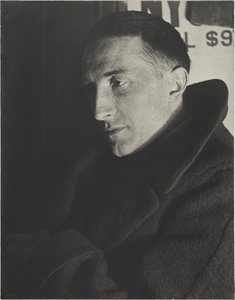
      Marcel Duchamp

      Marcel Duchamp

      1887 - 1968, France

      Quick facts about Marcel Duchamp

      • Artistic Movement Or Style:
        • Cubism
        • Dadaism
        • Conceptual Art
      • Artists Or Movements Influenced By This Artist:
        • Conceptual Art
        • Minimalism
        • Pop Art
      • Artists Who Influenced This Artist:
        • Cézanne
        • Picasso
        • Braque
      • Full Name: Henri-Robert-Marcel Duchamp
      • Nationality: French American
      • Notable Artworks:
        • Fountain
        • Bicycle Wheel
        • The Large Glass
      • Place Of Birth: Blainville-sur-Mer, France
      • Date Of Birth: 1887
      • Date Of Death: 1968

      Artist Biography

      A Revolutionary Spirit: The Life and Art of Marcel Duchamp

      Marcel Duchamp, born Henri-Robert-Marcel Duchamp in 1887 in Blainville-Crevon, Normandy, was more than an artist; he was a philosophical provocateur who fundamentally altered the course of modern art. His early life, though seemingly conventional – nurtured within a family that appreciated artistic expression with both brothers pursuing successful careers as artists – hinted at the iconoclasm to come. Duchamp initially pursued formal training, mastering traditional techniques and experimenting with post-impressionist styles. However, this academic foundation served not as an end in itself, but as a springboard for questioning the very nature of art, its purpose, and its definition. He wasn’t content merely to depict the world; he sought to challenge how we perceive it, and what constitutes artistic value. This restless intellectual curiosity would become the defining characteristic of his prolific career.

      From Cubism to Dada: A Rejection of Convention

      Duchamp's artistic journey was marked by a constant evolution, a deliberate shedding of established norms. His initial engagement with Cubism, evident in works like *Portrait of Chess Players* (1911), demonstrated an interest in fragmented forms and multiple perspectives – a departure from traditional representation. Yet, he quickly moved beyond purely aesthetic concerns, recognizing that simply rearranging visual elements wasn’t enough to address the deeper questions swirling within him. The horrors of World War I fueled this discontent, leading Duchamp to embrace Dadaism, a movement born out of disillusionment and a rejection of logic, reason, and traditional artistic values. It was within the Dadaist framework that Duchamp truly began to dismantle conventional notions of art. He wasn’t interested in creating beautiful objects; he wanted to provoke thought, challenge assumptions, and expose the arbitrariness of aesthetic judgment. This period saw the birth of his most radical innovation: the ‘readymade’.

      The Readymades and the Subversion of Art

      The introduction of readymades – ordinary manufactured objects selected and presented as art – was Duchamp’s most significant contribution to the 20th century. These weren't simply found objects; they were deliberate acts of artistic subversion. By taking an everyday item, like a urinal (*Fountain*, 1917), signing it “R. Mutt,” and submitting it to an art exhibition, Duchamp challenged the very definition of artistic skill and authorship. Was it the artist’s hand that created the work, or was it the artist's *idea*? This question became central to his practice and laid the groundwork for Conceptual Art. Other notable readymades like *L.H.O.O.Q.* (1919), a postcard reproduction of the Mona Lisa defaced with a mustache and goatee, were playful yet pointed critiques of art history and established cultural icons. These works weren’t meant to be admired for their aesthetic qualities; they were intended to provoke debate and force viewers to reconsider their preconceived notions about what constitutes art. Duchamp believed that art should reside in the mind, not merely in the eye.

      Legacy and Enduring Influence

      Marcel Duchamp's impact on subsequent generations of artists is immeasurable. He fundamentally altered our understanding of art, paving the way for movements like Conceptual Art, Minimalism, Pop Art, and countless others. His emphasis on the artist’s idea – the concept behind the work – over its aesthetic qualities continues to inspire artists today.
      • Cubism: Early exploration of fractured forms and spatial representation.
      • Dadaism: Rejection of logic, reason, and traditional artistic values in response to World War I.
      • Conceptual Art: Emphasis on the idea behind the artwork rather than its aesthetic qualities.
      His work continues to provoke debate and challenge viewers to reconsider their assumptions about creativity and artistic expression. Duchamp wasn’t simply an artist; he was a philosopher, a provocateur, and a revolutionary who dared to question everything. He remains a central figure in discussions about the nature of art and its role in society, his legacy resonating powerfully within the contemporary art world. The Large Glass (1915-1923), with its complex symbolism and enigmatic imagery, stands as a testament to his intellectual rigor and enduring influence. Duchamp’s work is not about providing answers; it's about asking questions – questions that continue to challenge and inspire us today.

      § 5Comparanda

      § 6Questions

      Quick Facts

      • Notable elements or techniques: Chronophotography influence; Sequential images
      • Title: Portrait (Dulcinea)
      • Influences:
        • Étienne-Jules Marey
        • Eadweard Muybridge
      • Artistic style: Geometric abstraction
      • Subject or theme: Female portraiture; Time and movement
      • Movement: Cubism

      § 7Cite this entry

      AllPaintingsStore.com, “Marcel Duchamp, Portrait (Dulcinea) (1911)”, https://allpaintingsstore.com/en/art/marcel-duchamp-portrait-dulcinea-8XYHE2-en/ArtistReproduction/ (accessed 3 October 2026).

      § 8The reproduction

      Hand Made Oil Reproduction

      Hand-painted oil on canvas in your size and frame, made to order by our artists. ( Switch to Print Switch to Digital Image)

      It is specified on the order sheet in the margin; the present state of that sheet reads as follows.

      Portrait (Dulcinea)

      Reproduction Medium

      Reproduction Size

      -

      Elite Senior Artist

      More detail, finesse, and extra production time

      -

      Reproduction Frame

      -

      -

      For artworks or reproductions larger than 105 cm (approximately 41 inches) on any side, the frame will be shipped as a kit, disassembled. This method ensures safe delivery and prevents damage during transport.

      Professional assembly required - this is not a DIY product.
      The kit must be assembled and the canvas stretched by an experienced professional framer, using wood glue (not supplied), a canvas stretching plier and clamps to hold the bars square while the glue dries. Incorrect assembly or uneven canvas tension can permanently damage the artwork and is not covered by our warranty.

      • All solid wood bars are included, precisely cut to size.

      • Assembled with the screws provided, plus wood glue for the corner joints, which is not supplied and must be sourced by your framer.

      • Professional tools are required and not included: a canvas stretching plier (tensioner) and clamps to hold the bars square while the glue dries.

      Important:
      The corner joints require wood glue, the bars must be held with clamps until the glue is fully dry, and tightening the canvas on the assembled frame requires a canvas stretching plier. None of these are included in the kit. Please arrange an experienced professional framer before ordering this size.

      Nameplate

      -

      -

      Protective Varnish

      Glossy Varnish (enhances colors, protects against light/moisture)

      -

      Customize My Artwork

      Examples of what can be changed: Replace face with customer photo; Add pet (e.g., replace cat with dog); Include hidden message in background; Change background landscape or elements.

      -

      Urgent

      Worldwide Delivery () in 3/4 weeks instead of standard 5 weeks. (31 October). No compromise on quality.

      -

      Express Shipping

      Worldwide Delivery () in 5 weeks. (7 November).

      Included

      Total Price

      $ 258

      Included with every order

      • Free Worldwide Express Shipping
      • High-Quality Linen Canvas
      • Full Shipping Insurance
      • Customs Tax Refund Guarantee
      • True Color Matching Guarantee
      • 100-Day Return Policy (Defects Only)
      • 100% Money-Back Guarantee
      • Bulk Discount Offer
      Order sheet