

No. 24 Hand-painted oil painting – standard and custom sizes
Oil On Canvas.

§ 1Catalogue data


This Artwork Is Under Copyright Protection
The artwork displayed on this page is protected by copyright law, which means we cannot legally create or sell an identical reproduction. This protection is enforced under international agreements such as the Berne Convention and by national laws, including those outlined by the U.S. Copyright Law - Title 17.
As a respectful and legal alternative, we offer custom, hand-painted artworks inspired by the original. Our skilled and professional artists carefully study the original's style, mood, and artistic essence to create a new, unique piece that evokes the same feeling - while remaining an original creation in its own right.
This method fully complies with copyright regulations because it does not involve copying or duplicating the protected artwork. Instead, it is a creative reinterpretation - a new painting that is influenced by the original but not identical to it.
 Read more
§ 2Abstract
Collectible Description
Experience the haunting beauty of Mark Rothko’s abstract expressionist masterpiece, ‘No. 24,’ capturing a contemplative face against a blurred monochrome backdrop—a poignant exploration of emotion and form from the mid-century period. Discover this evocative artwork and bring its timeless vision home.
Artist Biography
Mark Rothko mastered Color Field painting with the Seagram Murals. Discover the emotional power of his iconic abstract works today.
§ 3Commentary
The Weight of Absence: A Journey into Rothko’s No. 24
To stand before Mark Rothko’s No. 24 is not merely to view a painting, but to enter into a profound, silent dialogue with the human soul. In this evocative work, the boundaries between the viewer and the canvas begin to dissolve, leaving behind only a sense of weight, light, and an almost overwhelming emotional resonance. The painting presents a solitary human face—a deliberate simplification that prioritizes emotional resonance over realistic representation. Rothko eschews detailed anatomical rendering, opting instead for amorphous shapes that convey an overwhelming sense of vulnerability and introspection. The blurred background serves to heighten the focus on this central figure, creating a visual dialogue between presence and obscurity that pulls the observer into a meditative state.
The technical mastery behind this piece embodies the core tenets of Abstract Expressionism, specifically Rothko’s signature Color Field painting style. Through the thick application of rectangular blocks of color—primarily shades of black and white—the artist creates expansive planes that dominate the canvas. This technique is characterized by a deliberate lack of visible brushstrokes, resulting in a surface texture that appears almost velvety to the eye. The mesmerizing effect is achieved through careful pigment layering and optical blending, where colors seem to vibrate against one another. For the collector or interior designer, this creates a piece that possesses a unique atmospheric gravity, acting as a focal point that commands attention through its quiet, rhythmic breathing of color.
Symbolism and the Echoes of History
Emerging from the turbulent postwar artistic landscape, No. 24 reflects the deep-seated anxieties of an era marked by the disillusionment following World War II. Influenced by Surrealism and Gestalt psychology, Rothko sought to bypass conscious thought to tap into primal emotions. His chosen palette is laden with profound symbolic significance: the black represents darkness, grief, and mortality, while the white embodies purity, spirituality, and transcendence. The juxtaposition of these opposing hues creates a tension that mirrors the complexities of human existence itself. It is a visual manifestation of the search for meaning amidst chaos.
Beyond its aesthetic beauty, the painting invites deep contemplation on themes of isolation, loss, and the eternal yearning for connection. For those seeking to adorn a space with art that inspires reflection, this work offers a sanctuary of pure emotion. Whether placed in a quiet study or a grand gallery, a high-quality reproduction of No. 24 brings with it a sense of historical depth and existential inquiry, making it an incomparable choice for anyone looking to infuse their environment with intellectual and emotional sophistication.
Questions & Answers
How is the mood of "No. 24" by Mark Rothko described?
The overall mood of "No. 24" by Mark Rothko is calm. The mood describes the general atmosphere of the work.
How do the colors of "No. 24" relate to each other?
The color harmony of "No. 24" is recorded as unified palette.
Which color stands out most in "No. 24"?
The color that stands out most in "No. 24" is rosy brown (#b79d7f). The dominant color is useful when matching an artwork to an interior.
§ 4The artist
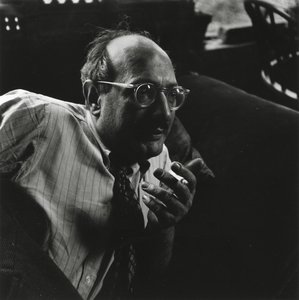
Mark Rothko
1903 - 1970, Latvia
Quick facts about Mark Rothko
- Artistic Movement Or Style: Abstract Expressionism, Color Field Painting
- Artists Or Movements Influenced By This Artist: ['Minimalist art']
- Full Name: Markus Yakovlevich Rothkowitz
- Nationality: American
- Notable Artworks:
- No. 10
- Seagram Murals
- Untitled
- Place Of Birth: Daugavpils, Latvia
- Date Of Birth: 1903
- Date Of Death: 1970
Artist Biography
A Life Shaped by Displacement
Mark Rothko arrived in the United States as a young boy, part of a family moving from Dvinsk, Latvia, to Portland, Oregon, in 1913. His early years were marked by the heavy atmosphere of the Pale of Settlement, where his family lived amidst political unrest and the fear of pogroms. This sense of instability followed him across the ocean. The loss of his father, Jacob, shortly after their arrival in America added a layer of personal grief to the challenges of settling in a new culture. While he studied at Yale University, the pull of New York City eventually led him to leave formal academics behind for the Art Students League.
His upbringing was one of intellect and debate. His father, a pharmacist with socialist leanings, fostered a home where learning was central. This environment, combined with the hardships of the immigrant experience, created a deep sensitivity to human suffering. These early experiences of loss and the struggle to find a place in a chaotic world became the quiet foundation for everything he would later paint.
From Figures to Fields of Color
In his early years in New York, Rothko focused on realism, painting portraits and urban scenes with careful attention to detail. As the 1940s brought the horrors of World War II, his work began to shift. He moved away from recognizable objects, looking instead toward Surrealism and mythology to find a way to express universal human emotions. During this period, his canvases featured biomorphic shapes that seemed to float between being figures and being abstract forms.
By the late 1940s, he had developed the style that would define his career. He stripped away all imagery, leaving only large-scale canvases with rectangular blocks of color. These forms appeared to hover and resonate against one another. He used thin washes of paint to create subtle changes in tone and texture, making the edges of his shapes appear blurred. He often avoided titles, using simple numbers like No. 1 or No. 6 so that viewers could face the work without any preconceived ideas.
The Search for Emotional Truth
Rothko’s mature period is associated with Color Field painting. His goal was to use color to speak directly to the human soul, bypassing the intellect to reach deep emotions such as tragedy, ecstasy, and despair. He meticulously layered paint to create a sense of depth and light that seemed to come from within the canvas itself. These large works were intended to envelop the viewer in an immersive experience.
His commitment to this emotional honesty led to several significant projects:
- The Seagram Murals, which he originally intended for a New York restaurant but later donated to the Tate Gallery after feeling the setting would compromise the work.
- The Rothko Chapel in Houston, Texas, a non-denominational space containing fourteen of his paintings in varying shades of black, designed as a place for quiet reflection.
- The Harvard Mural series, which were donated to a dining room at the Holyoke Center.
Despite his immense influence on Abstract Expressionism and the later Minimalist movement, Rothko struggled with depression throughout his life. He died by suicide in 1970. His work remains a central part of modern art history, found in permanent collections such as the Museum of Modern Art in New York and the Tate Modern in London.
§ 5Comparanda
Related Artworks


§ 6Questions
§ 7Cite this entry
AllPaintingsStore.com, “Mark Rothko, No. 24”, https://allpaintingsstore.com/en/art/mark-rothko-no-24-8BWU99-en/ArtistReproduction/ (accessed 1 October 2026).
§ 8The reproduction
Hand Made Oil Reproduction
Hand-painted oil on canvas in your size and frame, made to order by our artists. ( Switch to Print Switch to Digital Image)
It is specified on the order sheet in the margin; the present state of that sheet reads as follows.

No. 24
Reproduction Medium
Reproduction Size
-

Elite Senior Artist
More detail, finesse, and extra production time
-

Reproduction Frame
-
-
For artworks or reproductions larger than 105 cm (approximately 41 inches) on any side, the frame will be shipped as a kit, disassembled. This method ensures safe delivery and prevents damage during transport.
Professional assembly required - this is not a DIY product.
The kit must be assembled and the canvas stretched by an experienced professional framer, using wood glue (not supplied), a canvas stretching plier and clamps to hold the bars square while the glue dries. Incorrect assembly or uneven canvas tension can permanently damage the artwork and is not covered by our warranty.
 For artworks or reproductions larger than 105 cm (approximately 41 inches) on any side, the frame will be shipped as a kit, disassembled. This method ensures safe delivery and prevents damage during transport.
All solid wood bars are included, precisely cut to size.
Assembled with the screws provided, plus wood glue for the corner joints, which is not supplied and must be sourced by your framer.
Professional tools are required and not included: a canvas stretching plier (tensioner) and clamps to hold the bars square while the glue dries.
Important:
The corner joints require wood glue, the bars must be held with clamps until the glue is fully dry, and tightening the canvas on the assembled frame requires a canvas stretching plier. None of these are included in the kit. Please arrange an experienced professional framer before ordering this size.

Nameplate
-
-

Protective Varnish
Glossy Varnish (enhances colors, protects against light/moisture)
-

Customize My Artwork
Examples of what can be changed: Replace face with customer photo; Add pet (e.g., replace cat with dog); Include hidden message in background; Change background landscape or elements.
-

Urgent
Worldwide Delivery () in 3/4 weeks instead of standard 5 weeks. (29 October). No compromise on quality.
-
Express Shipping
Worldwide Delivery () in 5 weeks. (5 November).
Included
Total Price
$ 258
Included with every order
- Free Worldwide Express Shipping
- High-Quality Linen Canvas
- Full Shipping Insurance
- Customs Tax Refund Guarantee
- True Color Matching Guarantee
- 100-Day Return Policy (Defects Only)
- 100% Money-Back Guarantee
- Bulk Discount Offer


