Acrylic.

§ 1Catalogue data

This Artwork Is Under Copyright Protection
The artwork displayed on this page is protected by copyright law, which means we cannot legally create or sell an identical reproduction. This protection is enforced under international agreements such as the Berne Convention and by national laws, including those outlined by the U.S. Copyright Law - Title 17.
As a respectful and legal alternative, we offer custom, hand-painted artworks inspired by the original. Our skilled and professional artists carefully study the original's style, mood, and artistic essence to create a new, unique piece that evokes the same feeling - while remaining an original creation in its own right.
This method fully complies with copyright regulations because it does not involve copying or duplicating the protected artwork. Instead, it is a creative reinterpretation - a new painting that is influenced by the original but not identical to it.
 Read more
§ 2Abstract
Collectible Description
Experience the haunting beauty of Mark Rothko’s Untitled 131 – a monumental abstract expressionist canvas featuring layered crimson rectangles against a velvety dark backdrop. This evocative piece captures Rothko's signature meditative style, born from postwar anxieties and inviting contemplation on profound existential questions.
Artist Biography
Mark Rothko mastered Color Field painting with the Seagram Murals. Discover the emotional power of his iconic abstract works today.
§ 3Commentary
The Resonance of Absence: Exploring Mark Rothko’s Untitled 131
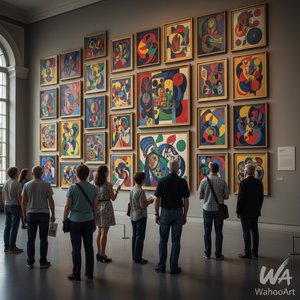
Mark Rothko's "Untitled 131" stands as a testament to the power of minimalist abstraction—a deceptively simple canvas that belies an immense depth of emotion and intellectual contemplation. Created in 1968, shortly before his death, this oil on canvas exemplifies Rothko’s signature approach to painting, prioritizing color and form over representational imagery to provoke profound responses from the viewer. The photograph captures a meticulously reproduced version of this iconic artwork, allowing us to appreciate its subtle nuances and enduring legacy.- Subject Matter: At first glance, “Untitled 131” presents itself as an austere expanse of dark pigment—a velvety black that dominates the canvas. However, scattered across this darkness are five rectangular blocks of crimson red, positioned vertically along the center axis. <
- Style and Technique: Rothko’s method was revolutionary for its time. He eschewed brushstrokes altogether, applying thin layers of oil paint in a technique known as “color field painting.” This process involved pouring pigment onto the canvas, allowing it to bleed into adjacent areas, creating an almost ethereal effect. The resulting surfaces are matte and luminous, absorbing light rather than reflecting it—a deliberate choice designed to immerse the viewer in a sensory experience.
Historical Context: Minimalism and Existential Anxiety
The late 1960s witnessed a burgeoning interest in minimalism within the art world, fueled by disillusionment with grand narratives and an urgent desire for introspection. Rothko’s work coincided perfectly with this cultural shift, reflecting the anxieties of the era—the Cold War tensions, the Vietnam War protests, and a pervasive questioning of societal values. Yet, unlike many artists grappling with these concerns, Rothko avoided explicit political statements; instead, he sought to communicate universal human emotions through pure color and shape.- Symbolism: The dark background serves as a canvas for the red rectangles, symbolizing not just color but also concepts of darkness, grief, and vulnerability. Simultaneously, the rectangles represent fragments of light—hope, remembrance, and perhaps even transcendence. Their placement along the vertical axis reinforces this duality, suggesting an interplay between opposing forces.
- Emotional Impact: Rothko famously described his paintings as “windows onto eternity.” He aimed to bypass rational thought and tap into primal feelings—a desire for solace, a yearning for connection with something larger than oneself. Viewing "Untitled 131" is intended to be an immersive experience, inviting contemplation and fostering a sense of profound stillness.
The Reproduction: Capturing Rothko’s Essence
A high-quality reproduction of “Untitled 131” allows collectors and interior designers alike to bring this masterpiece into their homes. Careful attention must be paid to pigment accuracy—reproducing the subtle variations in hue and tone that characterize Rothko's original canvases is paramount. Furthermore, the matte finish of the painting should be faithfully replicated to preserve its luminous quality and evoke the same contemplative atmosphere.- Considerations for Interior Design: The artwork’s muted palette lends itself beautifully to calming spaces—living rooms bathed in natural light or bedrooms seeking serenity. Its understated elegance complements a variety of design styles, from Scandinavian minimalism to contemporary bohemian chic.
- Investment Value: Rothko's work commands considerable respect within the art market, recognized for its artistic innovation and enduring emotional resonance. Reproductions offer an accessible pathway to experiencing this influential artist’s vision without incurring the substantial costs associated with owning original pieces.
Questions & Answers
Are the colors of "Untitled 131" by Mark Rothko vivid or muted?
The colors of "Untitled 131" by Mark Rothko show a muted saturation with a monochromatic intensity.
What national origin stands behind the Abstract Expressionism of "Untitled 131"?
"Untitled 131" connects the Abstract Expressionism movement with Latvia through its creator's birthplace.
What orientation does "Untitled 131" by Mark Rothko have?
The format of "Untitled 131" is portrait. This is useful when planning where a reproduction will be placed.


 Switch to Print


 For artworks or reproductions larger than 105 cm (approximately 41 inches) on any side, the frame will be shipped as a kit, disassembled. This method ensures safe delivery and prevents damage during transport.