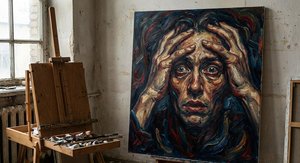
The Life and Art of Max Beckmann
Max Beckmann was a man of many disciplines, working as a painter, draftsman, printmaker, sculptor, and writer. He entered the world on February 12, 1884, in Leipzig, Saxony. He grew up in an upper-middle-class family as the youngest of three children. His early years were shaped by the quiet stability of his home until 1894, when his father, Carl Beckmann, a grain merchant, passed away. His mother, Antoine Beckmann, remained a central figure in his life as he began to find his way through the complexities of modern existence.
His work often felt like a confrontation with the reality of the human condition. He did not merely paint scenes; he captured the tension of a changing era through a variety of mediums. His output was vast, ranging from large-scale canvases to intimate prints. He was a man who sought to articulate the weight of history through his hands, often using the tools of his trade to process the shifting landscapes of the twentieth century.
Early Life and Artistic Training
Born into a middle-class family in Leipzig, Germany, Max Beckmann showed an early inclination toward drawing. His initial sketches revealed a precocious talent that hinted at the depth of his later work. During these formative years, he sought out the rigor of the old traditions, training in a conservative academic style that emphasized technical precision. This grounding in formal technique provided him with a solid foundation, even as his own spirit began to push against the boundaries of conventional methods.
As he matured, Beckmann found himself drawn to the Old Masters. He spent much of his time studying their compositions and mastery of form, a fascination that would eventually help him develop a strikingly original style. He was not content with mere imitation; instead, he used the lessons of the past to build a personal visual language. This period of study was marked by a tension between his academic training and a growing desire to express something more profound and less structured.
By 1912, he was already tackling ambitious subjects that required a command of large-scale composition. One such work was his painting of The Sinking of the Titanic, a piece that demonstrated his ability to handle complex, dramatic narratives. At this stage, his work was characterized by academically correct depictions, focusing on the weight and presence of figures within a defined space. He was a history painter at heart, using the grand scale of the past to explore the human condition through a lens of structured, deliberate form.
Experiences During World War I
The outbreak of World War I brought a sudden, violent end to Beckmann's academic training. He did not remain a bystander to the conflict; instead, he volunteered to serve in the medical corps. Working as a medical orderly, he was thrust into the direct reality of human suffering. The clinical, structured world of his early training was replaced by the chaotic and harrowing conditions of the front lines.
The strain of this service eventually became too much to bear. While stationed on the Belgian front, the weight of the war's devastation led to a nervous breakdown. He was discharged from the military in 1915, returning to a life that had been fundamentally altered by what he had witnessed. The horrors he saw during his time in the medical corps ignited a radical shift in his vision. The academic precision of his youth gave way to a new way of seeing, one that reflected a fractured and troubled humanity.
Artistic Style and Technique
Beckmann’s visual language was built from a tension between tradition and a restless, modern impulse. He looked back to the Old Masters, finding a foundation in the works of Rembrandt and Rubens, while also drawing from the structured forms of Cézanne and the emotive brushwork of Van Gogh. His compositions often felt crowded and compressed, utilizing shallow space and dark, heavy outlines to push his subjects toward the viewer. This technique created a sense of claustrophobia, as if the figures were trapped within the frame. He frequently paired this distorted figuration with a brutal realism, using his canvases to offer sharp social criticism of the world around him.
The physical application of paint was central to his expressive power. He favored a masterful impasto technique, applying the medium in thick, gestural brushstrokes that gave his surfaces a palpable, heavy weight. This texture added a sense of urgency to his depictions of human struggle. His interests were not limited to the Western tradition; he also found inspiration in the unsettling, symbolic narratives of Northern European artists like Bosch, Bruegel, and Matthias Grünewald. By blending these influences, he developed a way of painting that felt both ancient and deeply rooted in the anxieties of the twentieth century.
- The Night (1919)
- The Iron Bridge (View of Frankfurt) (1922)
- Self-Portrait with Horn (1938)
- The Night (1919)
The Weimar Republic and New Objectivity
During the 1920s, Beckmann found himself moving through a Germany that was struggling to find its footing. He became associated with the New Objectivity movement, a style that moved away from the inward-looking emotions of earlier years toward a more direct, often biting, look at reality. His work from this period captured the doomed nature of the Weimar Republic with a sense of acidic cynicism. He did not shy away from the chaos of the era, instead using his brush to document the tension of a society in transition.
Even when his subjects appeared light or festive, such as circus performers or social gatherings, an undercurrent of moodiness or unease often remained beneath the surface. There was a persistent sense of discomfort in his compositions. This tension was particularly evident in his graphic work. He produced several black-and-white print portfolios during these years, including the work titled Hell, which utilized the raw power of printmaking to explore the darker aspects of the human condition.
- The Night (1919)
- The Iron Bridge (View of Frankfurt) (1922)
- Rugby players (1929)
Exile in Amsterdam and the Nazi Regime
The political climate in Germany grew increasingly hostile toward Beckmann’s vision. In 1933, the rise of the Nazi regime brought direct consequences to his professional life when he was dismissed from his teaching position at the Stadel Art School in Frankfurt. His work was targeted by the authorities and included in the Degenerate Art exhibition, a move that signaled the impossibility of remaining in his homeland. Facing this mounting pressure and the threat of the regime, he chose to leave Germany behind.
Beckmann spent ten years in self-imposed exile in Amsterdam. This period was marked by the profound uncertainty of living through the Second World War. While in Amsterdam, his paintings often turned toward mythic and parabolic images, moving away from the specific realities of the world he had left behind. His art during these years reflected a sense of being unmoored from a particular time or place, focusing instead on the internal struggles of the human condition.
Life and Work in America
After years of living in exile in Amsterdam, Max Beckmann finally immigrated to America in 1947. His arrival marked a new chapter of stability, though his focus remained deeply tied to the act of creation and the sharing of his craft. He spent his first two years in the United States living in St. Louis, Missouri, where he became an active part of the local artistic community. During this time, he shared his knowledge through teaching positions at Washington University in St. Louis and the Brooklyn Museum.
The final years of his life were spent in New York, where he moved in 1949. This period was brief, lasting only until his death in 1950. Even in these concluding months, his work continued to reflect the personal and psychological depth that had characterized his entire career. His presence in the American art scene was marked by a refusal to simplify his complex visual language, even as he settled into a new home far from his German roots.
Notable and Key Artworks
Beckmann’s canvases often felt like crowded, claustrophobic rooms where the tension of the era was physically palpable. In 1919, he produced The Night, a work that captures the fragmentation of modern life through distorted figures and a sense of profound alienation. This piece reflects the societal trauma left in the wake of the Great War, using a heavy, psychological approach to depict the chaos of the post-war period. His ability to translate internal anxiety into a visual language became a defining feature of his output.
As the industrial landscape of Germany shifted, so did his focus. His 1922 painting, The Iron Bridge (View of Frankfurt), uses thick, gestural brushstrokes to depict a city in transition. The composition is anchored by the heavy, geometric silhouette of the suspension bridge, cutting through a palette of saturated earth tones and industrial grays. It captures the pulsating energy of an urban environment caught between the old world and a rapidly modernizing future.
Throughout his life, Beckmann returned to his own image, using his own face to explore the human condition. His 1938 work, Self-Portrait with Horn, shows him navigating a world of increasing uncertainty. Even in his final years, his work remained deeply personal. His Self-Portrait in Blue Jacket, painted in 1950, remains a significant part of his late period, reflecting the man he had become after his time in exile and his move to America.
Legacy and Historical Impact
Max Beckmann remains a central figure in the history of 20th-century painting. While he often resisted the labels placed upon him, his work is widely considered a cornerstone of the German Expressionism movement. He possessed a singular ability to translate the fractured psyche of a continent into a visual language that felt both deeply personal and universally understood. His paintings do not merely depict scenes; they carry an extraordinary psychological depth that forces a confrontation with the human condition.
His influence extended far beyond the borders of Germany. Even as he navigated the difficult years of exile in Amsterdam and his eventual move to the United States, his voice remained distinct. He managed to bridge the gap between traditional academic training and the radical shifts of modernism. By refusing to settle into a single movement, he carved out a space that was entirely his own, characterized by a tension between the physical world and the internal, often troubled, landscape of the mind.
- The Night (1919)
- The Iron Bridge (View of Frankfurt) (1922)
- Self-Portrait with Horn (1938)
- The Prodigal Son (1949)
Where to See His Works Today
Finding the physical traces of Beckmann's life requires traveling through the cities that shaped his exile and his later years. In Germany, the Kunstsammlung Nordrhein-Westfalen in Duesseldorf maintains a significant presence of his work, holding pieces like The Night from 1919. His presence in Europe is also felt in Zurich, where the Kunsthaus Zürich preserves his imagery. These collections offer a way to see how his vision shifted as he moved through the complexities of the early twentieth century.
For those following his path to the United States, his later life is documented in American institutions. The Metropolitan Museum of Art in New York holds works from his final years, including his 1950 Self-Portrait in Blue Jacket. The Museum of Modern Art (MoMA) also maintains his works within its permanent collection. These pieces reflect the final chapter of a man who spent his last years navigating the streets of New York.
- The Night (1919)
- Self-Portrait in Blue Jacket (1950)
- Seascape with poplars (1924)
- The Iron Bridge (View of Frankfurt) (1922)


 Read More


 Switch to Print


 For artworks or reproductions larger than 105 cm (approximately 41 inches) on any side, the frame will be shipped as a kit, disassembled. This method ensures safe delivery and prevents damage during transport.