


 Preview
 Send
Send Share
Share
 Details
 Guide
Guide

 Download
 Similars
 X-Ray
X-Ray Diaporama
 Q&A
Q&A Stats
StatsUntitled

- 38.0 x 50.0 cm


 Read More
The artwork displayed on this page is protected by copyright law, which means we cannot legally create or sell an identical reproduction. This protection is enforced under international agreements such as the Berne Convention and by national laws, including those outlined by the U.S. Copyright Law - Title 17.
This method fully complies with copyright regulations because it does not involve copying or duplicating the protected artwork. Instead, it is a creative reinterpretation - a new painting that is influenced by the original but not identical to it.
Giclée / Art Print
Museum-quality giclée or canvas print with fast production and flexible finish options. ( Buy Hand Made Painting Switch to Digital Image)




P118B $10

P118H $10

P118W $10

P438Z $10

P508JH $12

P508YH $12

P805H $10

P805Z $10

P919BZ $10

P919G $10

P919XJ $10

P959ZH $10

P968JZ $12

W106C $8

W218G $10

W218JH $8

W218Y $10

W307PJ $10

W316G $10

W316PJ $8

W316Y $10

W398PJ $8

W4111J $10

W500HY $15

W500JH $15

W692G $12

W849H $8

W940BG $15

W953PJ $8




Pick from our preset sizes that match the artwork's original proportions.

Type the width and the height you need, to fit your frame or your wall. A print can only be cut, never made bigger than the picture, so a size with a different shape loses a part of the image. We send you a digital mockup to approve before we print anything. The picture shown on this page does not show the real cut — only the mockup does.
Worldwide Delivery () in 2 weeks instead of standard 4/5 weeks. (1 November)

Free Worldwide Express Shipping

High-Quality Linen Canvas

Full Shipping Insurance

Customs Tax Refund Guarantee

True Color Matching Guarantee

100-Day Return Policy (Defects Only)

100% Money-Back Guarantee

Bulk Discount Offer
 Glass option is only available in size under 110 CM

Untitled
Giclée / Art Print
Reproduction Size
-


Total Price
$ 65
A Visionary Tapestry of Nature and Spirit
In the ethereal realm of Minnie Evans’ 1960 masterpiece, Untitled, the boundaries between the earthly and the divine dissolve into a breathtaking display of color and light. This captivating work invites the viewer into a dreamscape where two women, draped in flowing garments, stand as silent sentinels amidst a flourishing paradise. The composition is an intricate dance of life; long, cascading hair blends seamlessly with the surrounding flora, creating a sense of profound unity between the human form and the natural world. As one gazes upon this piece, the vibrant blue sky serves as a celestial backdrop for a scene teeming with movement—birds flit through the air, and distant figures emerge from the lush greenery, suggesting a larger, interconnected universe that exists just beyond the frame.
The technique employed in this work reflects Evans’ unique position as a premier Southern Folk and Visionary artist. Her approach is characterized by a meticulous, almost meditative attention to detail, where every petal, leaf, and feather is rendered with a rhythmic precision that feels both organic and supernatural. The painting utilizes a rich, saturated palette that breathes life into the canvas, using bright hues to evoke the warmth of a Southern afternoon and the spiritual clarity of a vision. This layering of intricate motifs creates a dense, textured visual experience, making the artwork feel less like a static image and more like a living, breathing ecosystem of symbols.
Symbolism and the Soul of the American South
To understand Untitled, one must look through the lens of Evans’ personal history and her deeply spiritual worldview. Born in the segregated South, Evans transformed her lived experiences and her profound religious visions into a universal language of hope and transcendence. The lush vegetation and blooming flowers are not merely decorative; they represent the cyclical nature of life, rebirth, and the enduring beauty that persists despite societal hardship. The presence of birds often serves as a symbol of the soul’s flight or a messenger from the divine, adding a layer of spiritual weight to the whimsical landscape. Each element within this botanical tapestry acts as a fragment of a larger, cosmic puzzle, inviting collectors and observers to contemplate the interconnectedness of all living things.
For the discerning collector or interior designer, this piece offers more than just aesthetic splendor; it provides an emotional anchor for any space. The artwork possesses a rare ability to command attention while simultaneously offering a sense of tranquility and peace. Whether placed in a contemporary gallery setting or as a focal point in a sophisticated residential interior, Untitled brings with it an aura of storytelling and historical depth. It is a piece that rewards repeated viewing, revealing new layers of complexity and charm each time the eye wanders through its enchanted garden, making it an incomparable acquisition for those who value art that speaks to the resilience and beauty of the human spirit.
Questions & Answers
Is "Untitled" by Minnie Evans a bright or a dark artwork?
Overall, "Untitled" is recorded as bright. Perceived brightness describes how light or dark the work appears.
What stage of Minnie Evans's career does "Untitled" (1960) belong to?
"Untitled", created in 1960, belongs to the Mature Period of Minnie Evans's career.
How harmonious are the colors of "Untitled" by Minnie Evans?
"Untitled" by Minnie Evans displays a discordant palette color harmony.
Related Artworks


Artist Biography
A Visionary’s Journey: The Life and Art of Minnie Evans
Minnie Eva Jones, known to the world as Minnie Evans, emerged from humble beginnings in Long Creek, North Carolina, in 1892, to become one of the most celebrated self-taught artists of the American South. Her life story is a testament to the power of inner vision and the enduring spirit of creativity flourishing against societal constraints. Born into challenging circumstances – her mother was just thirteen years old at the time of her birth – Evans’ early life was marked by movement and adaptation, relocating with her mother and grandmother to Wilmington, North Carolina, shortly after she was born. This formative period, steeped in the realities of a segregated society, undoubtedly shaped her perspective and fueled the intensely personal symbolism that would later define her art. Though formal education ended in the sixth grade, Evans’ intellectual curiosity remained vibrant, nurtured by stories, observations of nature, and a deep spiritual inclination. She worked various jobs, including selling shellfish door-to-door as a “sounder,” experiences which grounded her in the rhythms of daily life while simultaneously allowing space for the burgeoning world within her imagination.The Awakening: Dreams, Visions, and Artistic Genesis
The genesis of Evans’ artistic career was profoundly unconventional. It wasn't a gradual exploration or formal training that sparked her creativity, but rather an urgent inner compulsion. In 1935, on Good Friday, she completed two drawings dominated by concentric circles and linear motifs, accompanied by a powerful auditory hallucination: a voice commanding, “Why don’t you draw or die?” This wasn't merely inspiration; it was a directive, a life-altering call to express the visions that had haunted and captivated her since childhood. For several years, she paused her artistic endeavors, only returning to them in 1940, experimenting with wax crayons, pencils, and eventually oil paints. Her subject matter stemmed directly from these internal landscapes – biblical scenes interwoven with fantastical flora and fauna, portraits of enigmatic figures, and abstract compositions brimming with symbolic meaning. The influence of African, Caribbean, East Indian, Chinese, and Western cultures subtly permeated her work, a testament to the breadth of her inner world despite limited travel experiences. Her artistic process was intuitive and unrestrained; she claimed no imagination, stating that her works simply *happened*, dictated by the visions themselves.Airlie Gardens and Rising Recognition
For much of her adult life, Evans balanced her artistic pursuits with practical necessity. From 1948 until her retirement in 1974, she served as the gatekeeper at Airlie Gardens in Wilmington, North Carolina. This position proved pivotal not only for financial stability but also for exposure and inspiration. The lush gardens provided a constant source of imagery – vibrant colors, intricate patterns, and the organic forms that frequently appear in her paintings. More importantly, it allowed her to directly connect with visitors who were captivated by the unique artwork she displayed on the garden gate. Word spread, and soon people began visiting Airlie Gardens specifically to see Minnie Evans’ creations. Her first formal exhibition came in 1961 at The Artist's Gallery (later St. John’s Museum of Art) in Wilmington, marking a turning point in her career. This led to a crucial encounter with Nina Howell Starr, a photographer and art advocate who became instrumental in promoting Evans’ work on a national scale.Legacy and Lasting Impact
Nina Howell Starr's dedication was transformative. She not only publicized Evans’ art but also encouraged her to sign and date her pieces, establishing a sense of authorship and historical context. Starr arranged exhibitions in New York City, culminating in a major show at the Whitney Museum of American Art in 1975 – a landmark achievement for a self-taught African American artist. Throughout the late 1960s and 70s, Evans’ work gained increasing recognition, celebrated for its raw emotional power, vibrant colors, and deeply personal symbolism. Her art defied easy categorization, blending elements of folk art, surrealism, and visionary expression. Minnie Evans passed away in 1987 at the age of 95, leaving behind a rich artistic legacy that continues to inspire and intrigue. Today, her paintings are held in major museum collections across the United States, including the Smithsonian American Art Museum and the Cameron Art Museum, which houses the Minnie Evans Study Center dedicated to preserving and researching her life and work. Her story is a powerful reminder of the boundless potential of human creativity and the importance of recognizing artistic talent regardless of background or formal training. Her art remains a testament to the enduring power of dreams, visions, and the unwavering pursuit of self-expression.
Minnie Evans
1892 - 1987 , United States of America
Quick Facts
- Full Name: Minnie Eva Evans
- Nationality: American
- Date Of Birth: 1892
- Date Of Death: 1987
- Place Of Birth: Long Creek, South Carolina, United States of America
- Notable Artworks:
- Profile of Indian Woman
- African Face w/ Garden Scene
- Artistic Movement Or Style: Folk & Visionary art
- Artists Who Influenced This Artist:
- African, Caribbean cultures
- East India, Chinese styles
Related Articles

Echoes of Tradition: Exploring the Enduring Legacy of Folk Art Movements
Explore the rich history of folk art movements worldwide! Discover definitions, notable artists, and the enduring legacy of this captivating tradition. Expert insights & high-quality reproductions at AllPaintingsStore.

The Enduring Muse: Women as Subject & Symbol in Art History
Explore the rich history of women in art – from archetypal representations to contemporary voices challenging norms. Discover iconic artists & movements, and learn about reclaiming female narratives through painting and beyond.

The Soul of Tradition: Exploring the Vibrant Heritage and Naive Mastery of Global Folk Art
Discover the profound beauty of folk art through a cultural lens. Explore how naive masterpieces and vibrant global traditions preserve heritage, offering timeless inspiration for collectors and art enthusiasts seeking authenticity and soul in every brushstroke.

The Enduring Muse: Women as Subject & Symbol in Art History
Explore the rich history of women in art – from iconic muses to groundbreaking artists. Discover feminist movements, global perspectives & reclaim female narratives with AllPaintingsStore.
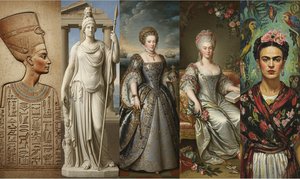
Portrayals of Power & Perception: A Historical Survey of Women in Art
Explore the rich history of women in art – from iconic muses to groundbreaking artists. Discover feminist movements & reclaim female narratives with AllPaintingsStore. Expert insights for discerning collectors.


