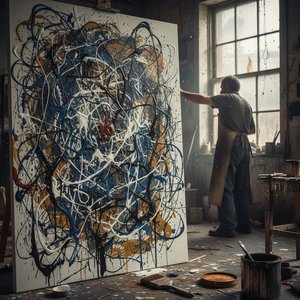
Oil On Canvas, 116.0 x 55.0 cm.

§ 1Catalogue data
 Oil On Canvas
- WallArt
- Abstract Expressionism
 Modern
 116.0 x 55.0 cm
§ 2Abstract
Collectible Description
Explore Jackson Pollock’s ‘Birth,’ a seminal Abstract Expressionist painting. Witness drip technique & chaotic energy in this 1950s oil on canvas masterpiece – a testament to raw emotion and innovative art.
 Read More
Artist Biography
Explore the revolutionary art of Jackson Pollock (1912-1956), pioneer of Abstract Expressionism & drip painting. Discover his iconic canvases, emotional intensity, and lasting impact on modern art. #AbstractExpressionism #Pollock
§ 3Commentary
A Tempestuous Birth: Decoding Pollock’s Abstract Vision
Jackson Pollock's *Birth* (1948-51) is a pivotal work within his mature “drip” period and a cornerstone of Abstract Expressionism. More than just an abstract composition, it represents a raw and visceral exploration of creation, chaos, and renewal – themes powerfully conveyed through its dynamic energy and complex layering. The painting doesn’t depict a literal birth; rather, it embodies the *feeling* of emergence, struggle, and transformation. It's a visual manifestation of internal forces unleashed onto the canvas.Technique & Materials: The Dance of Destruction and Creation
Pollock’s revolutionary technique is central to understanding *Birth*. Abandoning traditional easel painting, he laid his canvases on the floor, surrounding himself with pots of paint – primarily industrial enamels and aluminum paints alongside oil-based colors. He then employed sticks, hardened brushes, and even syringes to drip, fling, and pour paint onto the surface. This “action painting” wasn’t about carefully applying color; it was a performative act, a physical dialogue between artist and canvas. The resulting web of lines and splatters isn't random but meticulously controlled chaos. The layering is key, building up density and depth while simultaneously creating a sense of transparency where lighter colors peek through the darker ones. This technique allowed Pollock to circumvent representational concerns, focusing instead on pure form, color, and gesture. The size (116 x 55 cm) contributes to its immersive quality, drawing the viewer into the swirling vortex of paint.Symbolism & Interpretation: A Psychological Landscape
While Pollock resisted definitive interpretations of his work, *Birth* is often seen as reflecting his own psychological state and grappling with existential themes. The fragmented forms and turbulent energy can be interpreted as representing inner turmoil, anxiety, or the struggle to find meaning in a chaotic world. The presence of vaguely anthropomorphic shapes, particularly within the swirling blues and whites, suggests figures emerging from – or dissolving into – the surrounding darkness. Some scholars have linked these forms to ancient mythological imagery, hinting at archetypal themes of creation and destruction. The painting’s title itself is deliberately ambiguous; it doesn't specify *what* is being born, leaving room for personal interpretation. Is it a rebirth of the self? A new artistic vision? Or something more primal and universal?Historical Context & Legacy: Redefining Modern Art
Created in the aftermath of World War II, *Birth* reflects the anxieties and uncertainties of the era. Abstract Expressionism emerged as a distinctly American response to European artistic traditions, rejecting representational art in favor of subjective expression. Pollock’s work challenged conventional notions of painting, elevating process over product and emphasizing the artist's emotional experience. He became an icon of post-war America, embodying its spirit of innovation and rebellion. *Birth* remains a powerful testament to his artistic vision and continues to inspire artists and collectors today. Its influence can be seen in countless works of abstract art, solidifying Pollock’s place as one of the most important figures in 20th-century art history.Questions & Answers
What type of artwork is "Birth" by Paul Jackson Pollock?
"Birth" by Paul Jackson Pollock is classified as wall art. The category describes the kind of artwork the original is.
How strong is the contrast in "Birth" by Paul Jackson Pollock?
"Birth" by Paul Jackson Pollock shows a statement contrast between its light and dark areas.
Is "Birth" typical of what Paul Jackson Pollock usually created?
Paul Jackson Pollock's recurring themes include key drip painting example, exploration of emotion, pioneering abstract form, mexican muralism, european abstraction, jungian psychology, anxiety & trauma, existential struggle; "Birth" focuses on abstract expressionism, chaos and turmoil, emotional intensity, drip painting technique, dynamic composition, color field art”, “fragmented form”.


 Switch to Print


 For artworks or reproductions larger than 105 cm (approximately 41 inches) on any side, the frame will be shipped as a kit, disassembled. This method ensures safe delivery and prevents damage during transport.