Preview
 Send
Send Share
Share
 Details
 Guide
Guide

 Download
 Similars
 X-Ray
X-Ray Diaporama
 Stats
StatsThe Devil


 Read More
Hand Made Oil Reproduction
Hand-painted oil on canvas in your size and frame, made to order by our artists. ( Switch to Print Switch to Digital Image)




P118B $10

P118H $10

P118W $10

P438Z $10

P508JH $12

P508YH $12

P805H $10

P805Z $10

P919BZ $10

P919G $10

P919XJ $10

P959ZH $10

P968JZ $12

W106C $8

W218G $10

W218JH $8

W218Y $10

W307PJ $10

W316G $10

W316PJ $8

W316Y $10

W398PJ $8

W4111J $10

W500HY $15

W500JH $15

W692G $12

W849H $8

W940BG $15

W953PJ $8




Pick from our preset sizes that match the artwork's original proportions.

Type the width and the height you need, to fit your frame or your wall. This is hand-painted, so for a size with a different shape the artist can paint a bit more around the picture, or cut a bit — you choose. We send you a digital mockup to approve before the painting starts. The picture shown on this page does not show the real result — only the mockup does.
After order, AllPaintingsStore.com team will email client for instructions and provide a mockup preview
Worldwide Delivery () in 3/4 weeks instead of standard 5 weeks. (21 October). No compromise on quality.

Free Worldwide Express Shipping

High-Quality Linen Canvas

Full Shipping Insurance

Customs Tax Refund Guarantee

True Color Matching Guarantee

100-Day Return Policy (Defects Only)

100% Money-Back Guarantee

Bulk Discount Offer
 Glass option is only available in size under 110 CM

The Devil
Reproduction Medium
Reproduction Size
-


Total Price
$ 258
A Journey Across Time: The Allure of Peter Birmann's Masterpiece
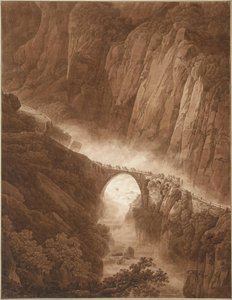
To gaze upon this depiction is to be transported across the rugged spine of the Alps, to stand at the precipice where human endeavor meets untamed nature. Peter Birmann’s painting, titled simply The Devil, captures more than just a scene; it encapsulates a moment suspended between myth and reality. The composition centers around a magnificent stone bridge, an architectural marvel spanning a powerful river, all set against a dramatic backdrop of towering mountains. It is a vision of bustling life—a confluence of human passage, animal industry, and the enduring power of the landscape itself.
Narrative Detail and Technical Brilliance
The sheer detail within this work is breathtaking. One can almost hear the clatter of the train crossing the structure, feel the spray of the river below, and observe the purposeful movement of the figures gathered upon the stone walkway. The inclusion of people alongside two sturdy horses adds a dynamic layer to the scene, suggesting a journey in progress—a vital artery connecting disparate worlds. Birmann’s technique allows these elements to coexist harmoniously; the meticulous rendering of the stonework contrasts beautifully with the soft textures suggested in the distant peaks. This masterful handling of light and shadow gives the entire composition an almost palpable depth, inviting the viewer to lose themselves within its narrative folds.
Symbolism Woven into the Landscape
The title itself, The Devil, imbues the seemingly pastoral scene with profound symbolic weight. The bridge, in art history, is a potent symbol of transition—a passage from one state of being to another. Here, crossing this structure over the rushing water suggests traversing boundaries, perhaps between civilization and wilderness, or even between life and fate itself. The presence of such powerful natural elements juxtaposed with the organized movement of man and machine hints at humanity’s eternal negotiation with forces greater than itself. It is a meditation on passage, risk, and the journey of the soul.
Historical Echoes and Enduring Appeal
Dating to 1805, this painting emerges from an era steeped in Romantic fervor, where the sublime power of nature often overshadowed Enlightenment rationality. Birmann captures that tension perfectly. For the modern collector or designer, owning a reproduction of this piece is not merely acquiring art; it is curating a narrative centerpiece for your home. It speaks to a timeless appreciation for grand vistas and the drama inherent in human enterprise against an epic backdrop. Whether placed in a study evoking scholarly contemplation or a great hall demanding dramatic flair, its energy remains undiminished.
Questions & Answers
At what size is "The Devil" recommended to be printed?
The recommended print size for "The Devil" by Peter Birmann is large.
What was Peter Birmann's age when "The Devil" was created?
Peter Birmann was 47 years old when creating "The Devil" in 1805. The age is computed from the artist's birth year, 1758.
What technique was used for "The Devil" by Peter Birmann?
The medium of "The Devil" by Peter Birmann is oil on canvas. Reproductions aim to render the appearance of this technique.
Related Artworks


Artist Biography
A Life Between Stone and Canvas
Born in Basel, Switzerland, to a stonemason named Rudolf Birmann, the life of Peter Birmann was shaped by a unique intersection of structural precision and artistic vision. His early years were spent under the tutelage of his father, where he gained an intimate understanding of the weight, texture, and permanence of stone—a foundation that would later manifest in his masterful depictions of architectural marvels and rugged landscapes. This technical grounding provided him with a rare perspective when he transitioned from the physical craft of masonry to the delicate nuances of fine art, studying under the guidance of Johann Ludwig Aberli.
The trajectory of Birmramn's career was profoundly altered by his time in Rome during the 1780s. This period of intense immersion in Italian culture allowed him to work within the studio of Louis Ducros and manage the engraving workshop of Giovanni Volpato. It was amidst the classical grandeur of Italy that his artistic identity truly flourished. He became a keen observer of the landscape, finding deep inspiration in the dramatic waterfalls of Tivoli and Terni. His ability to capture these scenes through watercolours and wash drawings earned him significant acclaim among international travellers from England, Germany, and Russia, eventually allowing him to achieve professional independence.
The Mastery of Landscape and Light
Birmann’s oeuvre is a testament to his ability to weave together the classical tradition with a burgeoning romantic sensibility. His work often serves as a bridge between the organized world of human architecture and the untamed majesty of nature. In masterpieces such as The Devil, one can witness his extraordinary technical brilliance; he renders the meticulous stonework of bridges and the purposeful movement of figures with such clarity that the viewer feels the spray of a rushing river or the weight of a mountain peak. His style was deeply influenced by the seventeenth-century master Claude Lorrain, a connection evident in his sophisticated handling of light and shadow, which imbues his compositions with an almost palpable depth.
Upon returning to Basel, Birmann did not merely replicate his Italian vistas but expanded his repertoire to include the sweeping landscapes of the Jura region. His artistic output was remarkably diverse, encompassing:
- Architectural Views: Detailed renderings of ruins, gardens, and cityscapes that capture the enduring spirit of historical structures.
- Italian Landscapes: Evocative depictions of the Roman countryside, focusing on the interplay between water and stone.
- Classical Landscapes: Works that applied a refined, classical style to the rugged terrains of Switzerland.
Legacy and Artistic Contribution
Beyond his individual canvases, Birmann was a pivotal figure in the cultural fabric of Basel. He was not only a painter but also an accomplished art dealer and publisher, establishing a workshop that contributed to the region's artistic vitality. His commitment to the local arts community was solidified when he became a founding member of the Basel Artists' Society in 1812. His influence extended into the realms of civic duty as well, serving on both the Grand Council and the Small Council of Basel for several decades.
The Birmann name would continue to resonate within the art world through his sons, Wilhelm and Samuel Birmann, both of whom followed in his footsteps as artists. Through his meticulous technique and his ability to capture the sublime tension between civilization and the wild, Peter Birmann left an indelible mark on the tradition of landscape painting, ensuring that his vision of the natural and constructed world would endure long after his passing.

Peter Birmann
1758 - 1844 , Switzerland
Quick Facts
- Artistic Movement Or Style: Classical landscape
- Artists Who Influenced This Artist:
- Johann Ludwig Aberli
- Claude Lorrain
- Full Name: Peter Birmann
- Nationality: Swiss
- Notable Artworks: ['The Devil']
- Place Of Birth: Basel, Switzerland
- Date Of Birth: 1758
- Date Of Death: 1844
Related Articles

Evocations of Place: A Historical Journey Through Landscape Art
Explore the rich history of landscape art with AllPaintingsStore. Discover renowned artists, movements like Impressionism & Romanticism, and expert guidance for collecting timeless pieces. Find your perfect serene escape today!

John Constable's Masterpieces: Explore 25 Iconic Landscapes for Your Home
Journey through John Constable's 25 most celebrated landscapes. Explore Romanticism, Dedham Vale & his masterful use of light in iconic paintings like 'Hay Wain'. Find museum-quality art reproductions and elevate your home decor on AllPaintingsStore.com.
Evoking Emotion & Transcendence: Romantic Landscape Painting (18th-19th Century)
Explore the emotional depth of Romantic landscape painting (18th-19th century). Discover key artists like Friedrich & Cole, and the concepts of the sublime. Expert insights for art lovers & collectors.
Evoking Nature's Sublime: A Comprehensive Exploration of 19th-Century Landscape Painting
Explore the captivating world of 19th-century landscape painting! Discover renowned artists like Friedrich & Monet, key movements, and find the perfect artwork to bring nature's serenity into your home. Expert insights at AllPaintingsStore.

Romantic Landscapes: 10 Masterpieces for Your Home | AllPaintingsStore
Journey through 10 Romantic landscape masterpieces by Friedrich, Turner & Cole. Explore emotional art, sublime nature scenes & iconic 19th-century paintings. Find museum-quality reproductions for your home at AllPaintingsStore.com – discover the full collection online!