


 Preview
 Send
Send Share
Share
 Details

 Download
 Similars
 X-Ray
X-Ray Diaporama
Venetian Doctor during the time of the plague

 Read More
Hand Made Oil Reproduction
Hand-painted oil on canvas in your size and frame, made to order by our artists. ( Switch to Print Switch to Image)




P118B $10

P118H $10

P118W $10

P438Z $10

P508JH $12

P508YH $12

P805H $10

P805Z $10

P919BZ $10

P919G $10

P919XJ $10

P959ZH $10

P968JZ $12

W106C $8

W218G $10

W218JH $8

W218Y $10

W307PJ $10

W316G $10

W316PJ $8

W316Y $10

W398PJ $8

W4111J $10

W500HY $15

W500JH $15

W692G $12

W849H $8

W940BG $15

W953PJ $8




Pick from our preset sizes that match the artwork's original proportions.

You may enter your own dimensions to fit a specific frame or space. If your selected size does not match the original image's proportions, we will either crop the artwork or extend the painting with additional hand-painted elements. A digital mockup will be sent for your approval before production begins.
Please note that the on-screen preview does not reflect the actual cropping or extension. Only the mockup will accurately show the final composition.
While custom sizes are available, we recommend selecting a dimension from the predefined list to preserve the original proportions.
After order, AllPaintingsStore.com team will email client for instructions and provide a mockup preview
Worldwide Delivery () in 3/4 weeks instead of standard 5 weeks. (5 August). No compromise on quality.

Free Worldwide Express Shipping

High-Quality Linen Canvas

Full Shipping Insurance

Customs Tax Refund Guarantee

True Color Matching Guarantee

60-Day Return Policy (Defects Only)

100% Money-Back Guarantee

Bulk Discount Offer
 Glass option is only available in size under 110 CM

Venetian Doctor during the time of the plague
Reproduction Medium
Reproduction Size
-


Total Price
$ 258
Related Artworks


Artist Biography
Jan van Grevenbroeck: A Venetian Observer of Everyday Life
Jan van Grevenbroeck (1731-1807) wasn’t a name etched in the annals of grand artistic movements like the Baroque or Rococo. Yet, within the vibrant tapestry of 18th-century Venice, he carved out a unique and remarkably detailed niche – documenting the city's inhabitants through meticulously observed watercolor paintings. Born into a family with roots in Flanders, van Grevenbroeck’s journey led him to settle permanently in Venice, where he spent nearly four decades capturing the nuances of daily life, from the opulent attire of the wealthy to the humble garments of laborers. His work offers an unparalleled visual record of Venetian society during a pivotal period of transition, bridging the gap between the fading grandeur of the Republic and the rising influence of Napoleon.
Initially apprenticed to the painter Pietro Gardenigo, van Grevenbroeck’s early career was marked by modest recognition. However, Gardenigo's patronage proved invaluable, providing him with a studio and a commission that would ultimately define his legacy: the creation of “Gli abiti de veneziani di quasi ogni età con diligenza raccolti e dipinti nel secolo XVIII” – "The Clothes of Venetians of Almost Every Age Collected and Painted with Diligence in the Eighteenth Century." This ambitious project, spanning four volumes and over six hundred watercolors, wasn’t merely a fashion record; it was a comprehensive social study. Van Grevenbroeck painstakingly documented the clothing styles worn by various professions – merchants, sailors, monks, gondoliers, even beggars – alongside detailed descriptions of their occupations and social standing. The project was commissioned by the noble Venetian Pietro Gardenigo, who himself kept a meticulous diary documenting events in Venice during his lifetime.
A Window into Venetian Society
What distinguishes van Grevenbroeck’s work is not simply its technical skill – though it's undeniably impressive, characterized by delicate washes and remarkably accurate detail. It’s the profound empathy he brought to his subject matter. He didn’t idealize or romanticize Venice; instead, he presented a realistic portrayal of its diverse population, capturing their individuality with remarkable sensitivity. His paintings offer glimpses into the lives of ordinary Venetians – a Jewish shopkeeper attending to his customers, a gondolier navigating the canals, a washerwoman tending her laundry – each rendered with a quiet dignity and attention to detail that speaks volumes about the artist’s respect for his subjects.
The watercolors are rich in symbolism. Clothing itself became a language through which van Grevenbroeck conveyed social status, profession, and even religious affiliation. The colors, fabrics, and embellishments all held specific meanings within Venetian society. His meticulous observations extended beyond clothing to encompass the tools of trade, domestic furnishings, and architectural details – creating a holistic picture of Venetian life. He was particularly interested in documenting the changes occurring during this period, reflecting on the impact of economic shifts and social transformations.
Technique and Influences
Van Grevenbroeck’s technique evolved over his career, influenced by both Flemish artistic traditions and the prevailing watercolor styles of Venice. He initially drew upon the meticulous detail characteristic of Flemish painting, evident in his early works depicting portraits and genre scenes. However, he quickly adapted to the Venetian preference for loose washes and atmospheric effects, incorporating these techniques into his own distinctive style. His use of light and shadow was particularly masterful, creating a sense of depth and realism that brought his subjects to life.
While largely self-taught, van Grevenbroeck’s work demonstrates an awareness of contemporary artistic trends. He drew inspiration from the works of other Venetian artists, such as Canaletto and Guardi, but he developed a unique visual language that set him apart. His detailed observations and empathetic portrayal of everyday life have earned him recognition as one of Venice's most important chroniclers of the 18th century.
Legacy and Historical Significance
Today, van Grevenbroeck’s “Gli abiti de veneziani” remains a priceless cultural treasure. The four volumes are housed in the Museo Correr in Venice, where they continue to fascinate scholars and art enthusiasts alike. His work provides an invaluable window into Venetian society during a period of profound change, offering insights into the city's social, economic, and cultural dynamics. Beyond his artistic achievements, van Grevenbroeck’s legacy lies in his ability to capture the essence of Venice – its beauty, its diversity, and its enduring spirit – through the quiet observation of everyday life.
His paintings are not merely depictions of clothing; they are portraits of a vanished world, offering a poignant reminder of the rich cultural heritage of Venice. The meticulous detail and empathetic portrayal of ordinary Venetians continue to resonate with viewers today, cementing van Grevenbroeck’s place as one of the most important chroniclers of 18th-century Venice.

jan van grevenbroeck
1731 - 1807 , United Kingdom
Quick Facts
- Artistic Movement Or Style: Genre scenes, Seascape
- Artists Or Movements Influenced By This Artist: ['Baroque Painting']
- Artists Who Influenced This Artist: ['Jan Kessel the Elder']
- Date Of Birth: 1731
- Date Of Death: 1807
- Full Name: Jan van Grevenbroeck
- Nationality: British
- Notable Artworks:
- A Venetian Traveller
- A Jewish Shopkeeper
- Claudio Monterverdi
- Place Of Birth: WahooArt, UK
Related Articles
The Rococo Aesthetic: Opulence, Rebellion & the Pursuit of Pleasure in 18th-Century Art
Explore the opulent world of Rococo art! Discover its origins, key artists like Watteau & Boucher, and lasting influence on design. Expert insights for collectors & enthusiasts.
Jan van Eyck: Innovation, Symbolism & the Dawn of Early Netherlandish Painting
Explore the revolutionary art of Jan van Eyck! Discover his groundbreaking oil painting techniques, hidden symbolism, and lasting impact on the Early Netherlandish Renaissance. A deep dive for art enthusiasts.
The Enduring Legacy of 18th & 19th Century Art: Movements, Masters & Societal Reflections
Explore the rich history of 18th & 19th-century art! Discover Romanticism, Realism, and iconic masters like Delacroix & Courbet. Expert insights & high-quality reproductions at AllPaintingsStore.
Sarah Churchill, Countess of Essex: A Patron's Influence on 18th-Century Art & Identity
Explore the fascinating world of Sarah Churchill, Countess of Essex, a pivotal figure in 18th-century art patronage. Discover her influence on Rococo aesthetics and portraiture, and learn about commissioning artworks as a statement of power & identity.
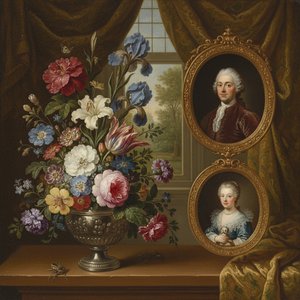
Jan van Kessel the Elder: A Baroque Master of Floral Still Life & Miniature Portraiture
Discover the exquisite detail of Jan van Kessel the Elder's Baroque floral still lifes & captivating miniatures. Explore his artistic legacy, scientific precision, and lasting influence on 17th-century Flemish painting.





