- Home

- Oil Painting Reproduction
- Thomas Cole
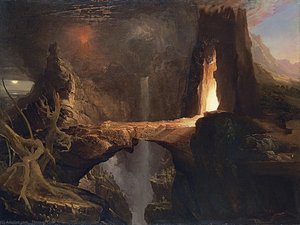
- Expulsion from the Garden of Eden

 Buy print
 Send
Send Share
Share
 Details

 Download
 Similars
 X-Ray
X-Ray Diaporama
Expulsion from the Garden of Eden
 Oil On Canvas
- WallArt
- Hudson River School
 1828
1828- 19th Century
 138.0 x 100.0 cm
 Museum of Fine Arts
 Read More
Hand Made Oil Reproduction
Hand-painted oil on canvas in your size and frame, made to order by our artists.




P118B $10

P118H $10

P118W $10

P438Z $10

P508JH $12

P508YH $12

P805H $10

P805Z $10

P919BZ $10

P919G $10

P919XJ $10

P959ZH $10

P968JZ $12

W106C $8

W218G $10

W218JH $8

W218Y $10

W307PJ $10

W316G $10

W316PJ $8

W316Y $10

W398PJ $8

W4111J $10

W500HY $15

W500JH $15

W692G $12

W849H $8

W940BG $15

W953PJ $8




Pick from our preset sizes that match the artwork's original proportions.

You may enter your own dimensions to fit a specific frame or space. If your selected size does not match the original image's proportions, we will either crop the artwork or extend the painting with additional hand-painted elements. A digital mockup will be sent for your approval before production begins.
Please note that the on-screen preview does not reflect the actual cropping or extension. Only the mockup will accurately show the final composition.
While custom sizes are available, we recommend selecting a dimension from the predefined list to preserve the original proportions.
After order, AllPaintingsStore.com team will email client for instructions and provide a mockup preview
Worldwide Delivery () in 3/4 weeks instead of standard 5 weeks. (16 July). No compromise on quality.

Free Worldwide Express Shipping

High-Quality Linen Canvas

Full Shipping Insurance

Customs Tax Refund Guarantee

True Color Matching Guarantee

60-Day Return Policy (Defects Only)

100% Money-Back Guarantee

Bulk Discount Offer
 Glass option is only available in size under 110 CM

Expulsion from the Garden of Eden
Reproduction Medium
Reproduction Size
-


Total Price
-
Artwork Description
A Descent from Paradise: The Dramatic Vision of Thomas Cole
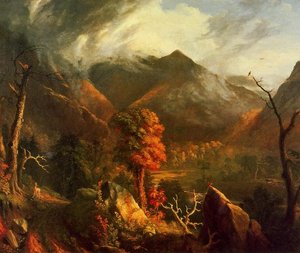
In the profound depths of 1828, Thomas Cole captured a moment of cosmic upheaval in his masterpiece, Expulsion from the Garden of Eden. This oil on canvas work serves as a breathtaking window into the soul of Romanticism, where the boundaries between the earthly and the divine blur amidst a landscape of intense emotion. Rather than merely illustrating a biblical event, Cole invites us to witness a fundamental shift in the human condition. The painting presents a striking dichotomy: the lush, tranquil sanctuary of Eden stands in stark, agonizing contrast to the encrovers of a harsh, untamed world. It is a scene that resonates with anyone who has ever felt the sting of loss or the weight of inevitable change.
The composition is a masterclass in the use of light and shadow, a technique designed to heighten the palpable tension within the frame. Cole utilizes dramatic chiaroscuro to separate the peaceful, sun-drenched groves from the encroaching darkness of the external wilderness. As the viewer’s eye wanders through the canvas, they encounter the small, vulnerable figures of Adam and Eve, almost swallowed by the sheer scale of the natural drama unfolding around them. This deliberate choice emphasizes the insignificance of man when confronted with the overwhelming forces of nature and divine will, a hallmark of the Hudson River School style that Cole helped pioneer.
Symbolism and the Sublime Landscape
Beyond its narrative surface, the painting is rich with allegorical depth. The landscape itself acts as a protagonist, communicating complex theological and philosophical ideas through terrain and atmosphere. The peaceful, tropical elements of the Garden represent a lost state of innocence, while the dark, stormy skies and rugged mountains looming in the distance symbolize the struggle, toil, and mortality that define human existence outside of grace. This juxtaposition creates a sense of the sublime—that specific aesthetic quality where beauty is inextricably linked to awe and even terror.
For the discerning collector or interior designer, this piece offers more than just visual splendor; it provides a profound focal point for contemplation. The way the light pierces through the canopy of trees creates a rhythmic movement across the canvas, drawing the eye toward the horizon where the known world meets the unknown. It is an artwork that demands attention, making it an ideal centerpiece for spaces designed to inspire deep thought and emotional resonance. Whether placed in a grand library or a sophisticated contemporary living space, the painting brings with it a sense of historical gravity and timeless storytelling.
A Legacy of American Romanticism
As a leading figure of the Hudson River School, Thomas Cole brought a unique spiritual dimension to the depiction of the American wilderness. In Expulsion from the Garden of Eden, we see his ability to infuse landscape painting with a sense of destiny and moral weight. This work is not merely a depiction of scenery; it is an exploration of the human spirit's relationship with the divine and the natural world. Owning a high-quality reproduction of this masterpiece allows one to inhabit this dramatic atmosphere daily, bringing the evocative power of 19th-century American art into the modern home.
Related Artworks




Artist Biography
A Pioneer of American Landscape Painting
Thomas Cole, a name synonymous with the birth of distinctly American art, stands as a pivotal figure in 19th-century painting. Born in Bolton le Moors, Lancashire, England, in 1801, his early life offered little indication of the profound impact he would have on the artistic landscape. Emigrating to the United States with his family in 1818 and settling in Ohio, Cole’s journey was one of self-discovery and artistic awakening. Initially working as an itinerant portrait painter—a common trade at the time—he soon found himself drawn to the untamed beauty of the American wilderness. This shift wasn't merely a change in subject matter; it represented a fundamental divergence from European artistic traditions, which often focused on historical or mythological narratives. Cole’s landscapes weren’t simply depictions of scenery; they were imbued with a spiritual and allegorical depth that resonated deeply with a nation forging its own identity. His move to Catskill, New York, in 1825 proved transformative, providing him with both inspiration and a permanent base from which to explore the surrounding Hudson River Valley—a region that would become inextricably linked with his artistic legacy.The Hudson River School and Romantic Ideals
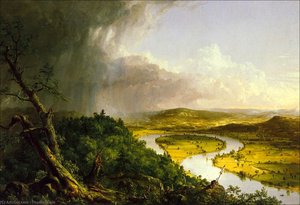
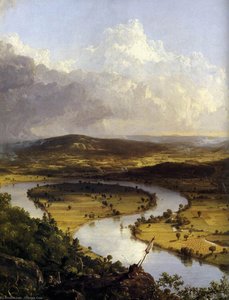
Cole is rightfully regarded as the founder of the Hudson River School, an art movement characterized by its romantic portrayal of the American landscape. However, to label him simply a “landscape painter” feels inadequate. His work transcended mere representation; it was deeply philosophical, often exploring themes of humanity’s relationship with nature, the passage of time, and the rise and fall of civilizations. Influenced by European Romanticism—particularly the works of Claude Lorrain and J.M.W. Turner—Cole adapted these sensibilities to an American context. Where European Romantics often depicted dramatic, sublime landscapes as a reflection of inner turmoil, Cole’s paintings frequently conveyed a sense of optimism and divine presence within the natural world. He saw in the vastness of the American wilderness a symbol of national potential and spiritual renewal. The Oxbow (1836), perhaps his most iconic work, exemplifies this perfectly—a sweeping vista that contrasts the wild, untamed river valley with the cultivated farmlands, representing both the promise and the challenges of westward expansion.Allegory and The Course of Empire
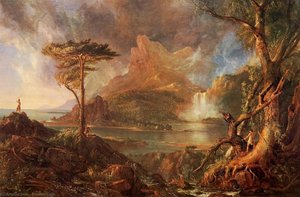
While celebrated for his realistic depictions of nature, Cole’s artistic ambition extended beyond pure landscape painting. He frequently employed allegory to convey complex moral and philosophical ideas. This is most powerfully demonstrated in his monumental series The Course of Empire, created between 1833 and 1836. Comprising five canvases—"Savage State," "Pastoral State," "Arcadian State," "Consummation," and "Destruction"—the series traces the cyclical history of a civilization, from its pristine origins to its inevitable decline. The paintings are not merely historical narratives; they serve as cautionary tales about the dangers of unchecked ambition and the fragility of human achievement. The Course of Empire resonated deeply with contemporary audiences, reflecting anxieties about the rapid industrialization and westward expansion that were transforming the American landscape. It cemented Cole’s reputation as a visionary artist capable of addressing profound societal concerns through his art.Legacy and Enduring Influence
Thomas Cole's untimely death in 1848 at the age of 47 marked a significant loss for the American art world. However, his influence continued to reverberate through generations of artists. He directly mentored Frederic Edwin Church, who would become one of the leading figures of the second generation of Hudson River School painters. His emphasis on observation from nature, combined with a deeply personal and symbolic approach to landscape painting, laid the foundation for a distinctly American artistic tradition.- Cole’s work continues to be exhibited in major museums across the United States, including the New-York Historical Society, the National Gallery of Art in Washington D.C., and the Smithsonian American Art Museum.
- His paintings are not merely historical artifacts; they remain powerfully evocative and relevant today, prompting viewers to contemplate their own relationship with nature and the enduring questions about humanity’s place in the world.
- The Thomas Cole National Historic Site in Catskill, New York, preserves his home and studio, offering visitors a glimpse into the life and work of this remarkable artist.

Thomas Cole
1801 - 1848 , United Kingdom
Quick Facts
- Artistic Movement Or Style: Hudson River School
- Artists Or Movements Influenced By This Artist:
- Asher B. Durand
- Frederic Edwin Church
- Date Of Birth: February 1, 1801
- Date Of Death: February 11, 1848
- Full Name: Thomas Cole
- Nationality: American
- Notable Artworks:
- The Course of Empire
- The Oxbow
- A View from Mount Etna
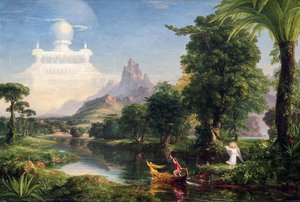
- The Voyage of Life
- Place Of Birth: Bolton, UK
Related Articles

Thomas Hill: Luminosity, Landscape & the American Pastoral Ideal
Explore the luminous landscapes of Thomas Hill, a pivotal figure in the Hudson River School & Luminism movements. Discover his artistic journey, philosophical depth, and enduring legacy with AllPaintingsStore.

Evoking Eden: Nature's Enduring Presence in Painting Across Historical Movements
Explore the rich history of landscape painting from ancient times to modern art! Discover renowned artists like Monet & Robinson, learn about Impressionism and Tonalism, and find the perfect artwork for your home at AllPaintingsStore.com.

Thomas Worthington Whittredge: Capturing the American Pastoral Ideal with Luminist Light
Explore the luminous landscapes of Thomas Worthington Whittredge, a key figure in the Hudson River School and master of Luminism. Discover his captivating paintings & legacy with AllPaintingsStore.
Echoes of Eden: Nature's Enduring Presence in Art History
Explore the rich history of landscape art, from Romantic masterpieces to contemporary reflections on nature's power. Discover iconic artists & commission bespoke paintings at AllPaintingsStore – handcrafted quality guaranteed.

Albrecht Altdorfer: Innovation, Spirituality & the Northern Renaissance Landscape
Explore the groundbreaking art of Albrecht Altdorfer, a pioneer of the Northern Renaissance's Danube School. Discover his innovative landscapes, spiritual symbolism & lasting influence on German painting.