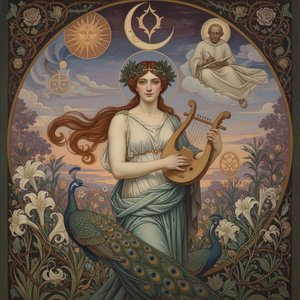
Acrylic On Canvas.

§ 1Catalogue data


§ 2Abstract
Collectible Description
Explore William Blake’s visionary ‘Newton.’ A monotype masterpiece blending Romanticism & scientific critique. Discover its symbolism & profound impact on art history.
 Read More
Artist Biography
A visionary of English Romanticism known for The Tyger. Discover his mystical illuminated prints and poetry today.
§ 3Commentary
A Visionary Dissection: William Blake’s “Newton”
William Blake's 1795 (and reworked in 1805) monotype, “Newton,” is far more than a portrait of the famed scientist; it’s a potent and layered statement on the boundaries of reason, the power of imagination, and the very nature of human perception. This artwork continues to captivate viewers today, sparking debate and offering fresh perspectives into Blake's unique artistic vision.
Subject & Composition: A Scholar Submerged
The image presents an arresting portrayal of Sir Isaac Newton. Stripped bare and hunched over a rocky outcrop – seemingly submerged in a dark, watery abyss or the vastness of space – Newton is intensely focused on geometric diagrams he meticulously drafts with a compass upon a scroll. This deliberate nudity isn’t merely anatomical; it symbolizes vulnerability, intellectual stripping away of societal constraints, and a raw pursuit of knowledge. The composition deliberately isolates Newton within his own realm of thought, emphasizing both the solitary nature of groundbreaking discovery and a potential disconnect from the natural world.
Artistic Style & Technique: Romantic Innovation
“Newton” exemplifies Blake’s distinctive Romantic style, rejecting the rigid Neoclassicism prevalent in his time. Executed as a monotype – a technique where ink is applied to a smooth surface and then transferred to paper – the artwork showcases Blake's innovative approach to printmaking. This method allows for an extraordinary depth of tone, textural richness, and fluidity not easily achieved through traditional engraving. The vibrant colors, meticulously layered, create a visually arresting image that transcends simple representation. The technique itself feels inherently exploratory, mirroring the intellectual exploration depicted within the artwork.
Historical Context: Enlightenment & Its Discontents
Created during the height of the Enlightenment, “Newton” exists as both a product and a critique of its time. While celebrating reason and scientific inquiry, the Enlightenment also faced growing criticism for neglecting spiritual and emotional dimensions of human experience. Blake, deeply skeptical of purely rational approaches, positioned himself firmly within this counter-current. He saw Newton’s emphasis on empirical observation and mathematical laws as potentially stifling to the imagination and hindering a deeper understanding of the universe. Blake wasn't anti-science per se, but rather wary of its potential to eclipse other vital modes of knowing.
Symbolism & Interpretation: Layers of Meaning
The artwork is laden with symbolism, inviting multiple layers of interpretation. The compass, a tool for precise measurement, represents the limitations imposed by scientific rationalism on imaginative vision. Newton’s position at the base of the rocky outcrop, surrounded by what appears to be marine life or otherworldly formations, suggests a descent into the depths of thought – a realm where enlightenment and isolation coexist. The dark, swirling environment can be interpreted as representing both the subconscious mind and the vast unknown beyond human comprehension. Blake's depiction isn’t simply celebratory; it serves as a profound critique of an over-reliance on reason at the expense of spiritual understanding.
Emotional Impact: Introspection & Tension
“Newton” evokes a powerful sense of introspection, intellectual tension, and even melancholy. The viewer is drawn into Newton’s world, experiencing both the allure and potential pitfalls of scientific inquiry. Blake's masterful use of color and composition creates an image that lingers in the mind long after viewing, prompting contemplation on the delicate balance between reason and imagination, science and spirituality.
Display Recommendations: A Statement Piece
“Newton” is a captivating statement piece suitable for a variety of settings. Its bold colors and dynamic composition make it equally at home in modern or traditional interiors. Consider displaying a high-quality reproduction in:
- Studies & Libraries: The artwork’s intellectual weight makes it ideal for spaces dedicated to learning and contemplation.
- Living Areas: Its striking imagery will undoubtedly spark conversation and add depth to any living space.
- Home Offices: A reminder of the power – and potential limitations – of focused thought.
The painting’s themes resonate with those interested in philosophy, science, art history, and the Romantic movement, making it a valuable addition to any discerning collection. Its unique blend of intellectual rigor and artistic expression ensures that “Newton” will continue to captivate and inspire for generations to come.
Questions & Answers
At what size is "Newton" recommended to be printed?
A large reproduction is suggested for "Newton" by William Blake. Size can be adjusted while keeping the proportions.
How do I discover artworks close to "Newton" by William Blake?
Artworks similar to "Newton" by William Blake are gathered on the artwork's Similars page.
What is the dominant hue of "Newton" by William Blake?
The dominant hue of "Newton" by William Blake is green to violet spectrum. The hue is the underlying tone of the palette.


 Switch to Print


 For artworks or reproductions larger than 105 cm (approximately 41 inches) on any side, the frame will be shipped as a kit, disassembled. This method ensures safe delivery and prevents damage during transport.