The Impulse to Define: Henry James and the Search for a National Identity
The desire to understand a nation often begins with a single observer attempting to find its rhythm. In the early 20th century, the writer Henry James embarked on a journey through the United States, documenting a country in the midst of a profound transformation. His 1907 book, The American Scene, emerged from travels conducted between 1904 and 1905, offering a perspective that was as controversial as it was detailed. James looked at the rapid growth of American industry and the shifting social structures of the turn of the century, often critiquing the perceived materialism that accompanied such progress. He observed the tension between the immense increase in material well-being for the average person and the fraying social fabric caused by unrestricted immigration and urban expansion.
This period of observation finds a historical echo in the early landscape traditions of the 19th century. Long before the social debates of the 1900s, artists like Thomas Cole were attempting to define the American spirit through the untamed wilderness. In works such as American Lake Scene, Cole used atmospheric perspective and detailed rendering to capture a sense of the sublime in the natural world. While James looked at the social consequences of a growing nation, Cole looked at the physical foundation of that nation. Both, however, were engaged in the same fundamental task: trying to determine what it meant to be American in a land that was constantly reinventing itself.
Cultivating the Heartland: Regionalism and the Echo of the American Landscape
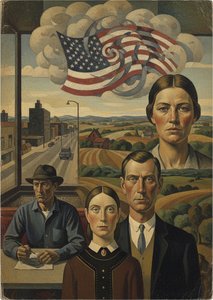
As the 1930s approached, the focus of American art shifted away from European modernism and toward the soil itself. This movement, known as Regionalism, sought to find a uniquely American style by looking inward at the rural heartland. Grant Wood, often considered the father of this movement, turned his attention to the quiet, structured life of the Midwest. His 1930 oil painting, American Gothic, remains a definitive image of this era. Depicting a farmer and his daughter in front of a Carpenter Gothic house in Eldon, Iowa, the work uses the rigid, vertical lines of the architecture to mirror the stoic, unyielding character of the figures. Wood used his sister, Nan Wood Graham, and the local dentist, Byron McKeeby, as models to create a scene that felt both specific to Iowa and universally representative of a certain American tenacity.
The roots of this interest in the American landscape stretch back to the Hudson River School. Artists of that era were preoccupied with the grandeur of the wilderness, often using allegory to imbue nature with spiritual significance. In A Wild Scene, Thomas Cole explored the raw power of mountains and waterfalls, treating the American landscape as a sacred space. While the Regionalists of the 1930s were less interested in the sublime and more interested in the domestic and the agricultural, they shared a common goal with the earlier Romantics: the belief that the American landscape was the most honest way to understand the American character.
The Dignity of the Ordinary: Narrative Art and the Folk Tradition
A master of narrative realism, Rockwell is famous for his Four Freedoms series. Explore his iconic American scenes today.
While Regionalism often focused on the stoic farmer, other artists sought to capture the warmth and humor of everyday life. Norman Rockwell became a household name through his work for the Saturday Evening Post, creating a visual language that resonated with the collective memory of the nation. His paintings, such as The Midnight Ride of Paul Revere or his various depictions of American life, moved between historical reverence and contemporary storytelling. Rockwell’s ability to find profound meaning in a simple gesture or a shared moment allowed him to document the social textures of the country with a sense of intimacy that felt accessible to everyone.
This focus on the local and the personal echoes the quiet resilience found in the work of early American folk artists like Mary Ann Willson. Working from the remote hills of Greene County, New York, Willson produced watercolors that captured the essence of 19th-century rural life. Without formal training, she used natural pigments—berries, vegetable dyes, and even brick dust—to create bold, geometric patterns and simplified forms. Her work, though created in relative isolation, shared a fundamental commitment with the later narrative painters: the belief that the unvarnished, everyday reality of a specific place was worthy of serious artistic attention.
Urban Realities: Social Realism and the Pulse of the Modern City
As the focus on the rural heartland grew, another movement was simultaneously documenting the grit and energy of the expanding cities. Social Realism turned its gaze toward the urban experience, focusing on the lives of the working class and the complexities of modern existence. Artists like Edward Hopper captured the quiet, often lonely, psychological weight of urban life, while others sought to depict the monumental scale of industrial labor. This was art that did not shy away from the shadows of the city, instead using them to highlight the human condition within the machine of modern progress.
This urban focus finds a parallel in the earlier American Realism of the late 19th century. Winslow Homer, for instance, moved between the leisure of the coast and the ruggedness of the outdoors. His watercolorScene in the Adirondacks shows a detailed observation of natural landscapes and the human presence within them. While Homer often focused on the interaction between man and the natural elements, the Social Realists shifted that interaction to the interaction between man and the built environment. Both movements, however, were driven by a commitment to seeing the world as it truly was, rather than through a lens of idealized beauty.
Shifting Horizons: The Transition from Localism to Global Abstraction
By the end of the 1940s, the era of the American Scene began to wane. The conclusion of World War II brought about significant cultural shifts, moving the art world toward abstraction. As the United States entered a period of rapid technological advancement and increased global interconnectedness, the intense focus on the local and the regional began to lose its dominance. The stability that Regionalism had sought to provide was being reshaped by a world that felt increasingly large and complex.
Yet, the legacy of these movements remains deeply embedded in the American identity. The artists who documented the textures of the heartland and the energy of the city left behind a visual record of a nation grappling with its own transformation. They taught us to find significance in the unvarnished moment and to recognize the dignity found in the everyday. Whether through the structured landscapes of the 19th century or the social observations of the 20th, the commitment to honest observation remains a fundamental part of the artistic heritage.
At AllPaintingsStore.com, we honor this tradition of observation. We offer a wide range of high-quality, hand-painted oil reproductions of these historical works, as well as custom commissions that allow you to bring a specific era into your own space. From the structured compositions of the Regionalists to the atmospheric landscapes of the Hudson River School, our artists are trained to capture the true essence of these styles on 100% cotton canvas.
Discover Grant Wood (1891-1942), the iconic American Regionalist painter of 'American Gothic.' Explore his evocative depictions of Midwest life, influenced by Flemish masters and a uniquely American vision.
Explore 10 defining masterpieces of Romantic Realism! Discover Courbet, Millet & Daumier's powerful paintings—capturing emotion and social realities. Find museum-quality reproductions for your home at AllPaintingsStore.com.
Explore the profound impact of Regionalism in art history. Discover how iconic painters captured local identity, rural resilience, and the American heartland through evocative landscapes and social commentary in this expert-led journey through art's most soulful movement.
Explore the rise of American Regionalism in interwar art! Discover Grant Wood, Thomas Hart Benton & the movement's impact on American identity. Expert analysis & historical context.
Explore the world of Grant Wood & American Regionalism with AllPaintingsStore. Discover the symbolism behind 'American Gothic', recurring themes, and the movement's lasting impact on art history. High-quality reproductions available.


 American Gothic
 Norman Rockwell
 The City