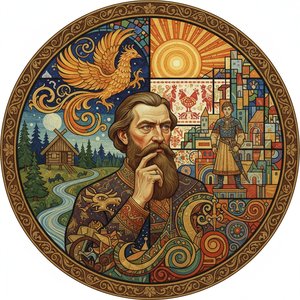
Albin Egger-Lienz: Life and Legacy
Early Life and Training
- Born: January 29, 1868, in Dölsach-Stribach near Lienz, Tyrol, Austria.
- Parentage: He was the natural son of Maria Trojer, a peasant girl, and Georg Egger, a church painter. He later adopted his father’s surname combined with his birthplace.
- His initial artistic education came from his father, laying the foundation for his future career.
- He continued his studies at the Academy in Munich, where he was profoundly influenced by artists like Franz Defregger and Jean-François Millet.
Artistic Development and Influences
- Egger-Lienz’s early works focused on scenes of peasant life and historical events, particularly the Tyrolean Rebellion of 1809.
- Key Influence: The artist Ferdinand Hodler significantly impacted Egger-Lienz's style, leading to a monumental expressiveness characterized by heroic figures in stage-like spaces.
- He joined the Vienna Secession in 1909, further solidifying his position within the Austrian art scene.
- His artistic language evolved towards strongly outlined, massive forms painted with an almost monochromatic palette of earth colors.
Major Works and Achievements
- Notable Paintings: Some of his most renowned works include “Der Totentanz von anno neun” (1906-1908), “Almlandschaft im Ötztal” (1911), and “Den Namenlosen” (1916).
- He participated in the Universal Exhibition in Paris in 1900, receiving a bronze medal for his painting "Feldsegen."
- During World War I, he served as a war painter on the southern Austrian front.
- His later works often incorporated religious themes alongside scenes of peasant life, such as “Christ’s Resurrection.”
Historical Significance and Legacy
- Unique Style: Egger-Lienz blended elements of Expressionism with traditional Austrian art, creating a distinctive style that set him apart from his contemporaries.
- His work often explored themes of heroism, sacrifice, and the connection between humanity and nature.
- He declined multiple professorships at prestigious academies, preferring to maintain artistic independence.
- Lasting Impact: His paintings continue to be celebrated for their emotional power and monumental scale, representing a significant contribution to Austrian art history.
Final Years and Death
- Egger-Lienz spent his final years painting frescoes for the Memorial Chapel of the Fallen in War in Lienz.
- Death: He passed away on November 4, 1926, in St. Justina-Rentsch, Bozen/Bolzano, South Tyrol/Alto Adige, Italy, leaving behind a rich artistic legacy.
Questions & Answers
How do I find works by Albin Egger Lienz on a specific theme?
Albin Egger Lienz's works can be explored by keyword on the artist's By Keywords page. Each keyword groups the related artworks.
Can I browse Albin Egger Lienz's works by mood?
Albin Egger Lienz's works can be browsed by mood on the artist's Mood Room page, which arranges the artworks by their recorded moods.
Is there a timeline of Albin Egger Lienz's works?
A timeline of Albin Egger Lienz's works exists: the artist's Artwork Timeline page orders the artworks by creation date.