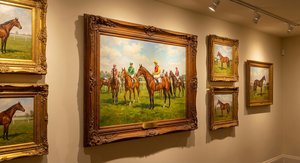
Alfred Egerton Cooper: A Traditionalist Capturing a Changing Era
Alfred Egerton Cooper (1883-1974) was more than just a British painter; he was a meticulous observer of his time, a steadfast traditionalist who navigated the tumultuous shifts of the 20th century with an unwavering commitment to established artistic principles. Born in Tettenhall, Staffordshire, into a family steeped in both art and industry – his father a railway clerk and political agent – Cooper’s early life instilled within him a respect for detail, observation, and a quiet dignity that would profoundly shape his artistic vision. His formal training at the Royal Academy Schools and subsequent studies with John Singer Sargent provided him with a solid foundation in technique, but it was his independent spirit and dedication to mastering the classical methods of portraiture and landscape painting that truly defined his legacy.
Cooper’s early career unfolded during the vibrant years following World War I. He quickly established himself as a skilled portraitist, capturing the likenesses of prominent figures – from members of the Royal Family to notable politicians and military leaders. His portraits weren't merely technical exercises; they were imbued with a sense of character, revealing the personalities beneath the formal facades. The influence of Sargent is evident in his careful attention to light and shadow, his ability to convey subtle nuances of expression, and his preference for a refined, almost understated elegance. However, Cooper never fully embraced the radical experimentation that characterized much of the art world at the time. He remained firmly rooted in the traditions of academic painting, prioritizing accuracy, realism, and a deep understanding of anatomy and composition.
- Early Influences: Beyond Sargent, Cooper’s artistic development was subtly shaped by his family history – his maternal grandparents were involved in the ironworks industry, fostering an appreciation for craftsmanship and detail.
- The War Years: The First World War proved a pivotal period. Serving as an artist in the Artists' Rifles and later as an official war artist for the Royal Air Force, Cooper witnessed firsthand the dramatic changes sweeping across Britain. This experience profoundly impacted his work, leading to a series of evocative paintings depicting airships – symbols of both technological advancement and the anxieties of a rapidly modernizing world.
- King George VI & Winston Churchill: Two portraits stand out as particularly significant achievements: his depiction of King George VI and, perhaps more famously, his portrait of Winston Churchill. The latter was painted during a period when Churchill’s personality was notoriously difficult to capture – requiring multiple sittings and meticulous observation. Cooper's ability to convey Churchill’s formidable presence and complex character is a testament to his skill as a portraitist.
A Landscape Painter of Quiet Observation
While best known for his portraits, Cooper was also a capable landscape painter. His landscapes, often set in the English countryside, are characterized by a similar attention to detail and a restrained palette as his portraits. Unlike many of his contemporaries who embraced Impressionism’s fleeting effects of light and color, Cooper favored a more traditional approach – meticulously rendering textures, forms, and atmospheric conditions with a precise hand. His landscapes aren't dramatic or emotionally charged; instead, they offer quiet glimpses into the beauty of the natural world, inviting the viewer to contemplate the subtle details of rural life.
His work during this period reflects the changing social landscape of Britain – the rise of air travel, the increasing prominence of technology, and the growing awareness of global events. Cooper’s paintings serve as a visual record of these transformations, capturing both the tangible changes in the physical environment and the shifting attitudes of British society. He wasn't overtly political, but his work subtly reflects the anxieties and aspirations of an era grappling with rapid modernization.
Technique and Style
Cooper’s artistic style can be described as a refined blend of academic tradition and personal expression. His portraits are characterized by their meticulous realism, precise draughtsmanship, and subtle use of color. He employed a layering technique, building up the image gradually with thin washes of paint, creating a sense of depth and luminosity. His landscapes similarly demonstrate his mastery of technique – carefully observed details, balanced compositions, and a restrained palette contribute to an atmosphere of quiet contemplation.
Despite his adherence to traditional methods, Cooper was not immune to the influences of his time. He experimented with different mediums and techniques throughout his career, adapting his style to suit the subject matter and the demands of the market. However, he always remained true to his core principles – prioritizing accuracy, realism, and a deep understanding of artistic form.
Legacy and Historical Significance
Alfred Egerton Cooper’s legacy lies not in revolutionary innovation but in his steadfast commitment to traditional values. He was a painter who understood the importance of craftsmanship, observation, and a respect for established artistic principles. His portraits and landscapes offer valuable insights into the social and cultural landscape of Britain during the 20th century – capturing the personalities, events, and anxieties of an era marked by rapid change. His works are held in numerous public collections, including the National Portrait Gallery and the Imperial War Museum, ensuring that his contribution to British art continues to be appreciated for generations to come.
Cooper’s career spanned over six decades, witnessing significant shifts in artistic trends and social attitudes. He remained a constant figure in the British art world, respected by his peers and admired by collectors. His paintings serve as a reminder of the enduring power of traditional techniques and the importance of capturing the essence of human experience with honesty and skill.
Questions & Answers
Is there a complete list of Alfred Egerton Cooper's artworks?
Every work by Alfred Egerton Cooper on this website can be browsed from the artist's All Artworks page.
Where can I see Alfred Egerton Cooper's artworks in a 3D gallery?
Alfred Egerton Cooper's artworks can be seen in a 3D gallery on the artist's 3D Museum page.
Which artworks by Alfred Egerton Cooper are the most viewed?
Statistics about Alfred Egerton Cooper's works are available on the artist's Stats page.