Jean Louis Tocqué: A Portraitist of the French Court
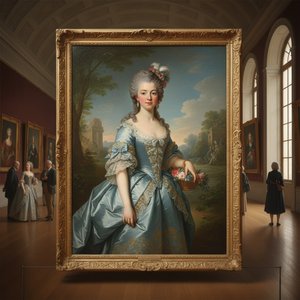
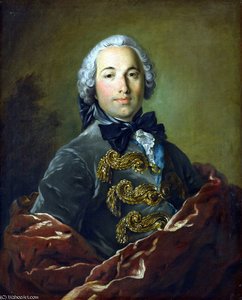
Jean Louis Tocqué, a name perhaps less familiar than some of his contemporaries, stands as a significant figure in 18th-century French portraiture. Born in Paris in 1696 and tragically passing away in 1772, Tocqué’s life was marked by both artistic apprenticeship and the privilege of capturing the likenesses of royalty and nobility. His career unfolded within the vibrant, yet often turbulent, world of the Parisian Salon, a crucial platform for artists to showcase their work and gain recognition. Tocqué's legacy rests primarily on his exquisite portraits, characterized by a refined elegance and an ability to imbue his subjects with a sense of both dignity and charm – qualities that resonated deeply within the court circles he served.
Early Life and Artistic Training
Jean Louis Tocqué’s artistic journey began in the shadow of his father, also a painter, whose untimely death in 1710 at the age of fourteen profoundly shaped young Louis's trajectory. This early loss propelled him into the care of Jean-Marc Nattier, a renowned portraitist already established within the French court. Nattier’s atelier became Tocqué’s formative environment, where he honed his skills under the tutelage of masters like Hyacinthe Rigaud and Nicolas Bertin. These influential figures instilled in him not only technical proficiency but also an appreciation for classical ideals and a meticulous approach to rendering form and detail. Tocqué's initial training was deeply rooted in Nattier’s style – a blend of realism, elegance, and a subtle theatricality—but he quickly developed his own distinctive voice, influenced by the more dynamic compositions of Hyacinthe Rigaud and the refined sensibilities of Nicolas de Largillière.
Royal Commissions and Salon Recognition
Tocqué’s rise to prominence was inextricably linked to his ability to secure commissions from the French court. His most celebrated work, the portrait of Louis XV (circa 1740), commissioned by his great-grandfather, King Louis XIV, stands as a testament to his skill and the esteem in which he was held. This monumental painting, now housed in the Louvre, exemplifies Tocqué’s mastery of light, color, and composition—a harmonious blend of regal authority and youthful charm. Beyond this grand commission, Tocqué consistently produced portraits of significant figures, including Marie Leszczyńska, Queen of France (1740), and infanta Maria Teresa Rafaela of Spain (1745). His work regularly appeared in the prestigious Salon exhibitions from 1737 to 1759, solidifying his reputation as one of the most sought-after portraitists of his time. These appearances weren’t merely displays; they were crucial for establishing connections and securing further patronage.
A Journey East: The Portrait of Empress Elizabeth Petrovna
In 1757, Tocqué embarked on a remarkable journey to the Russian Empire at the invitation of Empress Elizabeth Petrovna. This unprecedented opportunity allowed him to create a ceremonial portrait of the empress, an undertaking that cemented his international standing and resulted in a masterpiece now residing in the Hermitage Museum in Saint Petersburg. The portrait is notable for its intricate detail and the subtle portrayal of the empress’s power and grace—a testament to Tocqué's ability to capture not just physical likeness but also personality and status. This commission demonstrated Tocqué’s willingness to travel and adapt his style to suit different cultural contexts, showcasing a remarkable versatility as an artist.
Influence and Legacy
Tocqué’s influence extends beyond the portraits he created; he played a role in shaping the artistic landscape of Denmark during the 1760s. Invited to Copenhagen, he accepted a position at the Royal Danish Academy of Fine Arts, where he not only taught but also produced stunning portraits of the Danish royal family. His work in Denmark further broadened his stylistic range and demonstrated his ability to adapt to new environments while maintaining his signature elegance. While Tocqué’s output was relatively modest compared to some of his contemporaries, his portraits—particularly those commissioned by royalty—remain valuable examples of 18th-century French art. They offer a glimpse into the lives and personalities of influential figures, showcasing Tocqué's technical skill, artistic sensitivity, and ability to capture the essence of his subjects. His work continues to be studied and admired for its refined beauty and historical significance.
18th-century Danish painters like Jens Juel, Nicolai Abildgaard, and Peder Als define an era. Find museum-quality reproductions on AllPaintingsStore.com.
Explore the exquisite Rococo portraits of Jean-Marc Nattier, favored by French aristocracy. Discover his artistic techniques, patronage network, and lasting legacy – a guide for discerning collectors.