Early Life and Apprenticeship in the Dutch Golden Age
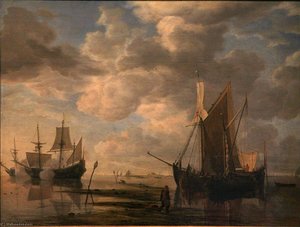
Simon de Vlieger, born in Rotterdam around 1601, emerged during the zenith of the Dutch Golden Age—a period defined by unprecedented prosperity, maritime dominance, and artistic flourishing. While specific details regarding his early training remain elusive, it’s understood he began his artistic journey within the vibrant milieu of his hometown. The bustling port city provided an immediate and compelling subject matter for a budding painter: ships. Unlike many artists who initially diversified their skills through genre scenes or portraiture, de Vlieger seems to have focused almost exclusively on marine subjects from a relatively young age, suggesting an early fascination with the sea and its vessels.
His initial style likely drew inspiration from earlier maritime painters like Jan Porcellis, whose work often featured dramatic, turbulent seascapes. However, de Vlieger quickly began to distinguish himself by moving away from the more monochrome palettes favored by his predecessors. He sought a greater degree of realism and luminosity in his depictions, aiming for an accurate representation of light reflecting on water and the intricate details of ship construction.
A Career Navigating Delft and Amsterdam
De Vlieger’s career unfolded across several key Dutch cities, each contributing to his artistic development. In 1627, he married Anna Gerridts van Willige, a union that provided stability as he established himself professionally. He joined the Guild of Saint Luke in Delft in 1634, signifying his acceptance into the established art community. This period saw him honing his skills and building a reputation for capturing the essence of Dutch maritime life.
Around 1638, de Vlieger relocated to Amsterdam, the heart of the Dutch art market and a major center for shipbuilding and trade. Here, he encountered a wider audience and greater opportunities. Despite maintaining a residence in Rotterdam until 1650—when he finally settled in Weesp, a smaller town near Amsterdam—Amsterdam became his primary base of operations. It was during this time that de Vlieger truly solidified his position as one of the leading maritime painters of the era.
Innovation and Artistic Style
De Vlieger’s artistic innovation lay in his meticulous attention to detail and his masterful use of color. He moved beyond simply depicting ships at sea; he sought to capture the *feeling* of being on the water—the spray of the waves, the glint of sunlight on sails, the complex rigging of a vessel. His paintings are characterized by their highly detailed representations of ship construction, reflecting a deep understanding of naval architecture.
He wasn’t merely a recorder of ships; he was an interpreter of maritime life. He painted scenes of ships in harbor, at sea during calm weather, and caught in the throes of violent storms. His storm seascapes are particularly compelling, conveying both the power of nature and the vulnerability of human endeavor. Beyond painting, de Vlieger demonstrated a remarkable versatility, designing tapestries, etchings, and even stained glass windows for Amsterdam’s Nieuwe Kerk and the organ screen for Rotterdam's St. Laurenskerk.
Legacy and Influence on Maritime Painting
Simon de Vlieger’s influence on subsequent generations of maritime painters was profound. He trained several pupils, including Willem van de Velde the Younger, Adriaen van de Velde, and Jan van der Cappelle—all of whom went on to achieve significant recognition in their own right. Van der Cappelle, in particular, held de Vlieger in high esteem, owning nine original paintings and over 1300 prints by his master.
Even after de Vlieger’s death in 1653, his work continued to circulate and inspire. Numerous unfinished works remained in his studio, testament to the constant demand for his art. One such painting—depicting fishermen dragging nets ashore—was sold by Van der Cappelle to Joanna Six, wife of Simon van der Stel, and shipped to the Cape of Good Hope, where it was displayed at Groot Constantia, the Van der Stel family estate. This act underscores the enduring appeal of de Vlieger’s work and its connection to the broader Dutch colonial enterprise.
De Vlieger's legacy extends beyond his technical skill; he captured a crucial aspect of Dutch identity—its relationship with the sea. His paintings are not simply beautiful depictions of ships; they are windows into a world defined by trade, exploration, and the constant interplay between humanity and nature. He remains a pivotal figure in the history of maritime art, celebrated for his realism, luminosity, and enduring ability to evoke the spirit of the Dutch Golden Age.
Questions & Answers
How many artworks by Simon De Vlieger are available to browse?
You can browse 69 artworks by Simon De Vlieger on the All Artworks page.
Where are Simon De Vlieger's artworks grouped by art movement?
The All Movements page groups Simon De Vlieger's artworks by art movement.
What colors did Simon De Vlieger use most often?
Simon De Vlieger's use of color across the works listed on this website can be studied on the artist's Palette Genome page.