The Life of Vincent Willem Van Gogh
Vincent Willem Van Gogh was born on March 30, 1853, in Zundert, Netherlands. He was the eldest of six children born to Theodorus and Anna Carbentus. His arrival followed a stillborn brother named Vincent, born exactly one year earlier. The family lived in the Brabant region, where the landscape and the quiet rhythms of rural life left a mark on his early years. His brother Theo was born on 1 May 1857, and their connection would remain a constant through the many letters they exchanged over the years.
His life was marked by a search for a place to belong. He moved through various roles, from working in art galleries to serving as a missionary, before finally turning to the canvas. This path was not easy. He faced periods of deep isolation and mental struggle that shadowed his work. He eventually moved through the light of southern France and the quiet of Saint-Rémy before his life ended in Auvers-sur-Oise, France. He died on July 29, 1890, at the age of 37, following a self-inflicted gunshot wound to the chest.
Early Life, Family and Training
The quiet village of Zundert in the Brabant region was where Vincent Willem Van Gogh was born. He was the second son of Theodorus van Gogh, a Protestant minister, and Anna Carbentus. His family life was shaped by the rhythms of the village and the frequent walks taken through the surrounding countryside. At age eleven, he was sent away to a boarding school in Zevenbergen. He found the experience there difficult and unhappy. By thirteen, he had moved to Tilburg to attend secondary school, though he left the institution halfway through his second academic year for reasons that remain unknown.
His professional life began through his uncle's connections. At sixteen, he started as a trainee at the Goupil & Cie branch in The Hague. This role brought him into constant contact with the works of others. In 1873, he moved to the London branch of Goupil & Cie, where he remained until May 1875. His work took him further into the heart of the art trade when he moved to the Paris branch of the same firm in May 1875. He stayed in Paris until April 1876. During these years, he maintained a growing correspondence with his younger brother, Theo, who was also working within the Goupil & Cie network.
The Search for a Purpose
Before the brushes and the heavy oils, there was a long period of trying to find a place in the world. He moved through different lives, testing various roles to see which one might hold. He spent time as an art dealer, working within the trade, and later tried his hand at teaching. These years were marked by a restless movement from one vocation to another, searching for a sense of direction that remained out of reach.
In England, he worked as a language teacher and a lay preacher. This period of religious seeking led him to the Borinage region in Belgium during the winter of 1879–80. There, he lived among the people as an evangelist, attempting to serve a community through his faith. He lived a life of solitude and struggle during these years, often facing the weight of his own convictions and the difficulty of his surroundings.
It was not until he was 27 that he finally turned his focus entirely to painting. This decision came after years of searching through other professions, including his time as a missionary. He began to pick up the tools of his craft with a late start, moving away from the roles of teacher and preacher to settle into the life of an artist.
The Paris Period and Artistic Awakening
In 1886, the move to Paris changed the way he saw light and color. The city brought him into contact with the Impressionist and Post-Impressionist movements, shifting his focus away from the dark, heavy tones of his earlier years. He spent time absorbing the techniques of masters like Monet, Renoir, and Pissarro. His palette began to brighten. The somber, earthy colors of his time in the Netherlands gave way to a new way of seeing the world through light and brushwork.
He moved through the circles of the avant-garde, meeting figures such as Émile Bernard and Paul Gauguin. These encounters were not merely social; they were part of a constant exchange of ideas regarding how to represent the world on a flat surface. He studied the bold outlines and flat planes of color found in Japanese prints, which he collected alongside his brother Theo. This period was a time of rapid technical change, where his brushwork became looser and his colors more direct.
The Creative Explosion in Arles
The move to Arles in 1888 brought a change in light. The southern French sun seemed to ignite the palette, leading to a period of intense output. He applied paint thickly, using an impasto technique that created a textured surface, making the canvas feel almost sculptural. This was the time of the sunflowers, where he worked on several versions of the flowers in a vase, and the studies of the night cafe. The colors became more saturated, moving away from the somber tones of his earlier years.
He sought a shared space for artists, inviting Paul Gauguin to join him in Arles. His hope was to establish a utopian colony where painters could live and work together. This period of collaboration was marked by tension. A dramatic confrontation between the two men eventually resulted in Van Gogh mutilating his own ear. This event marked a shift in his mental state and led to a period of institutionalization.
The Later Years in Saint-Rémy and Auvers
Following his time in Arles, Vincent Willem Van Gogh entered an asylum at Saint-Rémy. During this period, he turned his attention to the surrounding landscapes, capturing the movement of the sky and the earth in works like Starry Night. The brushwork here carries a rhythmic, swirling energy, reflecting the environment he observed from his window. He continued to paint prolifically, finding a way to translate the tension of his surroundings onto the canvas.
He eventually moved to Auvers-sur-Oise, staying under the care of Dr. Paul Gachet. This period was marked by a continued effort to capture the light and the fields of the French countryside. However, his internal struggles remained constant. On July 29, 1890, at the age of 37, he died in Auvers-sur-Oise, France, from a self-inflicted gunshot wound to the chest.
Technique and Artistic Style
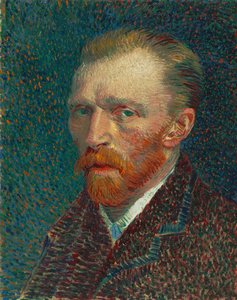
The paint on the canvas often sits in thick, heavy ridges. This impasto technique means the brushstrokes are not merely marks of color but physical layers that catch the light. He applied the oil paint with a sense of urgency, creating a textured surface that feels restless. These marks are often impulsive and dramatic, following the movement of the subject rather than the strict lines of a sketch. He did not aim for a photographic likeness of the world. Instead, he used color and form to communicate a subjective experience, prioritizing the intensity of a feeling over the objective reality of a scene.
His palette changed as his methods evolved. He moved away from the muted, earthy tones of his early years toward a use of bold, saturated colors. This was partly driven by his interest in Japanese woodblock prints, such as those by Hiroshige. From these prints, he learned to use flat planes of color and distinctive cropping. He also adopted the use of bold outlines and unusual perspectives. This influence helped him move toward a style where color was used to express internal states rather than just describing the natural light of a landscape.
Key Works and Masterpieces
In 1885, he sat with the heavy, dark tones of the Dutch countryside, producing The Potato Eaters. The paint here is thick, capturing the coarse textures of the earthenware and the weary faces of those gathered around the table. It is a study of earth and shadow, where the light seems to struggle against the gloom of the room. This period shows a man looking closely at the grit of manual labor, using a somber palette to reflect the lives of the working class.
The light changed when he moved south. In 1888, he turned his attention to the Sunflowers series, working on several versions to decorate a room in Arles. These canvases use a heavy impasto technique, where the paint is applied so thickly it creates its own physical relief. The yellows are bright and direct, applied with a rhythmic energy that makes the petals feel as though they are still moving. This was a time of intense color, moving away from the muted browns of his earlier years.
By 1889, his brushwork had taken on a swirling, restless quality. Starry Night shows this movement through deep blues and pulsing yellows, creating a sky that feels alive with motion. Later, in 1890, he painted The Church at Auvers, capturing the architecture of the village under a wide, open sky. His final works often reflected the landscape around him, whether it was the wheatfields or the quiet corners of a village, always marked by that same visible, heavy application of oil.
Legacy and Enduring Influence
The weight of his influence became clear in the early 20th century. His approach to color and form helped clear a path for Expressionism, moving art away from the need to mirror the physical world. Instead, the focus shifted toward the internal, using the canvas to communicate what is felt rather than just what is seen. This shift changed how many artists approached their work, prioritizing the subjective experience of the individual.
Much of what is known about his work today is due to the persistence of Johanna van Gogh-Bonger. After his death, she worked to ensure his paintings were seen and understood. She managed his estate and promoted his art, helping his reputation grow beyond the small circle of those who knew him during his life. Without her efforts, the breadth of his output might have remained hidden in private collections or forgotten in the shadows of his personal struggles.
He is often remembered as a tragic figure, a man whose life was marked by mental illness and poverty. This perception has become part of his history, often overshadowing the technical discipline he applied to his canvases. His story remains tied to the tension between his personal suffering and the intense, rhythmic energy he left behind in his oils. His presence in art history is defined by this intersection of a difficult life and a prolific, transformative output.
Where to See the Works Today
To see the physical traces of his brushwork, one can travel to several specific collections. The Kröller-Müller Museum in Otterlo holds the largest concentration of his work, with 143 pieces kept there. The Van Gogh Museum in Amsterdam follows with 100 works. These collections allow for a close look at how his style changed from the somber tones of his early years to the thick impasto of his later life.
Other significant groups of his paintings are held in major international museums. The Musée d'Orsay in Paris contains 22 works. Across the Atlantic, the Metropolitan Museum of Art in New York holds 15 pieces. These locations offer different perspectives on his development, from his early depictions of peasant life to the swirling skies of his final years.


 Read More


 Switch to Print


 For artworks or reproductions larger than 105 cm (approximately 41 inches) on any side, the frame will be shipped as a kit, disassembled. This method ensures safe delivery and prevents damage during transport.


