- Home

- Oil Painting Reproduction
- Benny Andrews
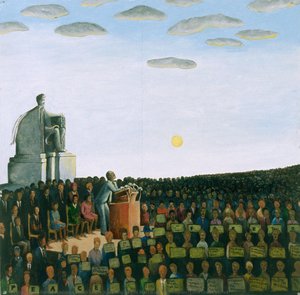
- John Lewis Speaking at the March on Washington (John Lewis Series)

 Buy print
 Send
Send Share
Share
 Details

 Download
 Similars
 X-Ray
X-Ray Diaporama
John Lewis Speaking at the March on Washington (John Lewis Series)
 Acrylic On Canvas
- WallArt
- Contemporary Realism
 2005
2005- 19th Century
 National Center for Civil and Human Rights
 Read More
Hand Made Oil Reproduction
Hand-painted oil on canvas in your size and frame, made to order by our artists.




P118B $10

P118H $10

P118W $10

P438Z $10

P508JH $12

P508YH $12

P805H $10

P805Z $10

P919BZ $10

P919G $10

P919XJ $10

P959ZH $10

P968JZ $12

W106C $8

W218G $10

W218JH $8

W218Y $10

W307PJ $10

W316G $10

W316PJ $8

W316Y $10

W398PJ $8

W4111J $10

W500HY $15

W500JH $15

W692G $12

W849H $8

W940BG $15

W953PJ $8




Pick from our preset sizes that match the artwork's original proportions.

You may enter your own dimensions to fit a specific frame or space. If your selected size does not match the original image's proportions, we will either crop the artwork or extend the painting with additional hand-painted elements. A digital mockup will be sent for your approval before production begins.
Please note that the on-screen preview does not reflect the actual cropping or extension. Only the mockup will accurately show the final composition.
While custom sizes are available, we recommend selecting a dimension from the predefined list to preserve the original proportions.
After order, AllPaintingsStore.com team will email client for instructions and provide a mockup preview
Worldwide Delivery () in 3/4 weeks instead of standard 5 weeks. (16 July). No compromise on quality.

Free Worldwide Express Shipping

High-Quality Linen Canvas

Full Shipping Insurance

Customs Tax Refund Guarantee

True Color Matching Guarantee

60-Day Return Policy (Defects Only)

100% Money-Back Guarantee

Bulk Discount Offer
 Glass option is only available in size under 110 CM

John Lewis Speaking at the March on Washington (John Lewis Series)
Reproduction Medium
Reproduction Size
-


Total Price
-
Artwork Description
John Lewis Speaking at the March on Washington (John Lewis Series) – A Monument to Courage and Collective Action
- Subject Matter: This monumental mural depicts John Lewis, one of the most influential figures in the American Civil Rights Movement, delivering a passionate speech during the March on Washington for Jobs and Freedom in 1963. The scene captures a pivotal moment in history—a collective effort to demand equality and justice for African Americans.
- Artist: Benny Andrews (1930-2006), an American artist renowned for his powerful depictions of social justice issues, skillfully portrays Lewis’s unwavering conviction amidst the fervor of the crowd.
- Style: Andrews' style leans heavily into Realism with expressive brushstrokes that convey both the solemnity and dynamism of the event. The artist utilizes a muted color palette—primarily browns, reds, and yellows—to create an atmosphere of earnest deliberation and resolute determination. This deliberate choice underscores the seriousness of the occasion.
- Technique: Executed in oil on canvas, Andrews employs layering techniques to build up texture and depth, capturing the palpable energy of the March on Washington. The artist’s meticulous attention to detail ensures that every element—from Lewis's posture to the expressions on the faces of his listeners—contributes to the overall narrative.
- Historical Context: Created in 2005, this artwork serves as a testament to the enduring legacy of the Civil Rights Movement. The March on Washington itself was a watershed moment, galvanizing public opinion and propelling legislative reforms aimed at dismantling segregation. Lewis’s presence embodies the spirit of resistance and unwavering commitment to achieving racial equality.
- Symbolism: The inclusion of a clock in the upper left corner subtly symbolizes the passage of time—a reminder that progress requires persistent effort and vigilance. Furthermore, the crowd itself represents the collective power of individuals united by a shared aspiration for justice. Andrews’s masterful composition reinforces this message.
- Emotional Impact: Viewing “John Lewis Speaking at the March on Washington” evokes feelings of admiration for Lewis's courage and compassion, as well as inspiration for advocating for social change. The mural’s subdued colors and textured surface invite contemplation—encouraging viewers to reflect on the importance of confronting injustice and striving towards a more equitable society.




Artist Biography
Benny Andrews: Life & Legacy
Early Life and Education
- Born: November 13, 1930, in Plainview, Georgia.
- Andrews grew up in a large family of ten children. His mother, Viola, instilled the importance of education, religion, and freedom of expression.
- Early Influences: His father, George Andrews, was a self-taught artist known locally as the “Dot Man,” who sparked Benny’s initial interest in art.
- He attended Fort Valley College on a two-year scholarship but left due to financial constraints and academic struggles.
- Andrews served in the U.S. Air Force from 1950 before pursuing formal artistic training.
Artistic Development & Career
- Andrews received his BFA from the School of the Art Institute of Chicago.
- He held his first solo exhibition in New York City in 1962, marking a significant step in his career.
- From 1968 to 1997, Andrews dedicated himself to teaching at Queens College, City University of New York.
- Prison Arts Program: He founded and directed a groundbreaking prison arts program that became a national model for rehabilitation through artistic expression.
- His work evolved into an expressive style characterized by bold colors and forms used to convey powerful emotions and social commentary.
Themes & Influences
- Key Themes: Andrews’ art frequently addressed themes of suffering, injustice, racial inequality, and the African American experience.
- His work often served as a visual protest against social and political issues of his time.
- He drew inspiration from personal experiences, observations of everyday life, and historical events.
- Artistic Influences: While developing his unique style, Andrews was influenced by various artistic movements, including Expressionism and Social Realism.
Notable Works
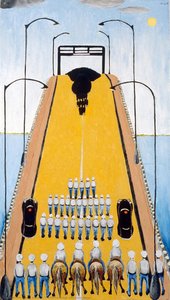
- Confrontation 2 (John Lewis Series): A powerful painting reflecting on the Civil Rights Movement and the struggles for equality.
- No More Games: A work that confronts issues of social injustice and inequality with raw emotion.
- Death of the Crow (1965): An early example of his expressive style, rendered in black and white oil on canvas.
Legacy & Historical Significance
- Benny Andrews’ work is featured in museum collections such as the Museum Collection Hugo Fischer (Bühl, Germany) and the Ogden Museum of Southern Art in New Orleans.
- Impact on Arts Education: His prison arts program demonstrated the transformative power of art for individuals facing incarceration.
- Andrews’ artistic contributions helped to raise awareness about social issues and promote dialogue around race, inequality, and justice.
- He passed away on November 10, 2006, leaving behind a lasting legacy as an artist, educator, and advocate for social change.

Benny Andrews
1930 - 2006 , United States of America
Quick Facts
- Dot Man')", 'Movement: Expressionism
- Birth Date: November 13, 1930
- Birth Place: Plainview, Georgia, USA
- Death Date: November 10, 2006
- Influenced: None, 'influenced by':
- Name: Benny Andrews
- Nationality: American
- Notable Works:
- Confrontation 2 (John Lewis Series)
- No More Games
- Death of the Crow
Related Articles

Gene Davis: Chromatic Explorations of Color Field Painting & the Washington Color School
Explore the vibrant world of Gene Davis and the Washington Color School. Discover his iconic stripe paintings, innovative techniques, and lasting impact on American abstract art. A deep dive for collectors & enthusiasts.

Sir John Tenniel: A Visual Chronicler of Victorian Society – Caricature, Illustration & Cultural Impact
Explore the life & work of Sir John Tenniel, Victorian England's master illustrator & political cartoonist. Discover his iconic 'Alice in Wonderland' art and lasting impact on satire & visual culture.

Alice Pike Barney: A Life Painted in Impressionism & Washington Society
Explore the life & art of Alice Pike Barney, a pioneering American Impressionist painter who defied convention and fostered Washington D.C.'s vibrant arts scene. Discover her unique style, portraits, and lasting legacy.

Sir John Lavery: A Study in Scottish Impressionism & the Portraiture of a Generation
Explore the life & art of Sir John Lavery, a master of Scottish Impressionism and renowned portraitist. Discover his captivating works, Irish heritage, and lasting legacy with AllPaintingsStore.

John Frederick Lewis: Orientalism, Detail & Genre Painting in 19th-Century British Art
Explore the captivating Orientalist paintings of John Frederick Lewis! Discover his mastery of detail, genre scenes & influence on 19th-century British art. Learn about his life, techniques & legacy at AllPaintingsStore.