- Home

- Oil Painting Reproduction
- Benny Andrews
- The Pettus Bridge (John Lewis Series)

 Buy print
 Send
Send Share
Share
 Details

 Download
 Similars
 X-Ray
X-Ray Diaporama
The Pettus Bridge (John Lewis Series)


 Read More
Hand Made Oil Reproduction
Hand-painted oil on canvas in your size and frame, made to order by our artists.




































Pick from our preset sizes that match the artwork's original proportions.

You may enter your own dimensions to fit a specific frame or space. If your selected size does not match the original image's proportions, we will either crop the artwork or extend the painting with additional hand-painted elements. A digital mockup will be sent for your approval before production begins.
Please note that the on-screen preview does not reflect the actual cropping or extension. Only the mockup will accurately show the final composition.
While custom sizes are available, we recommend selecting a dimension from the predefined list to preserve the original proportions.
After order, AllPaintingsStore.com team will email client for instructions and provide a mockup preview
Worldwide Delivery () in 3/4 weeks instead of standard 5 weeks. (16 July). No compromise on quality.

Free Worldwide Express Shipping

High-Quality Linen Canvas

Full Shipping Insurance

Customs Tax Refund Guarantee

True Color Matching Guarantee

60-Day Return Policy (Defects Only)

100% Money-Back Guarantee

Bulk Discount Offer
 Glass option is only available in size under 110 CM

The Pettus Bridge (John Lewis Series)
Reproduction Medium
Reproduction Size
-


Total Price
-
Artwork Description
A Tapestry of Resilience: The Spirit of Selma
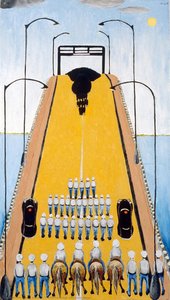
Benny Andrews’ depiction of The Pettus Bridge is far more than a mere rendering of an Alabama thoroughfare; it is a monumental echo of American conscience. This work captures the charged atmosphere surrounding the pivotal events of 1965, transforming a physical crossing point into a crucible for civil rights history. While the painting presents a scene of daily life—yellow roadways bearing cars and pedestrians shielding themselves from rain with umbrellas—the underlying narrative pulses with the weight of struggle and unwavering human dignity. Andrews masterfully juxtaposes the mundane rhythm of everyday activity against the monumental historical significance of the march itself, inviting the viewer into a moment suspended between routine and revolution.
Artistic Vision and Technique
Andrews’ signature style, deeply rooted in social commentary, shines through here with remarkable clarity. His technique allows for both detailed observation—the texture of the wet pavement, the presence of the horse adding an element of timeless transit—and sweeping emotional scope. The composition is rich, drawing the eye across the breadth of the bridge where figures move with purpose. For those drawn to art that speaks volumes without uttering a word, this piece offers profound visual storytelling. It possesses the immediacy of photojournalism yet retains the elevated, symbolic quality of fine art painting, making it a compelling focal point for any sophisticated interior space.
Historical Resonance and Symbolism
The context surrounding The Pettus Bridge is inseparable from its artistic power. This bridge became the site of confrontation, the flashpoint where peaceful aspiration met brutal force. By depicting the scene with such careful attention to the flow of people—the walkers, the vehicles—Andrews subtly acknowledges the tension inherent in that history. The umbrellas against the rain are potent symbols: protection, endurance, and the necessity of shielding one's ideals from harsh elements. It is a meditation on perseverance; the act of simply continuing to walk forward, together, despite the storm.
An Emotional Anchor for Modern Spaces
For collectors and designers alike, this reproduction offers an unparalleled opportunity to integrate powerful narrative art into a curated environment. The emotional impact of the piece is one of profound hope tempered by historical gravity. It serves as a quiet yet insistent reminder of the sacrifices made for fundamental freedoms. Owning this work means embracing a dialogue with American history—a conversation about justice, solidarity, and the enduring power of the human spirit to demand better. It is art that does not merely decorate; it inspires contemplation and champions the ongoing pursuit of equality.
Related Artworks


Artist Biography
Benny Andrews: Life & Legacy
Early Life and Education
- Born: November 13, 1930, in Plainview, Georgia.
- Andrews grew up in a large family of ten children. His mother, Viola, instilled the importance of education, religion, and freedom of expression.
- Early Influences: His father, George Andrews, was a self-taught artist known locally as the “Dot Man,” who sparked Benny’s initial interest in art.
- He attended Fort Valley College on a two-year scholarship but left due to financial constraints and academic struggles.
- Andrews served in the U.S. Air Force from 1950 before pursuing formal artistic training.
Artistic Development & Career
- Andrews received his BFA from the School of the Art Institute of Chicago.
- He held his first solo exhibition in New York City in 1962, marking a significant step in his career.
- From 1968 to 1997, Andrews dedicated himself to teaching at Queens College, City University of New York.
- Prison Arts Program: He founded and directed a groundbreaking prison arts program that became a national model for rehabilitation through artistic expression.
- His work evolved into an expressive style characterized by bold colors and forms used to convey powerful emotions and social commentary.
Themes & Influences
- Key Themes: Andrews’ art frequently addressed themes of suffering, injustice, racial inequality, and the African American experience.
- His work often served as a visual protest against social and political issues of his time.
- He drew inspiration from personal experiences, observations of everyday life, and historical events.
- Artistic Influences: While developing his unique style, Andrews was influenced by various artistic movements, including Expressionism and Social Realism.
Notable Works
- Confrontation 2 (John Lewis Series): A powerful painting reflecting on the Civil Rights Movement and the struggles for equality.
- No More Games: A work that confronts issues of social injustice and inequality with raw emotion.
- Death of the Crow (1965): An early example of his expressive style, rendered in black and white oil on canvas.
Legacy & Historical Significance
- Benny Andrews’ work is featured in museum collections such as the Museum Collection Hugo Fischer (Bühl, Germany) and the Ogden Museum of Southern Art in New Orleans.
- Impact on Arts Education: His prison arts program demonstrated the transformative power of art for individuals facing incarceration.
- Andrews’ artistic contributions helped to raise awareness about social issues and promote dialogue around race, inequality, and justice.
- He passed away on November 10, 2006, leaving behind a lasting legacy as an artist, educator, and advocate for social change.

Benny Andrews
1930 - 2006 , United States of America
Quick Facts
- Dot Man')", 'Movement: Expressionism
- Birth Date: November 13, 1930
- Birth Place: Plainview, Georgia, USA
- Death Date: November 10, 2006
- Influenced: None, 'influenced by':
- Name: Benny Andrews
- Nationality: American
- Notable Works:
- Confrontation 2 (John Lewis Series)
- No More Games
- Death of the Crow
Related Articles
Benny Andrews: A Life Painted in Layers – Narrative, Identity & the American Experience
Explore the powerful life & art of Benny Andrews – a pivotal figure in African American expressionism. Discover his unique collage style, activism, and poignant depictions of identity & social justice. A must-read for collectors.

American Realism: Capturing the Soul of Everyday Life through the Lens of Art History
Explore the profound beauty of American Realism. From Winslow Homer’s rural landscapes to the dignity of everyday life, discover how master artists captured the soul of a nation through evocative oil paintings and timeless fine art techniques.

American Regionalism: Capturing the Soul of the Heartland through the Lens of Art History
Explore the profound beauty of American Regionalism. Delve into the art history of Grant Wood and John Steuart Curry, uncovering how these masters captured the soul of the American Heartland through iconic landscapes and rural identity.

Oil on Canvas Masters: 10 Paintings That Redefined Art History |
Journey through art history with our guide to 10 legendary oil on canvas masterpieces! Explore iconic works by Van Gogh, Monet & Rembrandt. Find museum-quality reproductions and elevate your home decor at . Discover all masterpieces online.

Golden Masterpieces: 10 Paintings That Define Art History | AllPaintingsStore
Explore 10 breathtaking paintings where gold leaf shines! From Klimt to Byzantine icons, discover art history’s most gilded masterpieces. Find museum-quality reproductions & elevate your home decor with AllPaintingsStore. Explore the full collection online.