Benny Andrews: Life & Legacy
Early Life and Education
- Born: November 13, 1930, in Plainview, Georgia.
- Andrews grew up in a large family of ten children. His mother, Viola, instilled the importance of education, religion, and freedom of expression.
- Early Influences: His father, George Andrews, was a self-taught artist known locally as the “Dot Man,” who sparked Benny’s initial interest in art.
- He attended Fort Valley College on a two-year scholarship but left due to financial constraints and academic struggles.
- Andrews served in the U.S. Air Force from 1950 before pursuing formal artistic training.
Artistic Development & Career
- Andrews received his BFA from the School of the Art Institute of Chicago.
- He held his first solo exhibition in New York City in 1962, marking a significant step in his career.
- From 1968 to 1997, Andrews dedicated himself to teaching at Queens College, City University of New York.
- Prison Arts Program: He founded and directed a groundbreaking prison arts program that became a national model for rehabilitation through artistic expression.
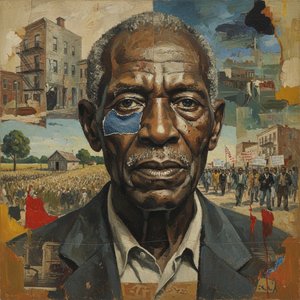
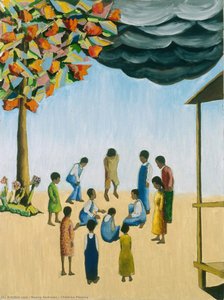
- His work evolved into an expressive style characterized by bold colors and forms used to convey powerful emotions and social commentary.
Themes & Influences
- Key Themes: Andrews’ art frequently addressed themes of suffering, injustice, racial inequality, and the African American experience.
- His work often served as a visual protest against social and political issues of his time.
- He drew inspiration from personal experiences, observations of everyday life, and historical events.
- Artistic Influences: While developing his unique style, Andrews was influenced by various artistic movements, including Expressionism and Social Realism.
Notable Works
- Confrontation 2 (John Lewis Series): A powerful painting reflecting on the Civil Rights Movement and the struggles for equality.
- No More Games: A work that confronts issues of social injustice and inequality with raw emotion.
- Death of the Crow (1965): An early example of his expressive style, rendered in black and white oil on canvas.
Legacy & Historical Significance
- Benny Andrews’ work is featured in museum collections such as the Museum Collection Hugo Fischer (Bühl, Germany) and the Ogden Museum of Southern Art in New Orleans.
- Impact on Arts Education: His prison arts program demonstrated the transformative power of art for individuals facing incarceration.
- Andrews’ artistic contributions helped to raise awareness about social issues and promote dialogue around race, inequality, and justice.
- He passed away on November 10, 2006, leaving behind a lasting legacy as an artist, educator, and advocate for social change.
Questions & Answers
Can I explore Benny Andrews's works by keyword?
To find works by Benny Andrews on a specific theme, use the artist's By Keywords page, which groups the artworks by keyword.
In which movements did Benny Andrews work?
Benny Andrews's works can be browsed by movement on the artist's All Movements page.
What are the birth city and country of Benny Andrews?
Benny Andrews was born in Plainview, in United States.