- Home

- Oil Painting Reproduction
- Franz Ehrlich
- Floor plan Sleeping room (with interior furnishings)

 Buy print
 Send
Send Share
Share
 Details

 Download
 Similars
 X-Ray
X-Ray Diaporama
Floor plan Sleeping room (with interior furnishings)
 Acrylic On Canvas
- WallArt
- Bauhaus Expressionism
 1962
1962 42.0 x 30.0 cm
 Bauhaus Dessau Foundation
 Read More
Hand Made Oil Reproduction
Hand-painted oil on canvas in your size and frame, made to order by our artists.




P118B $10

P118H $10

P118W $10

P438Z $10

P508JH $12

P508YH $12

P805H $10

P805Z $10

P919BZ $10

P919G $10

P919XJ $10

P959ZH $10

P968JZ $12

W106C $8

W218G $10

W218JH $8

W218Y $10

W307PJ $10

W316G $10

W316PJ $8

W316Y $10

W398PJ $8

W4111J $10

W500HY $15

W500JH $15

W692G $12

W849H $8

W940BG $15

W953PJ $8




Pick from our preset sizes that match the artwork's original proportions.

You may enter your own dimensions to fit a specific frame or space. If your selected size does not match the original image's proportions, we will either crop the artwork or extend the painting with additional hand-painted elements. A digital mockup will be sent for your approval before production begins.
Please note that the on-screen preview does not reflect the actual cropping or extension. Only the mockup will accurately show the final composition.
While custom sizes are available, we recommend selecting a dimension from the predefined list to preserve the original proportions.
After order, AllPaintingsStore.com team will email client for instructions and provide a mockup preview
Worldwide Delivery () in 3/4 weeks instead of standard 5 weeks. (16 July). No compromise on quality.

Free Worldwide Express Shipping

High-Quality Linen Canvas

Full Shipping Insurance

Customs Tax Refund Guarantee

True Color Matching Guarantee

60-Day Return Policy (Defects Only)

100% Money-Back Guarantee

Bulk Discount Offer
 Glass option is only available in size under 110 CM

Floor plan Sleeping room (with interior furnishings)
Reproduction Medium
Reproduction Size
-


Total Price
-
Artwork Description
A Quiet Reflection on Space: Franz Ehrlich’s Floor Plan for “Neues Leben – Neues Wohnen”
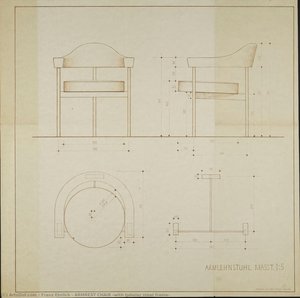
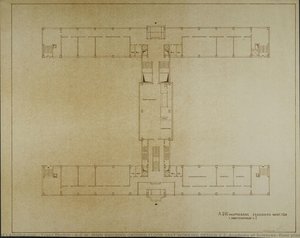
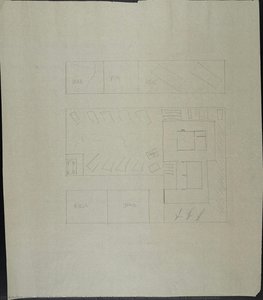
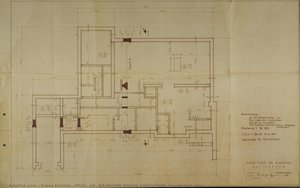
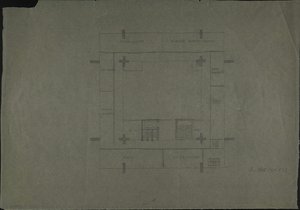
Franz Ehrlich's "Floor plan Sleeping room (with interior furnishings, for the exhibition neues leben - neues wohnen”, 1962 in Berlin-Fennpfuhl)" isn’t merely a technical drawing; it’s a distilled essence of Bauhaus principles—a testament to functionality imbued with an understated elegance that speaks volumes about the era's preoccupation with rational design and humanist ideals. Created during Ehrlich’s formative years at Dessau, this piece embodies the spirit of experimentation fostered by Walter Gropius and his colleagues, marking a crucial juncture in German architectural history. The drawing itself—a meticulously rendered graphite pencil sketch on off-white paper—captures a deceptively simple scene: a small room furnished with benches and a chair, bathed in diffused light. Yet, within its geometric confines lies a profound exploration of spatial relationships and the pursuit of harmonious living spaces.Composition and Technique: Embracing Orthographic Precision
The artwork’s compositional strategy prioritizes clarity and balance. Dominating the canvas is a rectangular outline delineating the room's dimensions—a foundational element reflecting the Bauhaus ethos of geometric abstraction. Lines converge to define walls, furniture placements, and doorways, meticulously measured and annotated with precise notations. These lines aren’t merely structural; they are conduits for conveying information about scale and proportion, mirroring the Bauhaus commitment to didactic design. Subtle hatching and cross-hatching contribute tonal variation—a restrained technique that avoids distracting from the core message of spatial organization. The graphite pencil demonstrates remarkable control, capturing textures with subtle gradations that hint at the materiality of surfaces without resorting to illusionistic rendering.Historical Context: Bauhaus Ideals Amidst Cold War Uncertainty
Ehrlich’s creation emerged against the backdrop of post-war Germany—a nation grappling with rebuilding its economy and redefining its cultural identity. The Bauhaus movement, established in 1919, championed a radical reimagining of architectural practice, rejecting ornamentation in favor of functionalism and prioritizing craftsmanship alongside technological innovation. “Neues Leben – Neues Wohnen,” the exhibition showcasing this floor plan, aimed to articulate the vision for a new kind of domestic life—one rooted in simplicity, efficiency, and human connection. The drawing serves as a tangible embodiment of these ideals, reflecting Bauhaus’s enduring influence on subsequent generations of architects and designers.Symbolism Beyond Geometry: Order and Human Scale
Despite its austere aesthetic, “Floor plan Sleeping room…” resonates with symbolic significance. The geometric precision—the dominant rectangles and squares—represents rationality and control—values central to the Bauhaus worldview. However, it’s equally important to recognize the drawing's subtle suggestion of human scale. The placement of furniture—particularly the benches—indicates a consideration for comfort and practicality—a deliberate counterbalance to the movement’s emphasis on abstraction. This harmonious blend of form and function underscores Bauhaus’s belief in architecture as a tool for enhancing human experience.Emotional Resonance: A Quiet Statement of Purpose
Ultimately, Ehrlich's floor plan transcends mere documentation; it communicates a quiet statement of purpose—a conviction that thoughtful design can elevate everyday life. The drawing evokes a sense of serenity and order—qualities prized during the Cold War era as Germany sought to forge a path toward stability and progress. It’s a reminder that beauty can reside in simplicity, and that architectural innovation should serve not only aesthetic considerations but also fundamental human needs. Viewing this reproduction offers an opportunity to appreciate Ehrlich's masterful distillation of Bauhaus principles—a legacy preserved through AllPaintingsStore.’s dedication to presenting exceptional artwork reproductions.Related Artworks





Artist Biography
early life and education
franz ehrlich, a renowned german architect, calligrapher, and graphic designer, was born in 1907. his formative years were marked by an innate inclination towards the arts, which led him to enroll at the bauhaus in dessau from 1927 to 1930. this prestigious institution played a pivotal role in shaping ehrlich's artistic perspective, introducing him to the avant-garde movements of the time.artistic career and communist affiliation
ehrlich's affiliation with the communist party had a profound impact on his life and career. in 1935, he was arrested and imprisoned by the nazi regime, an event that significantly altered the trajectory of his artistic pursuits. despite these challenges, ehrlich continued to contribute to the world of art, leaving behind a legacy that is both inspiring and thought-provoking.notable works
some of ehrlich's most notable works include:- 800 yrs. das buch [the book]. ground plan and views (exhibit display racks, leipzig trade fair), a testament to his innovative approach to design and architecture.
- prof. dr. baumann house execution (foundation plan), showcasing his expertise in architectural planning.
- 1933 (photo-sculptural advertising project), a unique blend of photography and sculpture, highlighting his experimental nature.
museums and collections featuring ehrlich's work
AllPaintingsStore.com features an extensive collection of ehrlich's works, including those mentioned above. the bauhaus dessau foundation (dessau-roßlau, germany) is also a significant repository of his artistic endeavors.legacy and impact
franz ehrlich's contributions to the world of art are multifaceted, reflecting his broad range of interests and talents. his experiences, both creatively and personally, offer valuable insights into the intersection of art and politics during a pivotal moment in german history.- view more of ehrlich's works at https://AllPaintingsStore.com/@/franz-ehrlich
- explore the bauhaus dessau foundation and its collection at bauhaus dessau foundation (dessau-roßlau, germany)

Franz Ehrlich
1907 - 1984 , Germany
Quick Facts
- Artistic Movement Or Style: Bauhaus, Expressionism
- Artists Or Movements Influenced By This Artist:
- Bauhaus
- Young Communist League
- Artists Who Influenced This Artist:
- Walter Gropius
- Moholy-Nagy
- Klee
- Joost Schmidt
- Date Of Birth: 1907
- Date Of Death: 1984
- Full Name: Franz Ehrlich
- Nationality: German
- Notable Artworks:
- 800 YRS. FRAMEWORK WALL 3
- Untitled (HKB I or II)
- Painting with Violin
- Place Of Birth: Reuth, Germany
Related Articles

Franz von Stuck: Symbolism, Decadence & the Pursuit of Ideal Beauty
Explore the captivating world of Franz von Stuck, a leading Symbolist painter. Discover his mythological masterpieces, decadent themes, & investment potential. Expert analysis for discerning collectors.

The Inevitable Canvas: Bespoke Art Design as Architectural Integration for Harmonious Interiors
Elevate your luxury home with bespoke art seamlessly integrated into architectural design. Expert consultation, custom commissions & museum-quality reproductions by AllPaintingsStore.

Beyond Aesthetics: Integrating Bespoke Art Curation as a Value-Added Service for Interior Design Professionals
Elevate your hotel design with expert art curation services. We help luxury hospitality professionals create immersive experiences & lasting impressions through bespoke collections and strategic art integration. Enhance guest satisfaction & property value.

The Seasonal Canvas: A Curatorial Approach to Dynamic Interior Design Through Rotating Art Collections
Elevate your space with strategic art rotation! Discover expert tips for curated collections, seasonal decor & preserving your investment. Transform your home into a dynamic gallery.

Beyond Decoration: Architectural Resonance of Fine Art Reproductions in Interior Design
Elevate hotel interiors with fine art reproductions that resonate architecturally. Discover how custom artwork & expert curation create unforgettable guest experiences. Explore Renaissance-inspired design solutions.