- Home

- Oil Painting Reproduction
- george innes
- Moonlight, Tarpon Springs

 Buy print
 Send
Send Share
Share
 Details

 Download
 Similars
 X-Ray
X-Ray Diaporama
Moonlight, Tarpon Springs


 Read More
Hand Made Oil Reproduction
Hand-painted oil on canvas in your size and frame, made to order by our artists.




P118B $10

P118H $10

P118W $10

P438Z $10

P508JH $12

P508YH $12

P805H $10

P805Z $10

P919BZ $10

P919G $10

P919XJ $10

P959ZH $10

P968JZ $12

W106C $8

W218G $10

W218JH $8

W218Y $10

W307PJ $10

W316G $10

W316PJ $8

W316Y $10

W398PJ $8

W4111J $10

W500HY $15

W500JH $15

W692G $12

W849H $8

W940BG $15

W953PJ $8




Pick from our preset sizes that match the artwork's original proportions.

You may enter your own dimensions to fit a specific frame or space. If your selected size does not match the original image's proportions, we will either crop the artwork or extend the painting with additional hand-painted elements. A digital mockup will be sent for your approval before production begins.
Please note that the on-screen preview does not reflect the actual cropping or extension. Only the mockup will accurately show the final composition.
While custom sizes are available, we recommend selecting a dimension from the predefined list to preserve the original proportions.
After order, AllPaintingsStore.com team will email client for instructions and provide a mockup preview
Worldwide Delivery () in 3/4 weeks instead of standard 5 weeks. (16 July). No compromise on quality.

Free Worldwide Express Shipping

High-Quality Linen Canvas

Full Shipping Insurance

Customs Tax Refund Guarantee

True Color Matching Guarantee

60-Day Return Policy (Defects Only)

100% Money-Back Guarantee

Bulk Discount Offer
 Glass option is only available in size under 110 CM

Moonlight, Tarpon Springs
Reproduction Medium
Reproduction Size
-


Total Price
-
Artwork Description
A Nocturnal Symphony of Light and Soul
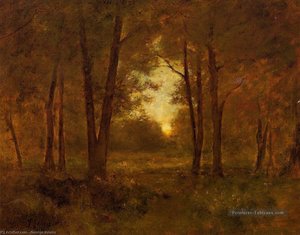
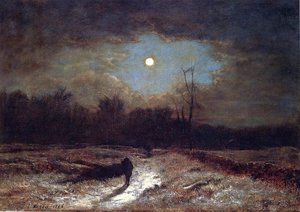
In the quietude of 1892, George Inness captured a moment that transcends mere landscape, offering instead a window into the spiritual essence of the night. Moonlight, Tarpon Springs is not simply a depiction of a nocturnal scene; it is an evocative exploration of atmosphere and introspection. The painting invites the viewer to step into a world where the boundaries between the physical earth and the ethereal sky begin to blur. At the heart of this composition stands a solitary woman, her back turned to the observer, acting as a surrogate for our own contemplative gaze. As she stands before the silhouette of a sentinel tree, bathed in the silver luminescence of the moon, we are drawn into her silent communion with the cosmos. The presence of distant figures and a wandering horse in the background adds layers of narrative depth, suggesting a shared, yet deeply personal, experience of nature’s quiet majesty.
The technique employed here is a masterclass in the American Impressionist tradition, where Inness moves away from the rigid precision of his predecessors to embrace a more fluid, emotive brushwork. Through the delicate manipulation of light and shadow, he achieves a luminous quality that makes the moonlight appear to vibrate against the dark foliage. The palette is a sophisticated arrangement of deep nocturnal blues, muted earth tones, and brilliant, silvery highlights that guide the eye through the landscape. This soft-focus approach allows the atmosphere to become a tangible character in the work, enveloping the subjects in a gentle, misty glow that softens the edges of reality and elevates the scene to something dreamlike and transcendent.
Symbolism and the Transcendentalist Vision
To understand this masterpiece, one must look through the lens of Transcendentalism, the philosophical movement that deeply influenced Inness. The painting serves as a visual manifestation of the belief in the interconnectedness of all living things and the divine presence within nature. The woman’s posture—looking away from the world of man and toward the infinite horizon—symbolizes the human soul seeking connection with the infinite. The tree, rooted firmly in the earth yet reaching toward the moon, acts as a bridge between the terrestrial and the celestial. Even the scattered figures in the distance contribute to this sense of cosmic unity, suggesting that while we may exist as individuals, we are all part of a larger, harmonious tapestry of existence.
For the discerning collector or interior designer, Moonlight, Tarpon Springs offers more than just aesthetic beauty; it provides an emotional anchor for a space. The painting’s inherent serenity makes it an ideal centerpiece for rooms designed for reflection, such as a library, a study, or a quiet sitting room. Its ability to evoke a sense of peace and timelessness allows it to complement both classic and contemporary decor, bringing a touch of historical depth and soulful tranquility to any environment. Owning a high-quality reproduction of this work is an opportunity to invite the profound, quiet beauty of Inness’s vision into one's daily life, serving as a constant reminder of the magic found in the stillness of the night.
Artist Biography
George Inness (1825–1894): The Quiet Observer of Nature’s Soul
George Inness, born in Newburgh, New York, in 1825, stands as a pivotal figure in American Impressionism—a movement that sought to capture fleeting moments of beauty and emotion through luminous color palettes and loose brushstrokes. Unlike the grand narratives championed by the Hudson River School, Inness’s artistic vision prioritized introspection and spiritual contemplation, reflecting his profound engagement with philosophical ideas. This dedication resulted in landscapes imbued with a palpable serenity, portraying rural scenes and animal life with remarkable sensitivity to light and atmosphere. His legacy continues to inspire artists today who strive for similar expressive depth.- Early Life & Education: Inness’s formative years were marked by exposure to Transcendentalist thinkers like Ralph Waldo Emerson and Henry David Thoreau, whose emphasis on intuition and connection with the natural world profoundly shaped his artistic sensibilities. He pursued formal training at Yale University before embarking on a self-directed study of art in Paris during the mid-1850s—a crucial period for absorbing Impressionistic techniques.
- Parisian Influences & Artistic Development: In Paris, Inness immersed himself in the burgeoning Impressionist movement, studying under Gustave Courbet and Jean-François Millet. These encounters solidified his commitment to capturing immediate visual sensations rather than meticulously recreating reality. He experimented with plein air painting—working outdoors directly from nature—developing a distinctive style characterized by subtle gradations of color and textured brushwork.
- Notable Landscapes & Paintings: Inness’s oeuvre comprises numerous iconic landscapes that exemplify the movement's aesthetic principles. Works such as “The Dark Side of Twilight” (1869) and “Winter Landscape” (1873) are celebrated for their masterful depiction of atmospheric conditions—particularly mist and snow—and their ability to evoke a sense of profound stillness. His portraits, too, reveal an artist’s keen observation of human psychology.
- Symbolism & Spiritual Vision: Beyond mere visual representation, Inness's paintings convey deeper symbolic meanings rooted in his philosophical convictions. Recurring motifs—such as trees and animals—represent resilience, harmony, and the interconnectedness of all living things. His canvases are not simply landscapes; they are meditations on the sublime beauty of nature and its capacity to inspire spiritual awareness.
- Legacy & Historical Significance: George Inness’s contribution to American art is undeniable. He championed a humanist aesthetic that prioritized emotional resonance over technical virtuosity—a stance that distinguished him from his contemporaries and cemented his place as one of the foremost Impressionist painters of his time. His influence extends beyond painting, inspiring subsequent generations of artists to explore themes of contemplation and connection with the natural world.

george innes
1825 - 1894 , United States of America
Quick Facts
- Artistic Movement Or Style: American Impressionism
- Artists Or Movements Influenced By This Artist: ['Impressionism']
- Artists Who Influenced This Artist: ['Hudson River School']
- Date Of Birth: 1825
- Full Name: George Inness
- Nationality: American
- Notable Artworks:
- The Black Swan
- A Bit of Roman Aqueduct
- Summer Days
- Place Of Birth: Newburgh, New York, United States
Related Articles

Beyond the Horizon: 10 Landscape Masterpieces for Your Home Decor
Journey through 10 breathtaking landscape paintings by Monet, Van Gogh & more! Explore iconic artworks, artistic techniques & find inspiration for your home decor. Museum-quality reproductions at AllPaintingsStore.com. Discover all masterpieces on AllPaintingsStore.com
Cézanne's Masterpieces: 25 Iconic Artworks to Transform Your Space
Journey through 25 iconic artworks by Paul Cézanne – a master of Impressionism and Post-Impressionism. Explore his landscapes, still lifes, and the stories behind these timeless masterpieces. Discover museum-quality reproductions & curated decor at AllPaintingsStore.com.

Evocations of Place: A Historical Journey Through Landscape Art
Explore the rich history of landscape art with AllPaintingsStore. Discover renowned artists, movements like Impressionism & Romanticism, and expert guidance for collecting timeless pieces. Find your perfect serene escape today!

Robert Spencer: Luminism, Narrative & the American Landscape Tradition
Explore the captivating world of Luminism & the Hudson River School with our expert analysis. Discover the history, artists, and enduring beauty of 19th-century American landscape painting. Find museum-quality reproductions at AllPaintingsStore.

Evocations of Place: A Historical Journey Through Landscape Art
Explore the rich history of landscape art with AllPaintingsStore. Discover renowned artists, movements like Impressionism & tonalism, and expert guidance for collecting timeless pieces. Find your perfect serene escape today!